Our verdict
On Rue de Verneuil in the 7th arrondissement, Cinq-Mars occupies a position in Paris's mid-register bistro tier that prioritises seasonal French produce handled with quiet precision. Sitting a few streets from Saint-Germain-des-Prés, it draws a neighbourhood crowd that values cooking over spectacle — a contrast to the grand-table formality of nearby €€€€ houses.

Pearl is the En Primeur Club membership app — saves, bookings, and concierge access live there. Same editors, same standards.
- Address
- 51 Rue de Verneuil, 75007 Paris, France
- Phone
- +33145446913
- Hours
- Mon–Thu 12–2:30 PM, 7–10 PMFri–Sat 12–2:30 PM, 7–10:30 PMSun 12–2:30 PM, 7–10 PM
- Website
- site-cinq-mars.webflow.io
- Directions
- Get directions
- Booking
- Book on Zenchef
The menu
What to order
- Conquet sausages with mashed potatoes
- Chocolate mousse
- Whole sea bass with fennel and pastis
- Escargots
- Pork chop
Rue de Verneuil and the 7th's Quieter Dining Register
The 7th arrondissement has two distinct dining registers. One is the formal, destination-led tier occupied by addresses like Arpège, where tasting menus and significant wine lists set the terms of engagement. The other is a quieter stratum of neighbourhood bistros and small tables that have always fed the arrondissement's residents rather than its tourists. Cinq-Mars, at 51 Rue de Verneuil, sits in that second register — a street-level address in a part of Paris where the buildings are 18th-century limestone and the pace slows noticeably once you step off Boulevard Saint-Germain.
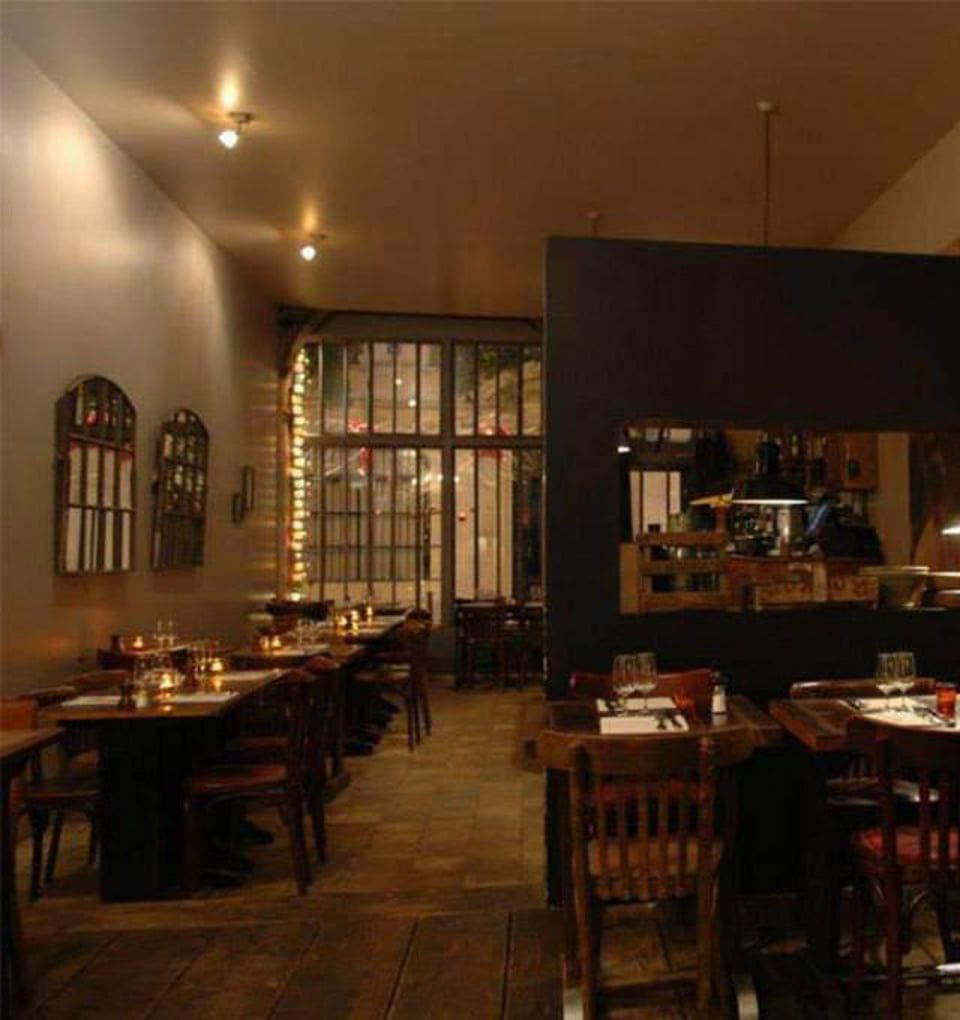
Arriving on foot from the Seine, Rue de Verneuil feels residential in the way that Parisian side streets still can: booksellers, a few gallery doors left ajar, little of the self-conscious signalling that clusters around the more tourist-facing stretches of the 6th. The physical environment at Cinq-Mars follows that register. It is a room that asks you to settle in, not perform.
Where French Technique Meets Market-Led Produce
The editorial angle worth applying to a place like Cinq-Mars is the intersection between classical French method and the market-first sourcing that has shaped left-bank bistro cooking for the better part of three decades. This is not the locavore posture of newer natural-wine destinations, nor the architectural plating of the grand houses. The working premise here — consistent with how the better bistros of the 7th and 6th have long operated, is that French technique exists to clarify and concentrate what a good ingredient already offers, rather than to transform it beyond recognition.
That approach has a clear lineage in French cooking. The philosophy running from Bras in Laguiole through the regional houses like Auberge de l'Ill in Illhaeusern and Georges Blanc in Vonnas is one that treats the raw material as the argument and the cook as its interpreter. In Paris, that philosophy tends to arrive without the theatrical framing. Cinq-Mars operates in that tradition: produce-forward, technique-present, format unpretentious.
The broader context matters here. Paris's mid-tier bistro category has come under sustained pressure in the past decade. Rising rents along the historically bohemian streets of the 6th and 7th have pushed some operators toward prix-fixe formats or lunch-only models to maintain margins. Addresses that continue to run as full-service neighbourhood restaurants in this zone are, by that fact alone, making a particular kind of commitment to the format.
The 7th's Position in the Paris Dining Map
Understanding Cinq-Mars means understanding how the 7th differs from the highly formalised dining corridors of the 8th, where Alléno Paris au Pavillon Ledoyen and Le Cinq at the Four Seasons George V anchor a €€€€ tier with significant ceremony and international draw. The 7th's identity is older and more residential. Government ministries, the Musée d'Orsay, and a dense concentration of embassies give the arrondissement its unhurried, slightly official character. Dining here has historically been for people who live and work nearby rather than for destination seekers arriving from the other side of the city.
That separation is narrowing, as it is across most of central Paris, but the 7th retains more of it than most. A bistro on Rue de Verneuil is, by geography and precedent, a local table first. The implication for visitors is that the experience is calibrated to that expectation: attentive but unshowy, the kind of service register that treats familiarity as a virtue rather than a lapse in formality.
By comparison, the grand expressions of modern French cooking, L'Ambroisie on Place des Vosges, or Kei in the 1st with its Franco-Japanese idiom, operate in a different register entirely, one where the occasion is the meal rather than the meal being a natural extension of a day in the city. Cinq-Mars belongs to the latter category.
French Bistro Cooking in an International Frame
The broader trend in premium French bistro cooking over the past fifteen years has been an absorption of technique from outside France without abandonment of French flavour logic. This is not the same as the fusion impulse of the 1990s. The contemporary model is subtler: a braise that holds the structural logic of a classic braise but draws its spicing from a wider pantry, or a sauce built on a classical reduction but finished with an acid or allium more common to other traditions. Mirazur in Menton and Flocons de Sel in Megève represent higher-altitude expressions of that synthesis, where geography and altitude shape ingredient choices without abandoning French method.
At the bistro level, the exchange is less dramatic but no less present. Parisian tables of this type often show influence from the training circuits of their kitchens, cooks who have passed through Lyonnaise bouchons, through Basque country, through brief stints at addresses like Troisgros or Les Prés d'Eugénie, and who bring those references back to a small room in the 7th. The result is rarely theatrical but often precise in ways that reward attention.
Outside France, the French bistro model has been adopted and adapted at addresses like Le Bernardin in New York, where the French technical inheritance is reconfigured around American seafood sourcing, and in more experimental formats like Lazy Bear in San Francisco, where the prix-fixe communal structure echoes the French tradition of the table d'hôte. Cinq-Mars operates closer to the source, a Parisian original rather than an export.
For a fuller map of where Cinq-Mars sits within the city's dining categories, our full Paris restaurants guide covers the range from neighbourhood bistros to three-star destinations.
Planning Your Visit
Cinq-Mars is located at 51 Rue de Verneuil in the 7th arrondissement, a short walk from either the Rue du Bac métro station (line 12) or the Saint-Germain-des-Prés station (line 4). The address is in the quieter interior of the 7th, away from the main tourist corridors, which means foot traffic is light and the surrounding streets are easy to walk at any hour. For addresses in this category, lunch service on weekdays tends to be the most available booking window; evening tables on Thursdays through Saturdays fill first.
Quick reference: 51 Rue de Verneuil, 75007 Paris. Nearest métro: Rue du Bac (line 12).
Frequently asked questions
What should I order at Cinq-Mars?
The kitchen at Cinq-Mars works within the French bistro tradition where seasonal availability shapes the menu more than a fixed signature list. Given the address sits in the 7th arrondissement, a short distance from the markets that supply some of Paris's most carefully sourced restaurants, including Arpège, the strongest choices on any given day tend to reflect what came in that morning rather than a standing dish. Ask the room what is driving the kitchen on the day of your visit; in a bistro of this type, the answer carries more information than a printed list.
Do I need a reservation for Cinq-Mars?
In the current Paris dining environment, mid-tier bistros in the 7th with a neighbourhood following book out faster than their profile might suggest. Addresses of this type rarely have the international booking pressure of a €€€€ table like L'Ambroisie or Le Cinq, but the local repeat clientele means that walk-in availability, particularly on weekday evenings, is not guaranteed. Booking ahead by at least three to four days is advisable for dinner; lunch midweek offers more flexibility.
Is Cinq-Mars a good option for a long, leisurely dinner in Paris rather than a quick meal?
The bistro format on Rue de Verneuil is built for exactly that purpose. Left-bank addresses of this type in the 7th have historically operated on the assumption that a table holds for the evening, a contrast to the faster-turnover model found in busier tourist corridors. This makes Cinq-Mars a reasonable choice for a group that wants to spend two to three hours at table without the formality or price commitment of a destination restaurant like Auberge du Vieux Puits or Paul Bocuse.
A Minimal comparable set
Comparable venues nearby, for context on price, style, and recognition.
| Venue | Cuisine | Price | Awards | Notes |
|---|---|---|---|---|
| Cinq-MarsThis venue — the venue you are viewing | Traditional French Bistro | $20–30 | Not listed | Not listed |
| François Félix | Classic French Bistro | $50–100 | Not listed | 8th arrondissement (Faubourg Saint-Honoré), Classic French Bistro |
| Lobineau | French Seafood | $30–50 | Not listed | Saint-Germain-des-Prés, French Seafood |
| Rocaille | Traditional French Bistro | $30–50 | Not listed | Latin Quarter, Traditional French Bistro |
| Duvin | Classic French Bistro | $30–50 | Wine Spectator Best of Award of Excellence | Pigalle, Classic French Bistro |
| Café Saint Germain | French-Italian Bistro | $20–30 | Not listed | Saint-Germain-des-Prés, French-Italian Bistro |
Continue exploring
More in Paris
Restaurants in Paris
Browse all →
Bars in Paris
Browse all →
Hotels in Paris
Browse all →
Details
- Cozy
- Classic
- Intimate
- Rustic
- Casual Hangout
- Group Dining
- After Work
- Standalone
- Beer Program
- Local Sourcing
- A La Carte
- Wine By The Glass
- Vegetarian Friendly
- Gluten Free Options
Current opening hours
- Monday
- 12–2:30 PM, 7–10 PM
- Tuesday
- 12–2:30 PM, 7–10 PM
- Wednesday
- 12–2:30 PM, 7–10 PM
- Thursday
- 12–2:30 PM, 7–10 PM
- Friday
- 12–2:30 PM, 7–10:30 PM
- Saturday
- 12–2:30 PM, 7–10:30 PM
- Sunday
- 12–2:30 PM, 7–10 PM
Hours can change for holidays and private events. Last verified .
Warm and homey with mixed modern and retro décor, featuring an enormous glass window typical of Parisian artist studios, creating an intimate and unpretentious atmosphere.