Turo Turo Tooting
Our verdict
Turo Turo Tooting sits at 102 Tooting High Street, part of a south London corridor that has quietly become one of the city's most consequential addresses for Filipino and Southeast Asian cooking. The canteen-style format, rooted in the Filipino tradition of pointing at pre-cooked dishes, places it firmly in a category that London's fine-dining circuit rarely acknowledges but locals have sustained for years.

Pearl is the En Primeur Club membership app, where members save venues, book tables and use the concierge.

The menu
What to order
- Grilled chicken inasal
- Pork sisig
- Oxtail kare kare croquettes
- Pancit palabok
South London's Filipino Canteen Tradition, Placed
London's Filipino food scene has long operated below the radar of the city's award-focused restaurant conversation. While the capital's critical attention has concentrated on Mayfair and Notting Hill, where venues like CORE by Clare Smyth and The Ledbury compete in the ££££ bracket, a different kind of institutional dining has been taking shape in Tooting. Here the reference point is not tasting menus but the turo-turo format itself: a Filipino canteen tradition in which cooked dishes are displayed behind glass and diners point at what they want. It is as direct a form of hospitality as exists in London, and at 102 Tooting High Street, Turo Turo Tooting has made that directness its entire proposition.
Tooting functions as one of the more consequential postcodes in London for South Asian and Southeast Asian cooking precisely because it was not shaped by tourism or critical recognition. The communities settled here, opened places that suited their own eating habits, and the neighbourhood's food culture followed from that rather than from any external validation. That context matters when reading Turo Turo Tooting: it sits inside a tradition built by and for a specific diaspora, not by restaurateurs positioning for a broader market.
How the Format Has Shifted Over Time
The turo-turo model as a category has gone through several phases in London. An earlier generation of Filipino canteens operated with almost no visibility outside their immediate communities, functioning more as social infrastructure than as restaurants in the conventional sense. A middle period saw some of those operations move toward more hybrid formats, adding table service or abbreviated menus to make the experience legible to non-Filipino diners. The current moment is more interesting: a number of operators have returned to something closer to the original canteen logic, finding that the format's transparency and informality are precisely what a segment of London diners now want, after years of elaborate dining theatre. Turo Turo Tooting's positioning on Tooting High Street reads as part of that return, a venue whose format communicates confidence in the tradition rather than apology for it.
This is not the trajectory followed by the fine-dining tier. Restaurant Gordon Ramsay, Sketch, The Lecture Room and Library, and Dinner by Heston Blumenthal operate in a register that requires advance booking, formal dress codes, and a specific kind of occasion logic. Turo Turo Tooting is not competing in that space; it occupies a category defined by accessibility, rotation of dishes, and the kind of cooking that does not hold well under prolonged pass times. The comparison is more usefully drawn to other London canteen traditions, from the Gujarati thali houses of Drummond Street to the West African chop bars of Peckham, all of which have shown a similar pattern of community origin followed by gradual wider recognition.
The Cooking in Canteen Context
Filipino cuisine in London remains underrepresented relative to its complexity. The cuisine draws on Malay, Spanish, Chinese, and American influences in proportions that vary sharply by region and household, producing a range that runs from the vinegar-forward sourness of sinigang to the dark, reduced richness of adobo, to grilled formats that owe more to regional tradition than to any single outside influence. The turo-turo format suits this range because it allows operators to cook across several preparations simultaneously and present the results as a rotating daily selection rather than a fixed menu. What is available on a Tuesday will differ from a Saturday, which is a structural feature of the format rather than a limitation. For the diner willing to work within that logic, it offers a more honest picture of how Filipino home cooking actually operates than any fixed menu could.
Venues working in this format in cities with deeper Filipino diaspora populations, from Los Angeles to Sydney to Dubai, have shown that the canteen model scales without necessarily losing its character. London's version of that trajectory is still developing, with Tooting as one of its primary sites. The comparison set here is not the Michelin-awarded British restaurants in the home counties, whether Waterside Inn in Bray, Le Manoir aux Quat'Saisons in Oxford, or L'Enclume in Cartmel, but the informal institutions that have earned loyalty through consistency and community rootedness over time.
Neighbourhood Position and What It Signals
Tooting High Street is a working commercial strip with a density of food businesses that reflects the area's demographic composition rather than any curated food quarter strategy. That matters because it means the venues that survive here do so on the basis of repeat custom from local residents rather than destination traffic or press attention. Longevity on this street functions as a kind of credibility signal distinct from awards. Where Moor Hall in Aughton or Midsummer House in Cambridge derive authority from critical recognition, operations like Turo Turo Tooting earn theirs from the more unforgiving metric of whether the community keeps returning. That form of validation is harder to manufacture and, in its own way, more durable.
For diners arriving from outside the neighbourhood, the practical orientation shifts accordingly. This is not an occasion restaurant in the way that Gidleigh Park in Chagford or Restaurant Andrew Fairlie in Auchterarder function as destinations requiring advance planning. The turo-turo format is by design a walk-in, point-and-eat proposition. The appropriate comparison within the broader London dining map is to institutions that have built reputations through dailiness rather than spectacle, a category that the city's editorial conversation has historically undervalued but that its dining population has consistently supported.
For broader London restaurant context, including the capital's fine-dining and neighbourhood dining tiers together, see our full London restaurants guide. Further afield, Opheem in Birmingham represents a different model of how diaspora-rooted cooking gains formal recognition, and hide and fox in Saltwood shows the range of registers in which serious British cooking now operates. Internationally, Atomix in New York City and Le Bernardin in New York City illustrate how different a fully institutionalised fine-dining trajectory looks when compared to the canteen tradition Turo Turo Tooting represents. Hand and Flowers in Marlow is another useful counter-reference: a pub format that earned Michelin recognition, demonstrating that informality and critical credibility are not mutually exclusive, even if Turo Turo Tooting is operating in a different mode entirely.
Know Before You Go
- Address: 102 Tooting High St, London SW17 0RR
- Format: Filipino turo-turo canteen (point-and-serve, pre-cooked dishes)
- Booking: Walk-in format; no booking details currently listed
- Price: Pricing information not currently available; canteen format typically operates at accessible price points
- Getting There: Tooting Broadway (Northern line) is the closest Underground station, a short walk along the High Street
- Dress Code: None; casual neighbourhood canteen
- Ideal time to visit: Midday and early afternoon typically offer the widest selection of dishes in turo-turo operations before trays begin to deplete
Frequently asked questions
Where exactly is Turo Turo Tooting?
Turo Turo Tooting is located at 102 Tooting High St, London SW17 0RR, United Kingdom, London.
Is Turo Turo Tooting a good option for an introduction to Filipino food in London?
For anyone unfamiliar with Filipino cooking, the turo-turo canteen format at Tooting High Street removes the usual friction of ordering, you see the dishes and point. Filipino cuisine draws on Malay, Spanish, Chinese, and American culinary threads, and a canteen spread tends to show that range across a single service in a way a short à la carte menu cannot. Tooting's demographic density means this is food cooked for a community that eats it regularly, not a simplified version shaped for outside audiences.
What do regulars order at Turo Turo Tooting?
The turo-turo format at 102 Tooting High Street means dishes are pre-cooked and displayed for selection, so what's available shifts daily. In Filipino canteens operating this model, rice-anchored plates are central: adobo, sinigang, and kare-kare are the backbone of most regular visits. The point-and-choose system rewards repeat customers who time their arrival to the freshest batch.
What's the best way to book Turo Turo Tooting?
Turo Turo Tooting operates on Tooting High Street as a canteen, and walk-in is the standard approach for venues in this format, reservations are not typically part of how turo-turo dining works. Arriving early in a lunch or dinner service window gives the widest choice of dishes. No booking contact is currently listed for this location.
What's the standout thing about Turo Turo Tooting?
The format itself is the point: turo-turo translates literally as 'point-point' in Tagalog, describing a style of canteen service where you select from pre-cooked trays rather than ordering off a menu. In London, where Filipino food has historically received less critical attention than the cuisine's complexity warrants, a venue operating this unapologetically functional format on a working commercial strip like Tooting High Street is a straightforward assertion of community over trend.
Budget Reality Check
Comparable venues nearby, for context on price, style, and recognition.
| Venue | Cuisine | Price | Notes |
|---|---|---|---|
| Turo Turo TootingThis venue (the venue you are viewing) | Filipino BBQ & Grill | $20–30 | Not listed |
| Kaffeine | Australian-Style Coffee Cafe | $10–20 | Fitzrovia, Australian-Style Coffee Cafe |
| Freud Cafe | Boho Cafe-Bar | $20–30 | St Giles, Boho Cafe-Bar |
| Raw Press | Plant-Based Juice Bar & Healthy Cafe | $10–20 | Belgravia, Plant-Based Juice Bar & Healthy Cafe |
| Bugis Kitchen | Modern Singaporean | $20–30 | South Kensington, Modern Singaporean |
Continue exploring
More in London
Restaurants in London
All restaurants in London →
Bars in London
All bars in London →

Details
- Lively
- Energetic
- Casual
- Trendy
- Casual Hangout
- Group Dining
- Celebration
- Open Kitchen
- Craft Cocktails
- Small Plates
- Family Style
- A La Carte
- Rum Cocktails
- Tropical Cocktails
Current opening hours
- Monday
- Closed
- Tuesday
- 5–10 PM
- Wednesday
- 5–10 PM
- Thursday
- 12–3:30 PM, 5–10:30 PM
- Friday
- 12–3:30 PM, 5–10:30 PM
- Saturday
- 10:30 AM–10:30 PM
- Sunday
- 10:30 AM–8 PM
Hours can change for holidays and private events. Hours as of .
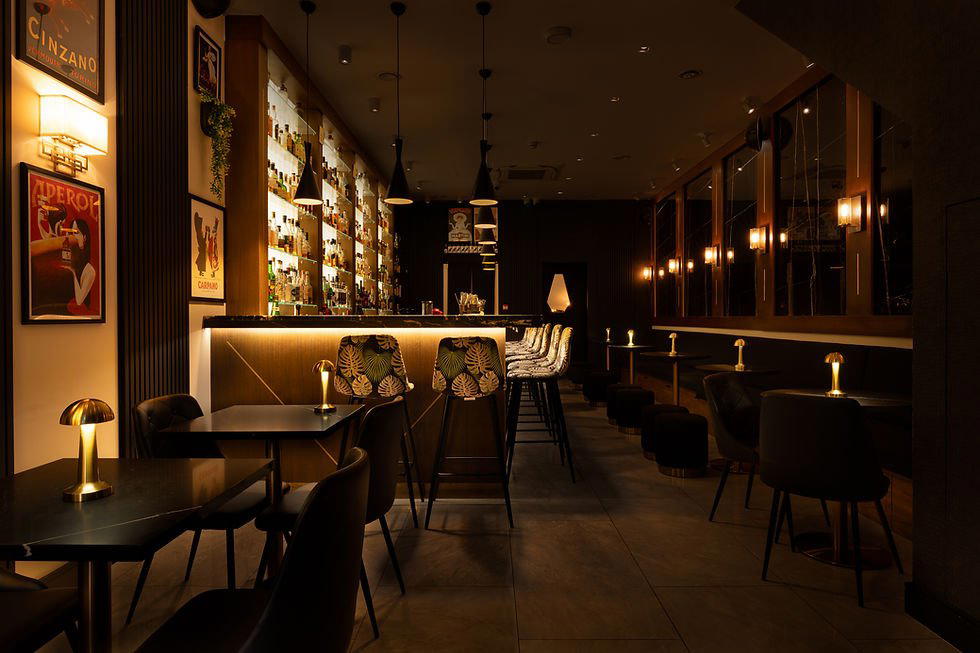
Warm, relaxed, and casual setting with lively energy and dynamic culinary experience showcased through open kitchen.