
Tabelog 100 #81
Our verdict
Tokyo Doujiang Seikatsu puts Taiwanese-style soy milk breakfast into Tokyo’s serious café conversation, with a Tabelog Cafe EAST 100 selection in 2025 and a low-price format that keeps the focus on staple ingredients rather than ceremony. In Nishigotanda, its small café-and-sweets setup reads as a counterpoint to Tokyo’s reservation-heavy dining culture: early, compact, practical, and ingredient-led.

Pearl is the En Primeur Club membership app, where members save venues, book tables and use the concierge.
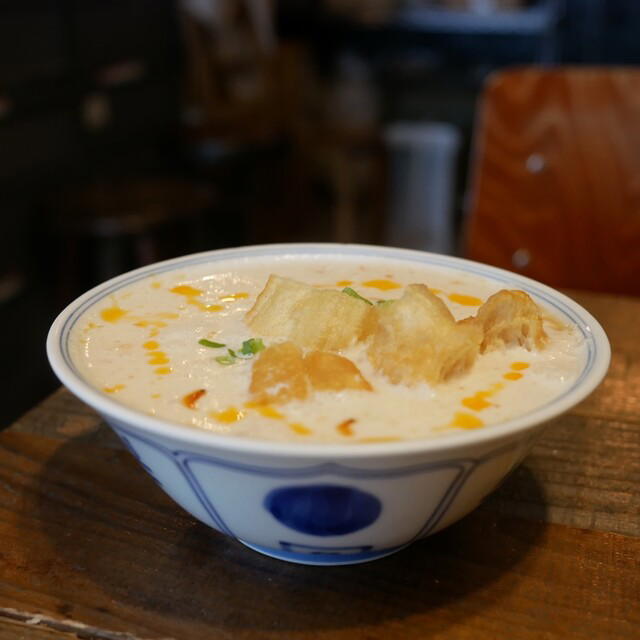
The menu
What to order
- 鹹豆漿 (xian doujiang / savory soy milk)
- 台湾式おにぎり(飯糰)Taiwanese rice ball
- 朝仕込み生豆乳 (fresh morning soy milk)
- 中華パン (handmade Chinese-style bread)
- お粥 (congee)
Tokyo dining moves through many registers, from polished reservations to everyday stops built around repeat use. Tokyo Doujiang Seikatsu fits that broader rhythm: a café and sweets venue that sits apart from the espresso-and-pastry model common across the city’s café map.
That distinction matters in Tokyo, where cafés often divide into design-led dessert rooms, kissaten nostalgia, and specialty coffee counters. Here, the documented appeal is more direct: it is listed in the café and sweets categories rather than as a long tasting structure. A 2025 Tabelog Hyakumeiten recognition places the shop within a documented café field, while its listed price band of - JPY 999 keeps it closer to everyday use than destination dining theater.
Café and sweets, treated as a serious morning category
Tokyo’s dining reputation rests on precision formats: sushi counters, yakitori counters, tempura counters, and tasting-menu rooms where sourcing and handling define hierarchy. Café and sweets venues rarely get equal attention, yet small-format dining can apply the same logic. The point is focus. A narrow format works only when the basics are handled with discipline.
This is why the café sits outside the usual Tokyo special-occasion conversation. It is not best understood as a hotel meal or a long Western-style brunch, but as a café and sweets stop where clarity and repeat use matter. The format rewards direct decision-making rather than a drawn-out meal. In a city where premium dining can mean months of planning, that accessibility is part of the appeal.
The venue’s listed categories sharpen the point. It reads editorially as an everyday café-and-sweets address rather than a laptop salon or a staged dining room, with the format doing more work than atmosphere alone. Tabelog’s 2025 recognition shows it has entered the city’s serious eating conversation without losing the democratic charge of a low listed price band.
Tokyo’s comparison set clarifies the position. Oniyanma Gotanda honten offers another example of speed and utility, while Swastika, Koko ni Motodaka, Tachinomi Todaka, and Shokudo Todaka point to other ways Tokyo venues can build identity around a tightly defined format. Tokyo Doujiang Seikatsu is not competing for occasion dining; it argues that an everyday café and sweets address can hold its own within Tokyo’s hierarchy of specialist rooms.
Tokyo gives the format its edge
Tokyo is useful terrain because it is not built purely for visitors. Between business traffic, residential areas, and citywide eating habits, a specialist venue must serve repeat use before it becomes an editorial name. That pressure strips away excess: the question is not whether the room photographs well, but whether the format can survive regular demand and visitor curiosity without losing identity.
The documented recognition reinforces the café-and-sweets reading without needing to turn the venue into a luxury address. Tokyo has many small, demand-sensitive food rooms where timing is part of the meal’s logic. For this kind of venue, planning is less about ceremony and more about choosing the right moment in the day.
The location is simple to place: Tokyo. For travelers already building a food itinerary in the city, it is best treated as a realistic café stop rather than a half-day project. As with many Tokyo venues, the smartest approach is to keep logistics flexible and let the meal sit naturally within the wider day.
Practical expectations should stay grounded. The venue is documented as a café and sweets address, with a 2025 Tabelog Hyakumeiten listing, a Tabelog score of 3.66, and a listed price band of - JPY 999. Those facts make the editorial case without adding unsupported claims about service style, room configuration, or amenities.
How to place it within a Tokyo eating day
Use Tokyo Doujiang Seikatsu as a defined stop, not filler between larger reservations. Tokyo rewards diners who separate categories rather than force every meal into the same luxury frame. A café visit, a casual lunch, a counter dinner, and a late bar can each say something different about the city’s food culture.
For that wider map, EP Club’s Tokyo coverage works by category rather than mood. Start with Our full Tokyo restaurants guide, then branch to Our full Tokyo bars guide, Our full Tokyo hotels guide, Our full Tokyo experiences guide, and Our full Tokyo wineries guide when building the day. Nearby and citywide references show the range: casual specialists, counter-format cooking, café culture, and other dining all sit within Tokyo’s broader restaurant map.
The broader Japan and overseas context underline the same editorial point: small formats travel well when anchored in staple foods and clear identity. Across Japan, cafés, casual counters, regional restaurants, and narrow specialists show how much range can fit inside modest formats. Abroad, Japanese and East Asian staple formats gain new meanings outside Japan while still depending on clarity, repetition, and everyday appeal.
The editorial case is simple: Tokyo’s café culture is broader than coffee, cake, and design rooms. Here, the café-and-sweets format carries the argument. The 2025 Tabelog Hyakumeiten recognition gives the address a credible signal, the listed pricing keeps it democratic, and Tokyo gives the format enough daily pressure to prevent it from drifting into spectacle. For travelers who care about everyday rituals as much as destination meals, this is a useful way to see another side of Tokyo dining.
Frequently asked questions
What days is Tokyo Doujiang Seikatsu closed?
Specific closing-day information is not provided in the documented venue facts for Tokyo Doujiang Seikatsu.
What does dinner at Tokyo Doujiang Seikatsu typically cost?
A specific dinner budget is not provided in the documented venue facts. The venue’s listed price band is - JPY 999, with lunch shown as - JPY 999.
What's Tokyo Doujiang Seikatsu's location?
Tokyo.
What's the standout thing about Tokyo Doujiang Seikatsu?
Its strongest documented credential is the 2025 Tabelog Hyakumeiten recognition, alongside a Tabelog score of 3.66. The venue is listed in the Cafe and Sweets categories, with pricing shown as - JPY 999.
A Minimal
Nearby venues at a similar price tier for orientation.
| Venue | Cuisine | Price | Awards | Notes |
|---|---|---|---|---|
| Tokyo Doujiang SeikatsuThis venue (the venue you are viewing) | Traditional Taiwanese Breakfast & Fresh Soy Milk | $10–20 | Tabelog 100 #81 | Not listed |
| Swastika | Japanese Cafeteria / Yoshoku / Curry | Not listed | Tabelog 100 #19 | JPY 1,000 - JPY 1,999 JPY 1,000 - JPY 1,999 |
| Koko ni Motodaka | Contemporary Japanese Izakaya | $50–100 | Tabelog 100 #1 | JPY 8,000 - JPY 9,999 JPY 8,000 - JPY 9,999 View spending breakdown |
| Tachinomi Todaka | Creative Japanese Izakaya Course | $100–150 | Tabelog 100 #44 | JPY 10,000 - JPY 14,999 JPY 10,000 - JPY 14,999 |
| Shokudo Todaka | Creative Izakaya-style Japanese | $100–150 | Tabelog 100 #31 | JPY 10,000 - JPY 14,999 |
| Oniyanma Gotanda honten | Standing Sanuki Udon Shop | $1–10 | Tabelog 100 #27 | JPY 999 - JPY 999 |
Recognition history
Dated appearances from independent guides and award organizations, with the underlying list record or original source where available.
Tabelog 100 #81 · No. 81
Tabelog · Tabelog 100 - Cafe - EAST - 2025
Continue exploring
More in Tokyo
Restaurants in Tokyo
All restaurants in Tokyo →
Bars in Tokyo
All bars in Tokyo →




Details
- Cozy
- Lively
- Brunch
- Solo
- Casual Hangout
- After Work
- Standalone
- Zero Proof
- Local Sourcing
- A La Carte
- Counter Dining
- Soy Milk
- Non Alcoholic
- Vegetarian Friendly
Current opening hours
- Monday
- 8 AM–3 PM
- Tuesday
- 8 AM–3 PM
- Wednesday
- 8 AM–3 PM
- Thursday
- 8 AM–3 PM
- Friday
- 8 AM–3 PM
- Saturday
- 9 AM–3 PM
- Sunday
- 9 AM–3 PM
Hours can change for holidays and private events. Hours as of .
A small, cozy breakfast shop with a casual, canteen-like feel where guests line up early; the atmosphere is lively in the morning but relaxed, with a focus on simple, clean surroundings and the comfort of hot soy milk and Taiwanese breakfast dishes.