
Thai Restaurant Kinmedai puts Funabashi’s small-format ethnic dining in sharp focus: an 8-seat Thai and curry address near Nishi-Funabashi with repeat Tabelog 100 Asian/Ethnic EAST selections from 2022 to 2024. The draw is not ceremony for its own sake, but a compact room, daily-changing menu rhythm, and prices that sit far below many destination dining rooms in the city.
Pearl is the En Primeur Club membership app — saves, bookings, and concierge access live there. Same editors, same standards.
- Address
- 千葉県船橋市山野町68-5 パストラル弐番館 1F
- Phone
- +819090119412
- Website
- tabelog.com
 Saves & bookings on Pearl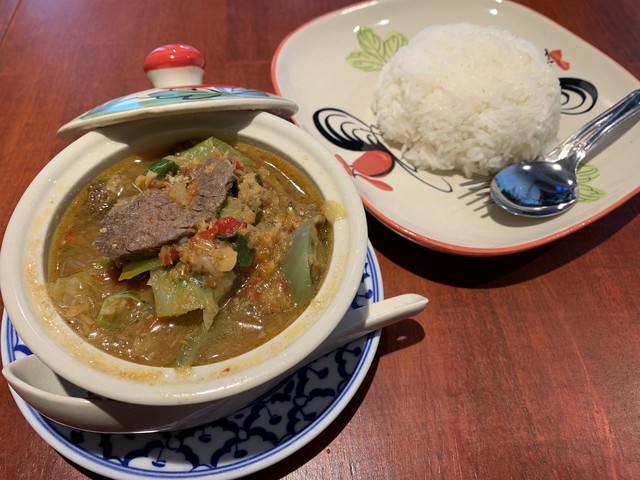
Approaching a tiny ground-floor room near Nishi-Funabashi, the dining ritual begins with scale. Funabashi has larger restaurants for expense-account sukiyaki, teppanyaki, and Italian dinners, but Thai and curry cooking at this address works in a tighter register: 8 seats, a narrow entrance, a compact floor plan, and a menu that can shift by the day. That physical constraint matters. It turns the meal into a small-room exchange rather than a passive ordering exercise, with diners reading the board, the room, and the pace before committing.
Thai Restaurant Kinmedai sits in a useful part of Funabashi’s dining map. The city is not Tokyo, and that difference is the point. Around Nishi-Funabashi, restaurants often serve commuters and locals who know exactly what they want, which leaves less room for decorative theatre and more room for restaurants with a narrow proposition. In that setting, a Thai and curry specialist gaining repeated Tabelog 100 Asian/Ethnic EAST selection in 2022, 2023, and 2024 says something about how Japan’s regional dining audience now treats non-Japanese cooking: not as a side category, but as a competitive field with its own benchmarks.
A small-room Thai ritual shaped by changing dishes
The format rewards flexible diners. The menu changes daily, and dishes may appear or disappear depending on ingredients and timing. That is not the same as a scripted tasting menu. It is closer to the rhythm of small Asian restaurants where availability, prep, and the cook’s bandwidth decide the evening’s shape. The useful etiquette is simple: arrive with a category in mind rather than a fixed dish name, ask directly, and accept that the better meal may come from what the kitchen can execute well that day.
That daily-change structure also separates the experience from a standardized curry stop. Funabashi has lower-priced casual options, including Tomonomoto and Robin's Indian Kitchen in the JPY 1,000 to JPY 1,999 bracket, while dinner-focused rooms such as Teppanyaki Kuku, Shogetsu En, and La Bonta sit several tiers higher. Kinmedai occupies the interesting middle: dinner listed at JPY 2,000 to JPY 2,999, lunch at under JPY 999, with a recognition profile stronger than the price might suggest. The value is not in abundance; it is in concentration.
For readers comparing the city’s dining categories, Our full Funabashi restaurants guide gives the broader restaurant frame, while nearby Funabashi references such as Akasaka Ajiichi, Ayutthaya, BHOYE CHHEN, Boulangerie Queue, and Funakko show how varied the local map becomes once the search moves beyond station-adjacent chains.
Recognition without the luxury price code
Tabelog’s Hyakumeiten lists are useful because they often capture specialist demand outside the usual luxury vocabulary. Selection for Asian cuisine and ethnic cuisine in the EAST region places this restaurant inside a field that includes Thai, curry, and other regional Asian cooking rather than French-style tasting menus or sushi counters. The category matters. Diners should read the award as a signal of sustained local attention in a specialist genre, not as a promise of linen, quiet luxury, or formal pacing.
The room’s 8-seat configuration changes the social contract. Large groups, stroller access, wheelchair access, and leisurely hovering are not natural fits for a narrow space. Private use is listed for up to 20 people, but the everyday experience is more intimate than that number suggests. Lunch is non-smoking, while dinner permits smoking with manners requested; that detail will divide diners and should shape timing for anyone sensitive to smoke. Payment also belongs to the old-school side of Japan’s casual dining culture: credit cards, electronic money, and QR code payments are not accepted.
Compared with Tokyo’s destination Thai restaurants, the Funabashi proposition is less about brand polish and more about proximity, price, and regularity. The south exit of JR Nishi-Funabashi puts the restaurant within a short walk, and the lack of on-site parking reinforces the train-first logic of the meal. For a broader trip plan, Our full Funabashi hotels guide, Our full Funabashi bars guide, Our full Funabashi wineries guide, and Our full Funabashi experiences guide help place dinner within a wider day rather than treating the city as a single stop.
How to read it within Japan's broader casual dining map
Japan’s serious casual dining is often strongest where format and audience align. A small Thai counter-room in Funabashi, a curry specialist in Sapporo, a Vietnamese address in Kawasaki, and a sake bar in Los Angeles do not share a cuisine, but they share a reader problem: the signal is not always a luxury price. For cross-category comparison, see [Curry Senmon Ten] Maruyama Kyoju. in Sapporo, (Shoku) Vietnam in Kawasaki, Jōdo Saké Bar in Los Angeles, and Onigiri Time in Pasadena. Each asks diners to evaluate specialization differently from fine-dining prestige.
That is also why national context can be helpful without flattening the meal into a checklist. A beef sukiyaki address such as -Grilled beef Sukiyaki- KAMAKURA TANUKIAN 鎌倉 たぬき庵 in Kamakura, a Tokyo seafood-and-charcoal room such as. 鮪と炭火焼き うお炭 秋葉原店 in Tokyo, a compact café entry like.cafe in Osaka, and.know in Kumamoto all sit in different dining traditions. Kinmedai’s strength is that it does not try to borrow their codes. It belongs to the small, local, ingredient-dependent style of eating where planning matters, expectations need calibration, and the reward is a meal shaped by the room’s limits rather than by spectacle.
Cuisine-First Comparison
Comparable options at the same price tier.
| Venue | Cuisine | Price | Notes |
|---|---|---|---|
| Thai Restaurant KinmedaiThis venue — the venue you are viewing | Authentic Thai Street‑Food & Curry | $$ | Not listed |
| Funakko | Sardine-focused Japanese Izakaya | $$ | Higashifunabashi |
| Tomonomoto | Ramen shop | $$ | Higashi Kaijin |
| Boulangerie Queue | Japanese neighborhood bakery | $ | Tsuboi Higashi |
| BHOYE CHHEN | Nepalese & Indian Restaurant-Bar | $ | Funabashi |
| Gandhi | Indian Curry House | $$ | Funabashi |
Recognition history
Dated appearances from independent guides and award organizations, with the underlying list record or original source where available.
Tabelog 100 #95 · No. 95
Tabelog · Tabelog 100 - Asian cuisine / Ethnic cuisine - EAST - 2024
Continue exploring
More in Funabashi
Restaurants in Funabashi
Browse all →



Bars in Funabashi
Browse all →




At a Glance
- Cozy
- Intimate
- Solo
- Casual Hangout
- After Work
- Group Dining
- Standalone
A small, casual neighborhood spot with only eight seats, simple interiors and a relaxed, conversational atmosphere that can feel like a cozy local counter restaurant.