
BHOYE CHHEN brings Nepalese, Indian and bar cooking into Funabashi’s low-price, high-frequency dining circuit, with Tabelog 100 Asian cuisine / Ethnic cuisine EAST selections in 2023 and 2024 giving it unusual recognition for this budget tier. The draw is not formality; it is the way South Asian and Himalayan cooking sits inside a Chiba commuter city where station-area restaurants do the serious everyday work.
Pearl is the En Primeur Club membership app — saves, bookings, and concierge access live there. Same editors, same standards.
- Address
- 千葉県船橋市本町2-11-22 友山ビル 2F
- Phone
- +81474003958
- Website
- tabelog.com
 Saves & bookings on Pearl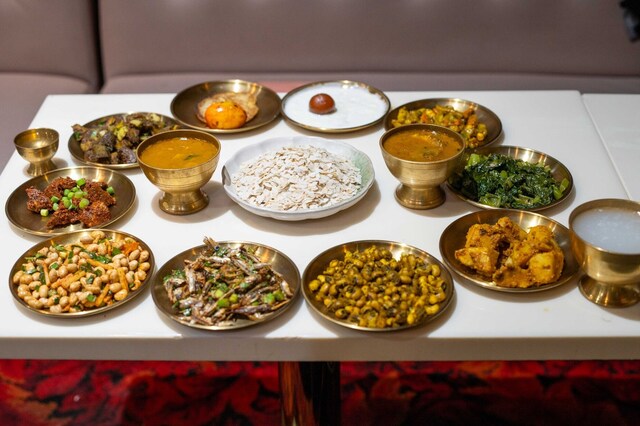
Approaching the second-floor dining room in Honcho, the first read is practical rather than theatrical: this is station-side Funabashi, where restaurants are judged by repeat use, price discipline and whether a table works for lunch as well as dinner. That context matters. Nepalese and Indian cooking in Japan often gets flattened into a generic curry-and-naan category, but the stronger addresses operate on a different register, balancing spice, grain, dairy, pulses and grilled proteins for a local audience that eats fast, compares closely and returns only when value holds.
BHOYE CHHEN belongs to that working-city category, but its recognition changes the frame. Selection for Tabelog 100 Asian cuisine / Ethnic cuisine EAST in both 2023 and 2024 places it in a narrower group than the average neighbourhood curry house, especially at a listed range of JPY 1,000 to JPY 1,999 for dinner and up to JPY 999 for lunch. In Funabashi, where everyday dining often competes on speed and price, that combination of low spend and regional recognition is the signal to notice.
South Asian cooking in a commuter city, not a destination dining costume
Funabashi’s restaurant scene is shaped by rail movement and practical appetite. Around the station, the stronger rooms tend to solve a clear problem: a quick solo meal, an inexpensive group dinner, a familiar counter, a place that can take office workers, families and regulars without forcing an occasion. That makes Asian and ethnic cooking especially competitive. The format has to be accessible, but not anonymous.
The categories here are Nepalese, Indian and bar, a useful trio because it points to breadth without requiring a tasting-menu frame. Nepalese cooking in Japan often overlaps with North Indian restaurant vocabulary, yet its stronger expressions carry different priorities: rice and lentils matter, spice is built for balance rather than heat performance, and snacks or grilled items can sit beside curry sets without feeling secondary. The editorial interest is the sourcing logic behind the food culture: spices, legumes, grain, dairy and pickles form the backbone, so the kitchen’s credibility depends less on luxury produce than on consistency, seasoning and the ability to make inexpensive staples feel complete.
That is why the price tier is not a footnote. At under JPY 2,000 for dinner, the margin for decorative dining is thin. Restaurants in this bracket live or fail on repeatable mise en place, restrained waste and broad appeal. Compared with Ayutthaya, another Funabashi Asian address listed in a modest dinner range, or Gandhi, which sits in a similar low-cost Indian bracket, BHOYE CHHEN has the extra marker of consecutive Tabelog 100 selection. That does not make it formal; it makes it more interesting as an everyday restaurant with external validation.
The award signal is stronger because the spend is low
Awards at luxury restaurants often confirm what pricing already announces. In a sub-JPY 2,000 room, they carry a different kind of information. Tabelog’s Hyakumeiten lists are not Michelin substitutes, but in Japan they are useful signals of category depth, especially for genres that do not always receive international guide attention. A 2024 selection in Asian cuisine / Ethnic cuisine EAST tells the reader that this is being judged inside a broad regional field, not merely inside Funabashi.
The listed score of 3.48 also needs local interpretation. On Tabelog, scores in the mid-threes can indicate meaningful traction, particularly outside central Tokyo and outside luxury formats. For a 52-seat restaurant with private-room availability for four and private use listed for groups over 50, the room appears built for volume as much as recognition. That matters because the food has to perform across use cases: lunch sets, family tables, group meals and bar-adjacent visits all put different pressure on a kitchen.
Funabashi’s comparison set reinforces the point. Akasaka Ajiichi occupies the city’s bargain end, while Funakko speaks to the local taste for direct, unfussy dining. Higher-spend rooms such as La Bonta compete on a different evening rhythm. BHOYE CHHEN is not trying to join that tier; its relevance lies in a category where spice, bread, rice and shared plates can carry a full meal without a high bill.
How to read the room before planning the meal
The practical profile is unusually friendly for mixed groups. The restaurant is listed as non-smoking, accepts reservations, and takes major credit cards, transport IC cards and several QR payments. It is a short walk from both Keisei Funabashi and JR Funabashi, which makes it easier to fold into a Chiba rail day than restaurants requiring a taxi detour. Parking is not attached, though coin parking is listed nearby, so rail remains the cleaner plan.
Hours are listed from 11:00 AM to 11:00 PM daily, giving the place a broad operating window that fits the way this category is used in Japan: lunch sets, early dinners, late casual meals and group tables. For families, the price range and 52-seat format are encouraging signals, though the smarter move is to reserve if timing matters. Consecutive recognition can increase demand, and the restaurant’s value proposition makes it easier for locals to return frequently rather than treat it as a special-occasion address.
For a wider read on the city, start with Our full Funabashi restaurants guide, then map the meal against nearby hospitality and drinking options in Our full Funabashi hotels guide, Our full Funabashi bars guide, Our full Funabashi wineries guide and Our full Funabashi experiences guide. Readers comparing genre and price across Japan can also look at Boulangerie Queue, -Grilled beef Sukiyaki- KAMAKURA TANUKIAN 鎌倉 たぬき庵 in Kamakura. 鮪と炭火焼き うお炭 秋葉原店 in Tokyo.cafe in Osaka.know in Kumamoto, (Shoku) Vietnam in Kawasaki, [Curry Senmon Ten] Maruyama Kyoju. in Sapporo, Jōdo Saké Bar in Los Angeles and Onigiri Time in Pasadena.
Quick Comparison
Comparable venues by cuisine and price in the same metro.
| Venue | Cuisine | Price | Notes |
|---|---|---|---|
| BHOYE CHHENThis venue — the venue you are viewing | Nepalese & Indian Restaurant-Bar | $ | Not listed |
| Gandhi | Indian Curry House | $$ | Funabashi |
| Motsuyaki Doppo Honmachi ten | Standing bar for grilled offal (motsuyaki) | $ | Honmachi, Funabashi |
| Akasaka Ajiichi | Classic niboshi ramen shop | $ | / Funabashi |
| La Bonta | Italian Trattoria | $$ | Funabashi |
| Thai Restaurant Kinmedai | Authentic Thai Street‑Food & Curry | $$ | Nishi-Funabashi |
Recognition history
Dated appearances from independent guides and award organizations, with the underlying list record or original source where available.
Tabelog 100 #89 · No. 89
Tabelog · Tabelog 100 - Asian cuisine / Ethnic cuisine - EAST - 2024
Continue exploring
More in Funabashi
Restaurants in Funabashi
Browse all →


Bars in Funabashi
Browse all →




At a Glance
- Lively
- Cozy
- Energetic
- Casual Hangout
- After Work
- Group Dining
- Solo
- Family
- Late Night
- Private Dining
- Standalone
- Beer Program
Casual, lively neighborhood restaurant‑bar with bright, relaxed seating for around 50 guests, suitable for groups and everyday meals rather than formal occasions.