
Thai Nanraku brings Toyama’s small-format dining culture into contact with Thai cooking, izakaya habits, curry, wine, and cocktails. Its Tabelog 100 Asian cuisine / Ethnic cuisine WEST selections from 2022 to 2024 give it a stronger signal than the usual neighbourhood ethnic restaurant, especially in a city better known to visitors for seafood, sushi, and sake-led counters.
Pearl is the En Primeur Club membership app — saves, bookings, and concierge access live there. Same editors, same standards.
- Address
- Japan, 〒930-0082 Toyama, Sakuragicho, 6−8 桜木町ビル 1F
- Phone
- +81 90-1394-1133
- Website
- nanraku.jp
 Saves & bookings on Pearl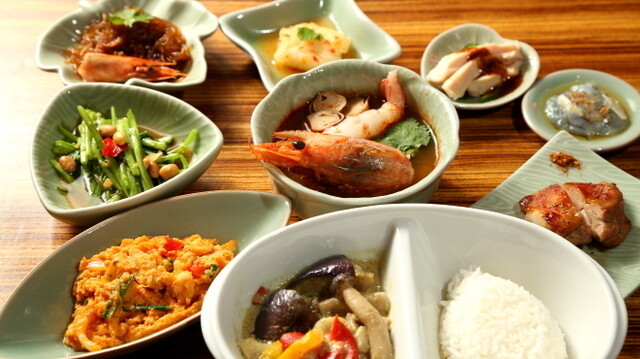
Sakuragicho is the kind of Toyama district where dinner often starts modestly: a low-lit building entrance, a compact room, a short walk from the tram, and a table that feels more like local habit than destination ritual. Thai Nanraku fits that register, but it is not simply a “Thai restaurant in Toyama.” More revealing is how regional Japanese cities absorb foreign cuisines: by folding them into izakaya pacing, small-room hospitality, and local expectations around sharing, drinking, and return visits.
Toyama’s restaurant conversation usually leans toward seafood, mountain vegetables, sushi counters, and Japanese cooking shaped by the Sea of Japan. That makes a Thai, izakaya, and curry address more revealing than it first appears. It shows the city’s dining range beyond the coastal script, and why recognition matters. Thai Nanraku was selected for Tabelog 100 Asian cuisine / Ethnic cuisine WEST in 2022, 2023, and 2024, a useful signal in a category where serious regional cooking can be easy to misread from outside.
Thai cooking filtered through Toyama's small-room dining habits
In Japan, Thai food often splits into two lanes: quick casual lunch cooking in larger cities, or tightly run evening rooms where spice, herbs, curry, rice, and drinks move like an izakaya meal. Thai Nanraku sits closer to the second. The listed categories, Thai, izakaya, and curry, are not contradictory; they describe how the meal is understood locally. Diners enter not a formal tasting-menu frame, but a compact evening restaurant where Southeast Asian flavours share space with the Japanese grammar of small plates, drinks, and lingering groups.
The ingredient story matters because Thai cooking depends on fragile balance outside Thailand: fresh herbs, aromatics, chilli, acidity, fermented seasonings, rice, and curry structure all need to stay legible after adaptation. In a regional Japanese city, the question is not whether a kitchen reproduces Bangkok exactly. It is whether the cooking keeps Thai logic intact while responding to Toyama’s supply chains and dining culture. A restaurant listed for Asian and ethnic cuisine across the WEST region suggests that balance has been noticed beyond a loyal neighbourhood audience.
That distinction helps travellers building a Toyama itinerary. A seafood-only reading misses how residents eat over several nights. The same trip might include regional Japanese cooking at Daimon, a specialist stop such as Cave Yunoki, or a casual local anchor like Boteyan and Boteyan Tanaka. The restaurant adds different evidence: Toyama’s dining scene is not only about products from nearby waters, but about how a compact city makes outside cuisines feel socially native.
Recognition in the ethnic-cuisine category means something different here
A Tabelog 100 selection in Asian cuisine and ethnic cuisine means something different from a Michelin star or hotel-dining award. It does not imply white-tablecloth formality. It points to category strength: restaurants earning sustained attention within a crowded field of Thai, Vietnamese, Indian, Korean, curry, and other non-Japanese formats across western Japan. For Toyama, that is sharper than a generic popularity signal, because the city has fewer international-dining venues visible to short-stay visitors than Tokyo, Osaka, or Kyoto.
The room scale reinforces the point. Fourteen seats, including counter seating and two tables, put the restaurant in the compact category where experience depends on rhythm, not spectacle. In that space, sourcing and preparation are hard to hide. A curry cannot be carried by décor. Herb freshness, heat management, rice, and drinking compatibility do the work. Wine and cocktails also matter, shifting the meal from a simple ethnic-food stop toward the Japanese evening pattern of food built around conversation and drinks.
Comparison within Toyama should be by category, not hierarchy. Daruma, le glouton, KAWAZ, 日本料理 雲海, and Ishitani Mochiya Toyama chuo dori honten occupy different roles in the city’s eating map, from Japanese dining to sweets, French-leaning cooking, and local casual formats. The restaurant fills another lane: a small, reservation-led Thai room with multi-year recognition in a field where national attention tends to cluster in larger cities.
Travellers comparing Japanese regional food cities should place this address beside broader ethnic and casual patterns across Japan. A Vietnam-focused restaurant such as (Shoku) Vietnam in Kawasaki, a curry specialist like [Curry Senmon Ten] Maruyama Kyoju. in Sapporo, or a café-format room such as.cafe in Osaka all show how imported or hybrid categories become local through use, not theatrical authenticity claims. The same logic extends outside Japan at venues such as Jōdo Saké Bar in Los Angeles and Onigiri Time in Pasadena, where Japanese forms adapt to a different dining public.
How to place it in a Toyama food itinerary
The strongest case for the restaurant is not that it replaces Toyama’s seafood or Japanese cooking, but that it sharpens a multi-night plan. Use it when the trip needs contrast: after sushi, kappo, or sake-led dinners, Thai herbs, curry, chilli, and cocktails reset the palate without leaving the city’s compact dining scale. The price band sits in serious dinner territory rather than quick casual eating, so expect an evening meal, not a convenience stop.
For planning, the practical facts are simple. The restaurant is in Sakuragicho, close to Sakurabashi, with a non-smoking room, card and cashless payment options, no private rooms, and nearby coin parking rather than dedicated parking. Children are welcome, and private use is available within the stated capacity, making the format more flexible than many small Japanese counters. The room remains small, so treat it as a planned dinner rather than an improvised fallback.
For a fuller city read, pair the restaurant with our full Toyama restaurants guide, then build the rest of the trip through our full Toyama hotels guide, our full Toyama bars guide, our full Toyama wineries guide, and our full Toyama experiences guide. Readers tracking how Japanese regional dining changes by city may also compare broader formats at -Grilled beef Sukiyaki- KAMAKURA TANUKIAN 鎌倉 たぬき庵 in Kamakura. 鮪と炭火焼き うお炭 秋葉原店 in Tokyo, and.know in Kumamoto.
Side-by-Side Snapshot
Comparable venues by cuisine and price in the same metro.
| Venue | Cuisine | Price | Notes |
|---|---|---|---|
| Thai NanrakuThis venue — the venue you are viewing | Authentic Thai restaurant with set-course menus | $$ | Not listed |
| Tachigui Sushi Jinjin | Dining | Not listed | Toyama |
| Boteyan | Okonomiyaki (Japanese Savory Pancake) | $$ | Toyama Station area |
| Yamazaki | Japanese | Not listed | Toyama |
| å¨ä¹ å± | japanese | Not listed | Toyama |
| Boteyan (ぼてやん多奈加) | Square Okonomiyaki Specialist | $$ | Toyama Station area |
Recognition history
Dated appearances from independent guides and award organizations, with the underlying list record or original source where available.
Tabelog 100 #19 · No. 19
Tabelog · Tabelog 100 - Asian cuisine / Ethnic cuisine - WEST - 2024
Continue exploring
More in Toyama
Restaurants in Toyama
Browse all →
At a Glance
- Cozy
- Lively
- Intimate
- Date Night
- Group Dining
- Casual Hangout
- After Work
- Solo
- Standalone
Current opening hours
- Monday
- Closed
- Tuesday
- 6–10 PM
- Wednesday
- 6–10 PM
- Thursday
- 6–10 PM
- Friday
- 6–10 PM
- Saturday
- 6–10 PM
- Sunday
- 6–9 PM
Hours can change for holidays and private events. Last verified .
Warm, intimate counter-style setting in a small Sakuragicho building, with a relaxed casual feel and focus on food rather than decor, often described as a hidden spot for serious Thai cuisine.