

A small restaurant on Rue du Palais Gallien where a Sardinian chef and his Breton partner run weekly-changing tasting menus that lean on Italian instinct without committing to Italian identity. The wine list skews heavily toward Italian producers, a deliberate counterpoint to Bordeaux's Francocentric cellar culture. Recognition from Michelin guides places it above its modest scale.
Pearl is the En Primeur Club membership app — saves, bookings, and concierge access live there. Same editors, same standards.
- Address
- 59 Rue du Palais Gallien, 33000 Bordeaux, France
- Phone
- +33 5 56 52 62 12
- Website
- tentazioni-bordeaux.com
- Directions
- Get directions
 Saves & bookings on Pearl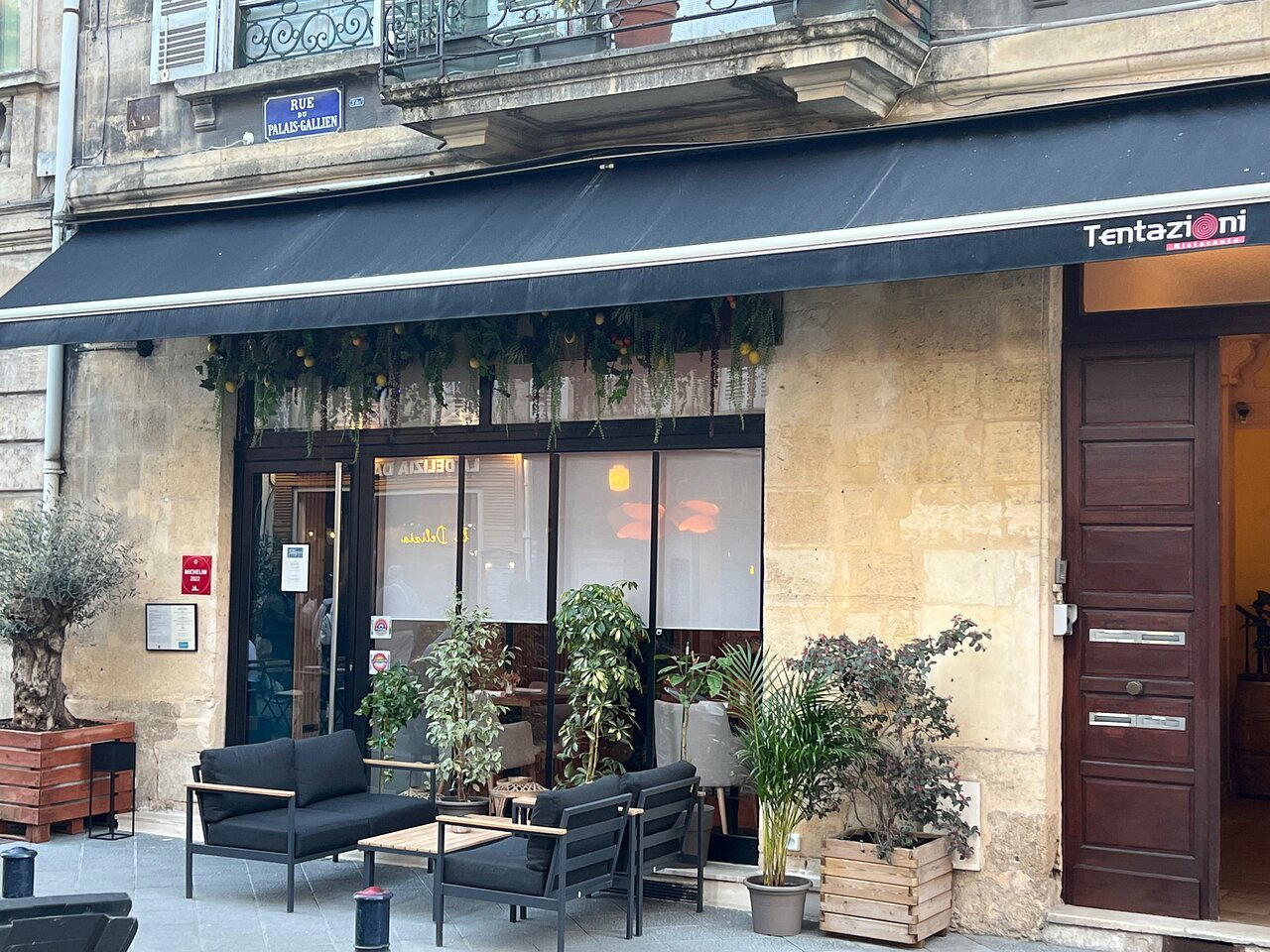
A Small Room With a Clear Point of View
Rue du Palais Gallien sits in the quieter residential stretch of central Bordeaux, away from the tourist circuits of Place de la Bourse and the Chartrons quays. The street runs alongside the fragmentary ruins of a Roman amphitheatre, and the neighbourhood around it has the low-key density of a city that still functions for its own residents. It is a Michelin-starred restaurant generating the kind of attention Tentazioni receives, and that gap between location and reputation is part of what defines it.
Bordeaux's fine-dining scene has historically organised itself around the city's wine trade, large-format rooms, classic French technique, and cellars built to flatter the region's own bottles. That model persists at addresses like Le Pressoir d'Argent - Gordon Ramsay and L'Observatoire du Gabriel. Tentazioni operates on different terms entirely: a small room, tight service hours (Tuesday through Saturday evenings, with Thursday and Friday lunches the only midday openings), and a weekly-changing tasting menu that answers to no commercial calendar.
The Logic of the Wine List
Wine lists in Bordeaux restaurants face a peculiar gravitational pull. The city's identity is so thoroughly bound to its own appellations that any list deviating from that centre reads as a statement. Tentazioni's list skews heavily toward Italian producers, and that choice is more than biographical preference. It positions the restaurant as a counterargument to the assumption that Bordeaux dining must serve Bordeaux wine. The approach adds personality, quality, and difference while keeping pleasure at its centre.
This is not an isolated instinct in the city. Amicis, another creative address at the €€€€ tier, also works outside the Bordelais reflex. But Tentazioni's commitment to Italian producers throughout the cellar, not just in token appearances, gives the pairing logic a consistency that runs from aperitivo to digestivo.
The Kitchen and the Team
The editorial angle that recurs in accounts of Tentazioni is the collaboration at its centre. The kitchen draws on Italian instinct for ingredient primacy and textural contrast, while the front of house carries a precision and warmth that suits the room. That geography is not decorative biography. It maps a sensibility: the kitchen draws on Italian instinct for ingredient primacy and textural contrast, the front-of-house carries the precision and warmth more characteristic of Breton hospitality culture, and the wine direction runs a programme that requires genuine knowledge of a national cellar most Bordeaux sommeliers have little reason to study.
The result is a room where the seams between kitchen, floor, and cellar are less visible than at larger establishments where those functions are managed in separate silos. In small restaurants operating at this price tier, the quality of that integration tends to determine whether a tasting menu reads as a curated argument or a sequence of dishes. Here, it reads as the former. The cooking is described as precise, inspired, and bursting with flavour while remaining free of nostalgia or identity proclamation. That kind of restraint in a kitchen with strong cultural roots is a team discipline, not an individual one.
Weekly menu rotation places unusual demands on both kitchen and floor. When the menu changes every week, service staff must stay closely in step with the kitchen to guide conversation and recommendation. The floor has to genuinely track what is being cooked, and the wine programme has to flex accordingly. At restaurants where menus are fixed for months, this problem disappears. At Tentazioni, it is a structural feature, and the consistency of recognition suggests it is being handled well.
What the Kitchen Reaches For
The kitchen's sourcing instincts point clearly to langoustines, spider crab, bluefin tuna, and pigeon. These are not generic fine-dining proteins. They are precise signals about a cook who prioritises ingredients with strong flavour identity and technical sensitivity, the kind of produce that rewards restraint and punishes overworking. In broader terms, this places the kitchen in the tradition of French-Italian crossover cooking that has found some of its clearest expression at addresses like Mirazur in Menton, where Italian geographic proximity informs French technique without collapsing the two into fusion.
France's long record of absorbing Italian influence into its haute cuisine, from the Medici court kitchens onward, has produced some of the country's most interesting contemporary tables. Flocons de Sel in Megève and Bras in Laguiole represent different registers of that tradition. Tentazioni's version is urban, weekly-shifting, and informed by a specific Sardinian rather than generalised Italian perspective, which is a narrower and more useful frame of reference than the pan-Italian shorthand that turns up in less specific restaurants.
Bordeaux's Smaller Modern Tables
The city's contemporary fine-dining has increasingly split between large-footprint heritage addresses and smaller, more agile rooms. Maison Nouvelle and L'Oiseau Bleu both occupy this smaller tier, where the argument for dining is made through precision and focus rather than room scale or wine cellar depth. Tentazioni competes within that cohort on the basis of its team coherence and the Italian wine position, both of which are differentiated enough to hold a distinct place in the city's conversation.
At the €€€€ price tier, the competitive set in Bordeaux is not particularly large, and the alternatives within it, including Le Pressoir d'Argent at the luxury hotel end, are serving a different kind of dining occasion. Tentazioni is a restaurant for people who want to eat rather than to be seen eating, which is a fine distinction but a real one at this price point in a city with significant wine-trade hospitality culture.
Planning Your Visit
The address is 59 Rue du Palais Gallien, in the Saint-Seurin quarter of central Bordeaux.
A Quick Peer Check
Comparable venues nearby, for context on price, style, and recognition.
| Venue | Cuisine | Price | Awards | Notes |
|---|---|---|---|---|
| TentazioniThis venue — the venue you are viewing | Michelin-Starred Modern Italian | $$$$ | Michelin 1 Star | Not listed |
| Ressources | Modern French Fine Dining | $$$$ | Michelin 1 Star | Centre ville |
| Soléna | Modern French Gastronomique | $$$ | Michelin 1 Star | Centre ville |
| Le Pavillon des Boulevards | Modern French Fine Dining | $$$$ | Michelin 1 Star | Centre ville |
| L'Oiseau Bleu | Modern French Gastronomique | $$$$ | Michelin 1 Star | La Bastide |
| Racines by Daniel Gallacher | Modern French with Scottish Influences | $$$ | Bib Gourmand | Centre ville |
Recognition history
Dated appearances from independent guides and award organizations, with the underlying list record or original source where available.
Michelin 1 Star
Michelin
Star Wine List
Star Wine List
Michelin 1 Star
Michelin
Continue exploring
More in Bordeaux
Restaurants in Bordeaux
Browse all →
Bars in Bordeaux
Browse all →
Hotels in Bordeaux
Browse all →
At a Glance
- Intimate
- Elegant
- Cozy
- Sophisticated
- Date Night
- Special Occasion
- Open Kitchen
- Extensive Wine List
- Sommelier Led
- Local Sourcing
Current opening hours
- Monday
- Closed
- Tuesday
- 7:30–9 PM
- Wednesday
- 7:30–9 PM
- Thursday
- 12:15–1 PM, 7:30–9 PM
- Friday
- 12:15–1:15 PM, 7:30–9 PM
- Saturday
- 7:30–9 PM
- Sunday
- Closed
Hours can change for holidays and private events. Last verified .
Warm, family-like atmosphere in a small room with 7 tables, beautifully decorated in light tones, hushed and intimate with minimalist decor.