
Tama Chan belongs to the coastal okonomiyaki culture of Hinase, where oyster country gives the griddle a local reason to exist beyond Osaka-style familiarity. The Bizen address, Tabelog Okonomiyaki 100 selection in 2025, and modest JPY 1,000–1,999 spend place it in a rare category: destination-level recognition without fine-dining pricing.
Pearl is the En Primeur Club membership app — saves, bookings, and concierge access live there. Same editors, same standards.
- Address
- 岡山県備前市日生町寒河1118
- Phone
- +81869740222
- Website
- tabelog.com
 Saves & bookings on Pearl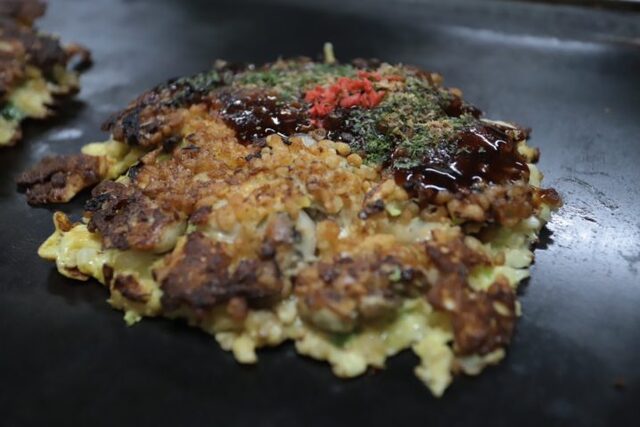
Approaching a house-style restaurant in Hinase, the mood is not urban theatre but coastal utility: a griddle room built around heat, turnover, and the local appetite for okonomiyaki. In Bizen, that matters. This is oyster country, and the better okonomiyaki addresses here are not simply borrowing a national comfort-food format; they are translating a local ingredient economy onto iron plates.
Tama Chan sits inside that tradition rather than above it. Its selection for Tabelog Okonomiyaki 100 in 2025 gives it a national signal, but the more interesting point is regional: Okayama’s Hinase area has a specific relationship with oysters, and okonomiyaki offers a democratic vehicle for them. At JPY 1,000–1,999, the format keeps the focus on ingredient and griddle work rather than ceremony.
Hinase oyster culture, read through the okonomiyaki griddle
Okonomiyaki is often discussed through the Osaka-Hiroshima divide, but coastal towns complicate that map. Hinase, within Bizen, has its own seasonal reputation around oysters, and that changes the way a griddled pancake is judged. The question is not only batter structure or sauce balance; it is whether the local seafood identity survives the heat, cabbage, noodles, and teppan rhythm.
That ingredient-first lens explains why a small, casual address can carry more editorial weight than a polished dining room. Tama Chan’s category listing covers okonomiyaki, stir-fried noodles, and teppanyaki, a cluster that points to a griddle-led kitchen rather than a broad izakaya menu. The room’s counter seats, where food is cooked on a hot plate in front of guests, reinforce the format: immediacy over choreography, heat management over plating display.
The appeal here is not luxury coding. It is the way regional Japanese food often works at its strongest: a local product, a familiar template, and a kitchen with enough repetition to make the combination feel inevitable. Tabelog’s 2025 Okonomiyaki 100 recognition places the restaurant within a national category, but its identity remains tied to Bizen’s coastal food logic.
A casual room with national recognition, not a fine-dining posture
Japan’s serious eating culture does not always announce itself through high spend. Some categories, ramen and okonomiyaki among them, reward specialization at everyday prices. Tama Chan’s Tabelog score of 3.62 and repeated Okonomiyaki 100 selections across recent years, including 2018, 2019, 2022, 2023, 2024, and 2025, put it in that specialist tier without changing the basic grammar of the experience.
That distinction is useful for travelers planning Bizen around food rather than monuments. A 31-seat setup, with tatami seating, tables, and a compact counter, suggests a place calibrated for groups, families, and solo diners who care about the griddle. It is not the kind of room that needs a chef mythology to justify itself. The evidence is format, recognition, and locality.
Compared with out-of-metro casual peers such as Chuka Soba Mugiemon at the sub-JPY 999 level, Cozzýs in the JPY 1,000–1,999 bracket, and kamos at JPY 2,000–2,999, this address occupies a useful middle ground: inexpensive enough for a regional detour, specific enough to be more than a convenience meal. Those comparisons are not cuisine-for-cuisine equivalents; they show how Japan’s regional dining value often sits outside metropolitan tasting-menu logic.
For visitors building a wider Bizen itinerary, the restaurant makes sense alongside Our full Bizen restaurants guide, with overnight planning through Our full Bizen hotels guide. Drink-focused readers can cross-check Our full Bizen bars guide, while regional producers and cultural stops sit in Our full Bizen wineries guide and Our full Bizen experiences guide.
How to place it in a Japan food itinerary
The strongest reason to come is category clarity. The restaurant is not trying to be a multi-course destination, and that restraint is the point. In a country where casual specialists can command long attention, okonomiyaki in Hinase carries the same broader lesson as regional noodles, curry counters, hamburger shops, and sake bars: the serious meal is often the one with the narrowest brief.
That is why it belongs in the same planning conversation as other tightly defined Japanese and Japan-linked specialists, even when the formats differ. A traveler comparing casual precision across cities might look at -Grilled beef Sukiyaki- KAMAKURA TANUKIAN 鎌倉 たぬき庵 in Kamakura, . 鮪と炭火焼き うお炭 秋葉原店 in Tokyo, .cafe in Osaka, .know in Kumamoto, and (Shoku) Vietnam in Kawasaki not as direct substitutes, but as examples of how focused concepts travel across Japan’s dining map.
The same logic applies beyond major cities: [Curry Senmon Ten] Maruyama Kyoju. in Sapporo, [ki:] in Kyoto, #肉といえば松田 奈良本店 in Kashihara, 1/3 HAMBURGER FACTORY in Kanazawa, 1000 in Yokohama, and 1000mヒュッテ 1000m Hut in Kutchan all illustrate the same editorial pattern: narrow formats can define a trip as sharply as formal restaurants.
For readers based in California, Jōdo Saké Bar in Los Angeles and Onigiri Time in Pasadena offer a useful contrast in how Japanese casual forms are interpreted abroad. Bizen’s version is less about translation and more about origin: local produce, local appetite, and a griddle tradition that earns attention without changing its scale.
A Quick Peer Check
Comparable venues by cuisine and price in the same metro.
| Venue | Cuisine | Price | Notes |
|---|---|---|---|
| Tama Chan | Okonomiyaki / Teppanyaki | $ | Hinase-cho, Bizen |
| Ippudo (一風堂) | Tonkotsu Ramen | $ | Narita International Airport |
| Okonomiyaki Chotto Yonnai | Hiroshima-Style Okonomiyaki | $ | Tomo |
| Human beings everybody noodles (人類みな麺類) | Traditional Shoyu Ramen | $ | Nishinakajima, Yodogawa-ku |
| Miyazato Soba (宮里そば) | Okinawan Soba | $ | Miyazato |
| Chiikawa Bakery | Chiikawa-themed Japanese bakery café | $ | Umeda |
Recognition history
Dated appearances from independent guides and award organizations, with the underlying list record or original source where available.
Tabelog 100 #67 · No. 67
Tabelog · Tabelog 100 - Okonomiyaki - 2025
Continue exploring
More in Bizen
Restaurants in Bizen
Browse all →


At a Glance
- Cozy
- Classic
- Family
- Group Dining
- Casual Hangout
- Open Kitchen
- Standalone
- Sake Program
- Beer Program
- Local Sourcing
- Street Scene
Casual, bustling, and down-to-earth house-restaurant atmosphere with a lively local feel, especially during oyster season.