Swee Choon Tim Sum Restaurant on Jalan Besar is one of Singapore's most established dim sum addresses, drawing queues through the night on a stretch that mixes old shophouses with the city's evolving dining scene. The format is old-school and unapologetic: trolleys, steamer baskets, and a room that runs long past midnight. It occupies a position in the city's Chinese dining tradition that few newer operations can replicate.
Pearl is the En Primeur Club membership app — saves, bookings, and concierge access live there. Same editors, same standards.
- Address
- 183/185/187/189, 191 Jln Besar, 191/193, Singapore 208882
- Website
- sweechoon.com
- Directions
- Get directions
 Saves & bookings on Pearl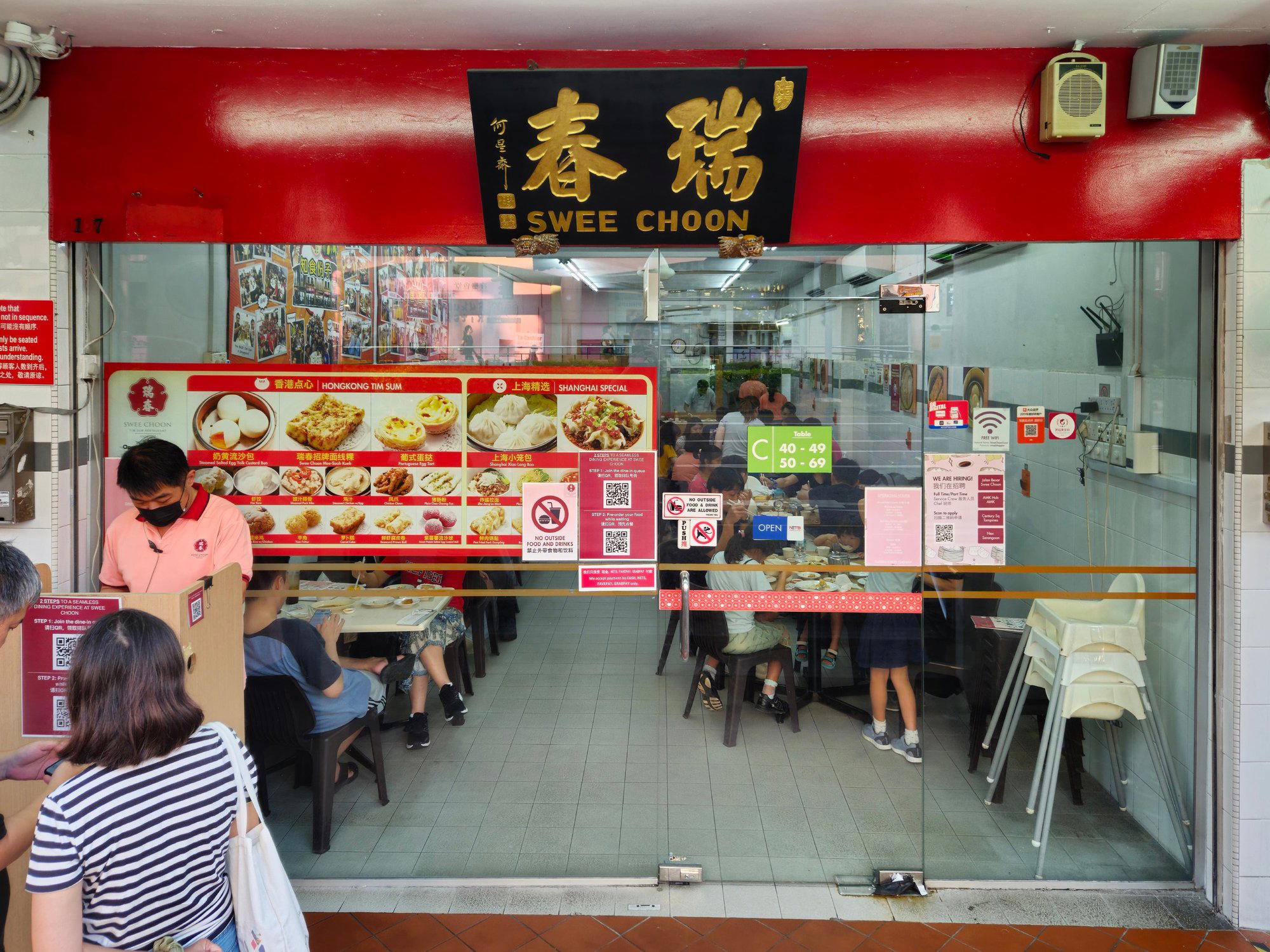
Jalan Besar After Dark: How Singapore Does Late-Night Dim Sum
Jalan Besar sits at an intersection the city has been renegotiating for decades. The street runs through a district that has absorbed waves of immigration, urban renewal, and gentrification without fully surrendering its original character. Old coffee shops and provision stores share blocks with boutique hotels and specialty cafes. It is on this stretch, across a cluster of connected shophouse units at 183 to 193 Jalan Besar, that Swee Choon Tim Sum Restaurant has built its reputation, not through fine-dining credentials or chef-driven narrative, but through the kind of institutional consistency that takes a long time to earn and a short time to lose.
Late-night dim sum is a specific subgenre of Chinese dining that Singapore has preserved more carefully than most cities. In Hong Kong, the tradition has contracted under rising rents and staffing pressures. In mainland China, it was largely an urban morning ritual to begin with. Singapore's version, particularly in the Jalan Besar and Geylang corridors, occupies a different hour: the kitchen fires well into the early morning, and the crowd that arrives after midnight is as much a part of the format as the food itself. Swee Choon is one of the few places in the city that embodies this tradition without having repositioned itself for a more convenient demographic.
The Room and What It Tells You
The physical setup across those interconnected shophouse units is functional in the way that long-running Chinese restaurants tend to be: round tables, plastic stools in some sections, a kitchen that operates visibly and audibly, and a service pace calibrated to volume rather than ceremony. This is not a weakness, it is the operating logic of a room designed to serve hundreds of people across an extended service window. The atmosphere at 1am on a weekend sits somewhere between a canteen and a community hall, with the noise level tracking the crowd rather than any designed acoustic treatment.
For readers accustomed to the quieter registers of Singapore's upper tier, the considered interiors at Odette, the precise room at Zén, or the controlled calm at Les Amis, Swee Choon reads as a deliberate counterpoint. The city's dining offer runs from the tasting-menu tier that places Singapore restaurants in the same conversation as Le Bernardin or Atomix, down to hawker centres and late-night institutions where the benchmark is consistency and value. Swee Choon occupies the latter category without apology.
Service as Coordination, Not Performance
The editorial angle here is less about individual dishes and more about how a high-volume dim sum operation actually functions as a team. In the premium-dining tier, the collaboration between kitchen and floor is often discussed in terms of choreography. At a place like Swee Choon, the coordination is less elegant but no less demanding. The kitchen must maintain output across dozens of dim sum varieties simultaneously. The floor team must manage table turnover, order-taking, and trolley circulation for a room that fills and refills across multiple sittings. The result, when it works, is a kind of organised chaos that long-time customers read as warmth.
This service model contrasts sharply with the more structured front-of-house approaches at venues like Jaan by Kirk Westaway or Meta, where the ratio of staff to diner is built around attention rather than volume. Neither is superior in abstract terms, they serve entirely different purposes in the city's dining ecosystem. What Swee Choon has developed over its decades of operation is a floor rhythm that its regular clientele finds reliable. That reliability is its own form of hospitality.
The Dim Sum Tradition Swee Choon Represents
Dim sum as a dining format has a long history in Cantonese culture, originally tied to the yum cha tradition of tea-drinking accompanied by small dishes. In Singapore, the Cantonese influence on Chinese dining has been significant, though the city's broader Hokkien, Teochew, and Hakka communities have added their own dimensions to the food culture. The late-night dim sum format that Swee Choon runs is a specifically Singaporean evolution, extending a morning tradition into the hours when other restaurants have closed, serving a population that has always kept unusual hours.
This positions Swee Choon within a comparable set that includes other Jalan Besar and Geylang operations rather than the Chinese fine-dining addresses like Imperial Treasure Fine Chinese Cuisine in the Downtown Core. The comparison is instructive: where Imperial Treasure works at the formal, banquet-facing end of Chinese dining, Swee Choon works the informal, high-frequency end. Both are responses to what Singapore's Chinese dining public actually wants, at different price points and occasions.
Elsewhere in the city's dining spread, places like Fu He Delights in Rochor and Béni in Orchard serve different constituencies. The full range of what Singapore offers, from neighbourhood operations like KTMW chicken rice tea-cafe in Bedok and Asian Twist by 365 Food in Queenstown to larger-format dining at Haidilao Hot Pot in Sembawang, reflects how seriously this city takes the full spectrum of eating, not just the leading end. Swee Choon sits confidently within that full picture. For the broader Singapore context, our full Singapore restaurants guide maps the city's dining by neighbourhood and category.
Planning a Visit
Swee Choon's address across the Jalan Besar shophouses puts it within reach of the Farrer Park and Boon Keng MRT stations, making it accessible from most parts of the city without requiring a taxi. The operation runs late, this is one of its primary draws for those finishing dinner elsewhere or arriving from evening events. It is open Mon to Thu and Sun from 7 AM to 2 AM, and Fri to Sat from 7 AM to 4 AM. Given the volume the restaurant handles, walk-ins have generally been the norm rather than advance reservations, though this may vary on weekends and public holidays. Dress is entirely casual; the room neither expects nor rewards anything else.
- Mee Sua Kueh
- Har Gow
- Siew Mai
- Salted Egg Custard Bun
- Xiao Long Bao
- Char Siew Pau
In Context: Similar Options
Comparable venues nearby, for context on price, style, and recognition.
| Venue | Cuisine | Price | Notes |
|---|---|---|---|
| Swee Choon Tim Sum RestaurantThis venue — the venue you are viewing | Hong Kong & Shanghai Dim Sum | $ | Not listed |
| Kampong Chicken Eating House | Traditional Hainanese Kampong Chicken Rice | $ | TIONG BAHRU |
| Ah Tei Hainanese Chicken | Hainanese Chicken Rice | $ | Chinatown |
| 545 Whampoa Prawn Noodle | Traditional Singapore Prawn Noodles | $ | BALESTIER |
| Bao Zai | Traditional Handmade Bao & Dim Sum | $ | ALEXANDRA HILL |
| Fragrance Garden Chicken Rice | Hainanese Chicken Rice | $ | Central Area |
Continue exploring
More in Singapore
Restaurants in Singapore
Browse all →
Bars in Singapore
Browse all →
At a Glance
- Lively
- Classic
- Casual
- Well Known
- Group Dining
- Family
- Casual Hangout
- Late Night
- After Work
- Open Kitchen
Current opening hours
- Monday
- 7 AM–2 AM
- Tuesday
- 7 AM–2 AM
- Wednesday
- 7 AM–2 AM
- Thursday
- 7 AM–2 AM
- Friday
- 7 AM–4 AM
- Saturday
- 7 AM–4 AM
- Sunday
- 7 AM–2 AM
Hours can change for holidays and private events. Last verified .
Busy, fast-paced Hong Kong-style dim sum restaurant with casual coffee-shop setting; average environment with efficient service focused on throughput rather than ambiance.