At Lau Pa Sat, one of Singapore's most recognisable Victorian cast-iron market halls, Fragrance Garden Chicken Rice represents the hawker tradition at its most functional: a single-dish focus, rapid service, and pricing that keeps the CBD lunch crowd moving. The stall draws on the Hainanese chicken rice canon that has defined Singaporean food culture for generations, making it a reliable reference point in a district otherwise dominated by expense-account dining.
Pearl is the En Primeur Club membership app — saves, bookings, and concierge access live there. Same editors, same standards.
- Address
- Lau Pa Sat Singapore
- Directions
- Get directions
 Saves & bookings on Pearl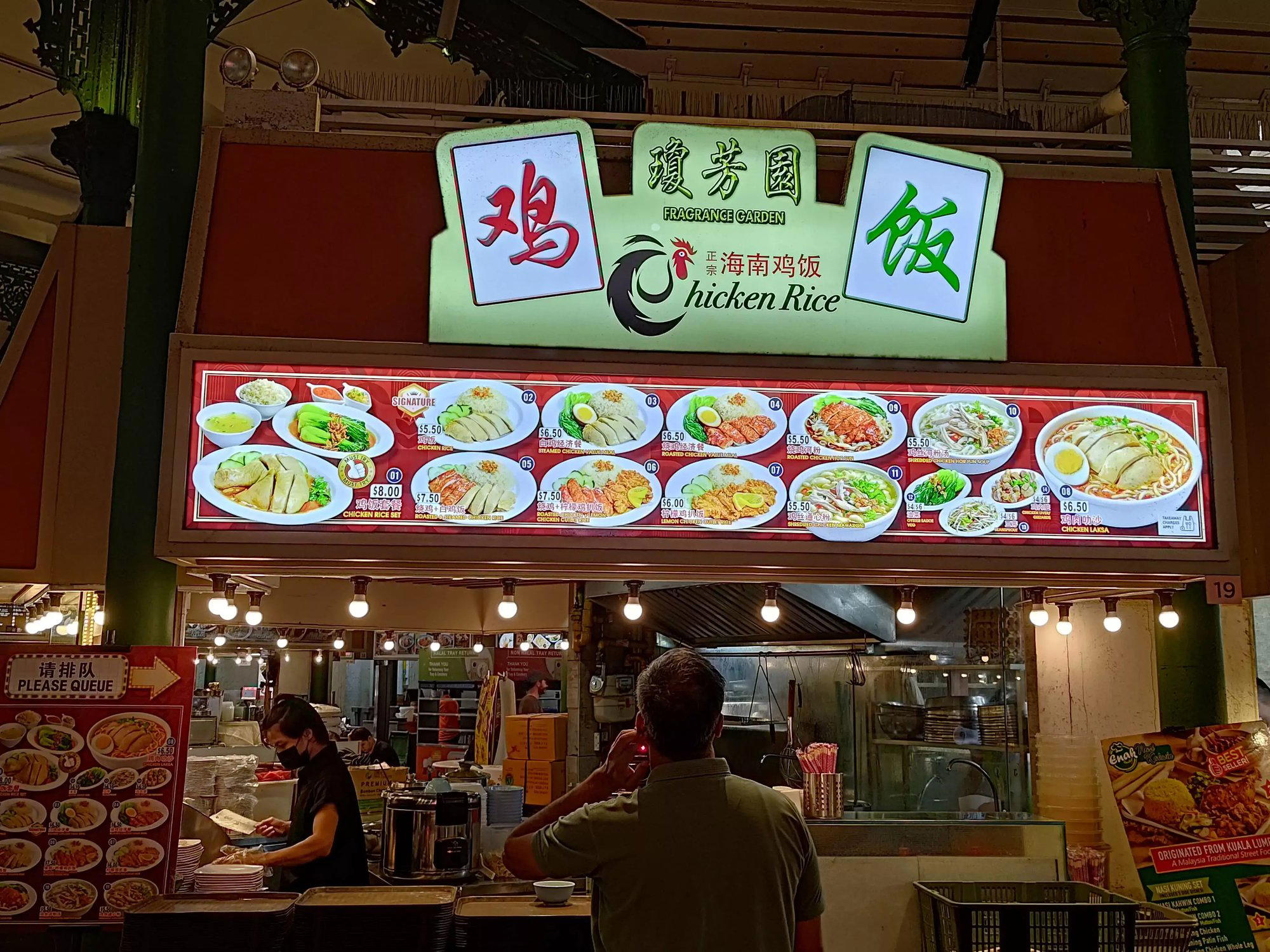
Chicken Rice at the Foot of the Financial District
Few cities draw as sharp a line between their fine-dining tier and their hawker culture as Singapore does, and nowhere is that contrast more visible than at Lau Pa Sat. The Victorian cast-iron market hall on Raffles Quay sits within walking distance of restaurants where tasting menus run to several hundred Singapore dollars, places like Zén, Odette, and Les Amis, yet inside its wrought-iron canopy, the calculus is entirely different. Here, the meal is measured in dollars, not tens of dollars, and the dish in question has been Singapore's most-debated plate for at least half a century. Fragrance Garden Chicken Rice is a casual, walk-in-friendly restaurant serving Hainanese Chicken Rice at Lau Pa Sat Singapore, with dishes around US$6.
The Dish That Defines the Tradition
Hainanese chicken rice is not a simple preparation despite its modest appearance. The method descends from Hainanese immigrants who adapted the Wenchang chicken technique to local conditions: poaching the bird gently in a master stock, then finishing it in ice water to tighten the skin, and serving it alongside rice cooked in the same stock with garlic and ginger. The accompanying sauces, typically a ginger-scallion oil, a dark soy, and a fresh chilli paste, are where individual stalls differentiate themselves most clearly. The result is a dish that rewards close attention: the rice should carry a clean fat-forward flavour without heaviness, and the chicken should yield at the joint without dryness anywhere along the breast. Fragrance Garden operates within this canon. Whether it does so at the level of the city's most-discussed chicken rice counters is a question that matters more to the lunchtime regular than to the first-time visitor, for whom the category itself is the point.
Singapore's chicken rice scene has produced a number of stalls that have crossed into broader recognition, some have received mentions in international food press, and at least one has attracted Michelin Bib Gourmand attention over the years, a category that signals quality cooking at accessible price points. Fragrance Garden sits within the Lau Pa Sat cluster, which means it competes laterally with other stalls in the same hall rather than against destination restaurants. For context on how other chicken rice formats are distributed across the city, Bugis Street Ah Huat Hainanese Chicken Rice at Changi Airport and KTMW chicken rice tea-cafe in Bedok represent how the dish travels to different neighbourhoods and formats across the island.
The Lunch vs. Dinner Divide at Lau Pa Sat
At lunch, the hall operates under a different set of conditions than it does after dark, and understanding that divide is useful practical insight a visitor can carry.
Midday service at Lau Pa Sat is driven by the CBD workforce. The lunch window, roughly noon to two in the afternoon on weekdays, brings the hall to capacity quickly. Tables turn fast, noise levels are sustained, and the interaction at a chicken rice stall is transactional by design: you choose your cut, whole chicken portions, breast, thigh, or roast chicken depending on what the stall offers, indicate your rice quantity, and move aside. This is hawker dining in its most efficient register, and it suits the office worker with forty minutes, not the leisure traveller with an afternoon to spend. The value-to-cost ratio at this hour is among the strongest in the CBD, given that the surrounding neighbourhood's sit-down restaurant options price substantially higher for comparable satisfaction.
Evening service shifts the character of Lau Pa Sat significantly. After around seven in the evening, the pavement outside the hall transforms: the satay stalls that line the perimeter set up their charcoal grills, and the crowd composition changes from suits to a mix of tourists, post-work groups, and families. The hawker centre takes on a more communal, unhurried atmosphere. For a chicken rice stall, evening service can mean reduced queue pressure, though it also means the day's stock may be more limited, a detail worth bearing in mind for anyone with specific preferences for cut or preparation. The physical experience of eating here at night, with the glow of the market hall against the CBD skyline, is more atmospheric than a lunchtime visit, though the dish on the plate is identical.
For a different read on how neighbourhood hawker culture operates outside the CBD, Ah Ter Teochew Fishball Noodles in the Downtown Core offers a comparison point within the same district.
Lau Pa Sat and Its Place in Singapore's Food Geography
Lau Pa Sat itself was built in 1894 to a design attributed to James MacRitchie and later renovated using the cast-iron framework that now gives it architectural distinction. The structure was gazetted as a national monument in 1973. The hall has gone through various operational phases, including a period of closure during MRT construction in the 1980s, but has functioned as a hawker centre in its current form for several decades.
The CBD location means that Lau Pa Sat draws a visitor profile unlike the neighbourhood hawker centres in Bedok, Ang Mo Kio, or Tampines. For visitors whose Singapore itinerary includes fine dining at restaurants such as Jaan by Kirk Westaway or Meta, a hawker meal at Lau Pa Sat provides a useful calibration, a reminder that Singapore's food identity was built on this register long before the city accumulated its current Michelin count.
Other dining options in the broader area cover a wide range of formats and cuisines. Etna Restaurant in Outram and Cicheti in Rochor represent the European-leaning end of the city's mid-range; Béni in Orchard operates at a more formal pitch.
Planning a Visit
Lau Pa Sat is accessible via Raffles Place MRT on the East-West and North-South lines. No reservations apply at a hawker stall; the mechanics are walk-in, queue, order, and find a seat, which at peak lunch hour requires some patience. Payment customs at Singapore hawker centres typically favour cash, though many stalls have adopted local QR payment systems in recent years. Visitors planning around the satay experience on the perimeter should aim for evenings, when those stalls operate.
Cuisine and Credentials
Comparable venues nearby, for context on price, style, and recognition.
| Venue | Cuisine | Price | Notes |
|---|---|---|---|
| Fragrance Garden Chicken RiceThis venue — the venue you are viewing | Hainanese Chicken Rice | $ | Not listed |
| Ah Tei Hainanese Chicken | Hainanese Chicken Rice | $ | Chinatown |
| Beach Road Scissor-Cut Curry Rice | Hainanese Scissor-Cut Curry Rice | $ | Jalan Besar |
| Hup Kee Fried Oyster Omelette | Singaporean Fried Oyster Omelette | $ | NEWTON CIRCUS |
| Swee Choon Tim Sum Restaurant | Hong Kong & Shanghai Dim Sum | $ | LITTLE INDIA |
| Bee Cheng Hiang | Bakkwa Fusion Grillery | $$ | Bendemeer |
Continue exploring
More in Singapore
Restaurants in Singapore
Browse all →
Bars in Singapore
Browse all →
At a Glance
- Casual Hangout
- Standalone
Casual hawker stall atmosphere in a bustling food market with conversational noise levels.