
Hamamatsu’s eel culture rewards specialists that treat sourcing and charcoal work as the point, not decoration. Sumiyaki Unagi Aoiya sits in that lane with Tabelog 100 Unagi selections in 2018, 2019, 2022, and 2024, a 40-seat house-restaurant format, counter seating, take-out, sake and wine, and a price band that keeps it within reach of a serious lunch or dinner.
Pearl is the En Primeur Club membership app — saves, bookings, and concierge access live there. Same editors, same standards.
- Address
- 616-2 Iidacho, Chuo Ward, Hamamatsu, Shizuoka 435-0028, Japan
- Phone
- +81 53-464-6323
- Website
- aoiya-unagi.com
 Saves & bookings on Pearl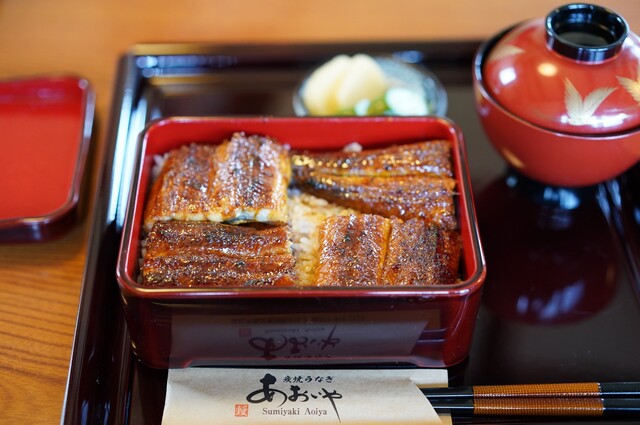
In Hamamatsu, eel is not a novelty order. It is part of the city’s food identity, tied to Lake Hamana, long-established freshwater fish cookery, and the local habit of treating unagi as both everyday reward and regional calling card. Sumiyaki Unagi Aoiya enters that tradition through a house-restaurant setting and a counter-seating format, which puts the emphasis where it belongs: fish, rice, charcoal, and pacing rather than ceremony for its own sake.
The sharper way to read Hamamatsu’s restaurant scene is through specialization. Gyoza houses, soba rooms, Chinese counters, and eel restaurants occupy different lanes rather than competing for the same occasion. In that context, eel specialists are judged less by novelty than by consistency, sourcing discipline, and how confidently they handle a narrow repertoire. Tabelog’s Unagi 100 selections in 2018, 2019, 2022, and 2024 place this restaurant inside a national conversation about eel cooking, not simply a local one.
Hamamatsu eel culture rewards restraint, sourcing, and charcoal control
Unagi restaurants in Japan live or die on procurement and heat management. The category gives little cover to theatrical plating or long tasting-menu architecture. The central question is direct: how well does the kitchen handle eel as a fish, and how clearly does the cooking respect the rice-bowl format around it? The restaurant’s listed categories, unagi and donburi, make that priority plain. This is a focused address rather than a broad izakaya with eel as one more option.
That focus matters in Shizuoka. Hamamatsu’s eel reputation is not built only on appetite; it comes from geography and habit. Lake Hamana has long shaped the city’s freshwater fish culture, while the Tokaido corridor helped make eel a familiar meal for travelers and locals. The result is a demanding audience. A restaurant in this city cannot rely on the mere presence of unagi to create authority. It has to sit convincingly within a local field where diners already know the form.
Compared with lower-priced Hamamatsu addresses such as Kohaku and Fukumitsu, Sumiyaki Unagi Aoiya occupies a more deliberate eel-restaurant spend. It does not reach the higher dinner bracket represented by Binshan Li, which belongs to a different dining category altogether, but it sits above casual lunch territory. That middle position is useful: serious enough for a planned eel meal, not so formal that the format loses its regional directness.
The format is compact, family-friendly, and built around repeatable craft
A 40-seat room changes the rhythm of an eel meal. It is large enough to work for families and small groups, but not so large that the specialist identity gets diluted. The house-restaurant setting also fits the category. Many of Japan’s stronger regional food rooms are not designed as destination architecture; they are practical places where a limited menu, repeat customers, and a recognizable cooking style do the work.
The recognition matters because eel is a crowded category with deep regional bias. Tabelog’s Unagi 100 is not the same signal as a Michelin star, but it is relevant for this exact genre because it is category-specific. Repeated selection across several cycles suggests the restaurant has not been treated as a single-year curiosity. For travelers using Hamamatsu as a food stop rather than a long stay, that is the useful trust signal: a specialist, in the right city, recognized within the right category.
The drinks listing, sake and wine, also says something about how modern eel dining has broadened without becoming a luxury tasting format. Sake remains the natural partner for many Japanese fish preparations, while wine gives the room a slightly wider register for diners who want a slower dinner. Take-out adds another clue about local function. This is not only a table-service destination for visitors; it also serves the city’s practical appetite for eel outside the dining room.
For a wider read on the city, use Our full Hamamatsu restaurants guide alongside Our full Hamamatsu hotels guide, Our full Hamamatsu bars guide, Our full Hamamatsu wineries guide, and Our full Hamamatsu experiences guide. Hamamatsu makes more sense when eel is read beside gyoza, station-area drinking, day trips, and the city’s position between Nagoya and Shizuoka rather than as a single-meal detour.
How to place it within a Japan food itinerary
Travelers often overbuild Japan restaurant plans around Tokyo and Kyoto, then treat regional cities as transit. Hamamatsu argues against that. Its eel culture gives the city a clear dining reason to stop, particularly for travelers moving along the Tokaido Shinkansen route. Sumiyaki Unagi Aoiya is the kind of specialist that works as an anchor meal rather than a filler between trains, especially for diners who care about ingredient identity more than chef biography.
Within an EP Club itinerary, the useful comparison is not only another eel restaurant. It is the broader question of how Japan’s regional specialists differ from big-city dining rooms. A soba address such as Honkaku Teuchi Moriya Toukyou ten, a Shizuoka-area counter like Kibori, and a French-leaning room such as Abondance all answer different versions of the same question: when does a narrow format become the stronger choice than a broader menu?
That question travels well beyond Hamamatsu. For contrast, see how Japanese dining categories shift at -Grilled beef Sukiyaki- KAMAKURA TANUKIAN 鎌倉 たぬき庵 in Kamakura,. 鮪と炭火焼き うお炭 秋葉原店 in Tokyo,.cafe in Osaka,.know in Kumamoto, (Shoku) Vietnam in Kawasaki, and [Curry Senmon Ten] Maruyama Kyoju. in Sapporo. Abroad, Jōdo Saké Bar in Los Angeles and Onigiri Time in Pasadena show how specific Japanese formats change when removed from their home context.
The editorial case for this restaurant is therefore simple. Hamamatsu is a city where eel carries local meaning, the restaurant works within that specialty rather than around it, and repeated Tabelog Unagi 100 selections give the room a category-specific credential. For diners choosing one eel meal in Hamamatsu, that combination is more useful than a long menu, a famous chef narrative, or a room designed to announce itself.
- Unaju (charcoal-grilled eel over rice)
- Kabayaki (sauce-grilled eel)
- Shirayaki (plain grilled eel)
- Unagi bento
- Grilled eel liver
- Crunchy fried eel bones
A Quick Peer Check
Comparable venues by cuisine and price in the same metro.
| Venue | Cuisine | Price | Awards | Notes |
|---|---|---|---|---|
| Sumiyaki Unagi AoiyaThis venue — the venue you are viewing | Kansai-style Charcoal-Grilled Unagi | $$ | , | |
| Shukou Yuzen Jinen | Japanese Izakaya | $$$ | , | Tamachi, Naka-ku |
| Sumiyaki Unagi Hajime | Charcoal-grilled Unagi Specialist | $$$ | , | Nishi-ku |
| Honkaku Teuchi Moriya Toukyou ten | Traditional Sanuki Udon | $$ | , | Hamamatsucho |
| Ton Kara Ten | Tonkatsu & Oyako-don Specialist | $$ | , | Chuo Ward, Hamamatsu City |
| 焼き鳥幸羽(こはね) | Amagi Shamo Yakitori Omakase | $$$$ | , | Chiyoda Ward, near Shin-Hamamatsu Station |
Continue exploring
More in Hamamatsu
Restaurants in Hamamatsu
Browse all →
Hotels in Hamamatsu
Browse all →
At a Glance
- Cozy
- Classic
- Elegant
- Rustic
- Hidden Gem
- Family
- Group Dining
- Casual Hangout
- Special Occasion
- Solo
- Date Night
- Standalone
- Design Destination
- Sake Program
- Beer Program
- Local Sourcing
- Sustainable Seafood
The restaurant has a calm, folk-art-style interior lit by soft white lighting, with festival-themed decor and around 150 hanging tsurushibina ornaments from the ceiling, creating an elegant yet unpretentious, cozy atmosphere suited to relaxed meals rather than formal dining.
- Unaju (charcoal-grilled eel over rice)
- Kabayaki (sauce-grilled eel)
- Shirayaki (plain grilled eel)
- Unagi bento
- Grilled eel liver
- Crunchy fried eel bones