
Tabelog 100 #26
Our verdict
A Shima unagi specialist near Ugata Station, Sumibiyaki Unagi Higashiyama Bussan belongs to the charcoal-grilled eel tradition rather than the resort dining circuit. Its Tabelog 100 Unagi 2024 selection, no-seat-reservation format, tatami seating, takeout options, and cash-only payment make it a practical, local counterpoint to Shima’s higher-priced hotel restaurants.

Pearl is the En Primeur Club membership app — saves, bookings, and concierge access live there. Same editors, same standards.
- Address
- 4032 Agocho Ugata, Shima, Mie 517-0501, Japan
- Phone
- +81 599-43-0539
- Hours
- Mon 10 AM–7 PMTue ClosedWed–Sun 10 AM–7 PM
- Website
- r.gnavi.co.jp
- Directions
- Get directions
The menu
What to order
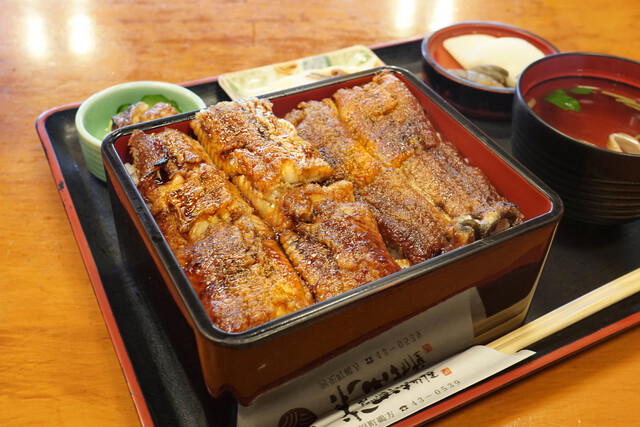
- Unajū (eel over rice box)
- Unadon (eel rice bowl)
- Unagi teishoku set
- Kabayaki grilled eel
Approaching Shima, the area’s resort polish gives way in places to a more workaday rhythm: local traffic, low buildings, and the smell of charcoal where eel houses can still operate as everyday luxury rather than ceremony. In that setting, Sumibiyaki Unagi Higashiyama Bussan reads less like a destination dining room than a reminder of how unagi functions in Japan: a meal tied to craft, stamina, season, and repetition, not spectacle.
Unagi occupies a particular place in Japanese dining culture. It is celebratory without being formal, expensive enough to signal occasion, familiar enough to bring children, parents, and friends to the same table. The cooking tradition prizes a narrow set of decisions: how the eel is prepared, how the tare is handled, how the charcoal heat is controlled, and how quickly the rice and fish meet the guest. Shima, better known to travellers for seafood, ryokan hospitality, and Ise-Shima resort dining, gives that tradition a quieter stage than Tokyo or Nagoya.
Charcoal eel in a city better known for resort dining
The useful way to place this restaurant is against Shima’s broader dining map. At the polished end sit destination rooms such as La Mer The Classic, RIAS by Kokotxa, and Tempura Tobari, where pricing and format pull the meal toward tasting-menu travel. ラ・メール belongs to the same resort-facing conversation. Sumibiyaki Unagi Higashiyama Bussan sits in a different lane: an unagi and bento house selected for Tabelog 100 Unagi 2024, with a listed Tabelog score of 3.71. That recognition matters because eel is a category with deep regional loyalties and plenty of competent specialists; a current Hyakumeiten selection signals consistency rather than fashion.
The category also explains the restaurant’s appeal for travellers who want one meal in Shima that is not built around a hotel dining room. Charcoal-grilled eel is not casual in technique, but the experience can be direct: eel, rice, bento formats, and a restaurant rhythm designed for regular use as much as culinary pilgrimage. The listed categories, Unagi (Eel) and Bento (Lunch box), reinforce that dual identity. It is serious food in a practical local format.
For broader planning, Our full Shima restaurants guide is the natural next stop, particularly for travellers balancing local specialists with higher-budget rooms. Shima’s hospitality context also matters: Our full Shima hotels guide helps frame where resort dining fits, while Our full Shima bars guide, Our full Shima wineries guide, and Our full Shima experiences guide map the rest of the stay.
The appeal is discipline, not theatre
Japan’s unagi houses tend to reward patience with format. Unlike multi-course kaiseki or chef-led counters, the drama is compressed into a few variables: cut, heat, sauce, rice, and timing. The restaurant’s Tabelog score of 3.71 places it in a credible specialist bracket for a regional eel shop, and its Tabelog 100 Unagi inclusion gives a clearer trust signal than vague local popularity. The listed food categories align with what matters in this genre: eel and bento rather than a menu built for breadth.
That makes it a useful corrective to a common Ise-Shima itinerary. Travellers often arrive expecting seafood, coastal scenery, and polished dining rooms. Eel offers a different Japanese luxury code: concentrated, protein-rich, rice-based, and built on repeat customers. In that sense, this is not a substitute for a formal dinner at a resort restaurant; it is the meal that shows how the region eats when the occasion is satisfying rather than ceremonial.
The practical rhythm is part of the editorial judgment. This is a focused specialist rather than a room designed around extended service rituals, so travellers should treat it as a targeted meal and plan with a local-restaurant mindset. The published budget is approachable for the category, listed as Dinner: JPY 3,000 - JPY 3,999 and Lunch: JPY 2,000 - JPY 2,999. For visitors comparing Shima options, that makes the restaurant a grounded counterpoint to more expensive destination dining.
Shima’s comparison set sharpens the point. Tempura Tobari sits in a different dining category, while La Mer The Classic and RIAS by Kokotxa make sense for travellers seeking a longer, more composed dining arc. The eel house is a tighter proposition: go for the charcoal-grilled unagi tradition, not for breadth, wine pairing, or resort ambience.
How it fits into a Japan itinerary
For visitors building a wider food route through Japan, Sumibiyaki Unagi Higashiyama Bussan belongs with focused regional specialists rather than prestige dining rooms. That same logic connects, at a national scale, to many unnamed local restaurants where single-category commitment defines the meal more clearly than breadth. The point is not that the cuisines are comparable, but that a narrow format can often reveal more about local dining culture than a longer menu.
For readers travelling beyond Japan, the same editorial distinction applies. Compact specialists in other cities can help decode why a narrow format is often more revealing than an extended menu. In Shima, the decision is simple: choose this stop when the day calls for a grounded expression of Japanese eel culture, with the practical mindset of a local restaurant rather than the expectations of a resort dinner.
Frequently asked questions
Is Sumibiyaki Unagi Higashiyama Bussan child-friendly?
Sumibiyaki Unagi Higashiyama Bussan is an unagi and bento restaurant in Shima. For families, the useful planning point is the format: eel and rice dishes can work well for a straightforward lunch or dinner when everyone wants a focused local meal.
What's the overall feel of Sumibiyaki Unagi Higashiyama Bussan?
It reads as a house-style unagi spot rather than a formal dining room, with Unagi (Eel) and Bento (Lunch box) as the listed categories. The budget is Dinner: JPY 3,000 - JPY 3,999 and Lunch: JPY 2,000 - JPY 2,999, and the 2024 Tabelog 100 Unagi selection gives it added credibility.
What should I budget for a meal at Sumibiyaki Unagi Higashiyama Bussan?
Pricing at Sumibiyaki Unagi Higashiyama Bussan is listed as Dinner: JPY 3,000 - JPY 3,999; Lunch: JPY 2,000 - JPY 2,999.
When can I go to Sumibiyaki Unagi Higashiyama Bussan?
Specific opening hours are not included in the verified venue details here, so check directly with the restaurant before making a special trip.
How do I find Sumibiyaki Unagi Higashiyama Bussan?
Shima.
What's the signature at Sumibiyaki Unagi Higashiyama Bussan?
Unagi is the focus, with Bento (Lunch box) also listed as a category. The restaurant was selected for Tabelog 100 Unagi in 2024, so eel is the clear point of reference here.
Cost Snapshot
Comparable venues by cuisine and price in the same metro.
| Venue | Cuisine | Price | Awards | Notes |
|---|---|---|---|---|
| Sumibiyaki Unagi Higashiyama BussanThis venue — the venue you are viewing | Traditional charcoal-grilled unagi | $30–50 | Tabelog 100 #26 | Not listed |
| Amanemu Restaurant | Seasonal Japanese Fine Dining | $500+ | Not listed | Hamajima-cho, Seasonal Japanese Fine Dining |
| Tempura Tobari | Japanese Tempura Omakase | Not listed | Tabelog 100 #2 | Ugata, Japanese Tempura Omakase |
| RIAS by Kokotxa | New Basque fine dining by Michelin-starred Kokotxa | Not listed | Tabelog 100 #69 | Shima Mediterranean Village, New Basque fine dining by Michelin-starred Kokotxa |
| La Mer The Classic | Traditional French seafood fine dining | $150–200 | Tabelog 100 #59 | Agocho Shinmei, Traditional French seafood fine dining |
| ラ・メール | Seafood French Cuisine | $150–200 | Not listed | Kashikojima, Seafood French Cuisine |
Recognition history
Dated appearances from independent guides and award organizations, with the underlying list record or original source where available.
Tabelog 100 #26 · No. 26
Tabelog · Tabelog 100 - Unagi - 2024
Details
- Classic
- Cozy
- Family
- Group Dining
- Casual Hangout
- Solo
- Special Occasion
- Standalone
- Historic Building
- Local Sourcing
- A La Carte
- Set Menu
- Tea
- Beer
- Pescatarian Friendly
Current opening hours
- Monday
- 10 AM–7 PM
- Tuesday
- Closed
- Wednesday
- 10 AM–7 PM
- Thursday
- 10 AM–7 PM
- Friday
- 10 AM–7 PM
- Saturday
- 10 AM–7 PM
- Sunday
- 10 AM–7 PM
Hours can change for holidays and private events. Last verified .