
Suien Dosai Honten places Shizuoka’s tonkatsu culture in a disciplined, everyday register rather than a luxury-tasting-menu frame. Its Tabelog Tonkatsu 100 selections in 2022, 2024, and 2026 give it national category weight, while the house-restaurant setting and accessible price band keep the meal close to the local rhythm of cutlet, rice, cabbage, and sauce.
Pearl is the En Primeur Club membership app — saves, bookings, and concierge access live there. Same editors, same standards.
- Address
- 静岡県静岡市葵区相生町6-22
- Phone
- +81542464884
- Website
- suiendosai.com
 Saves & bookings on Pearl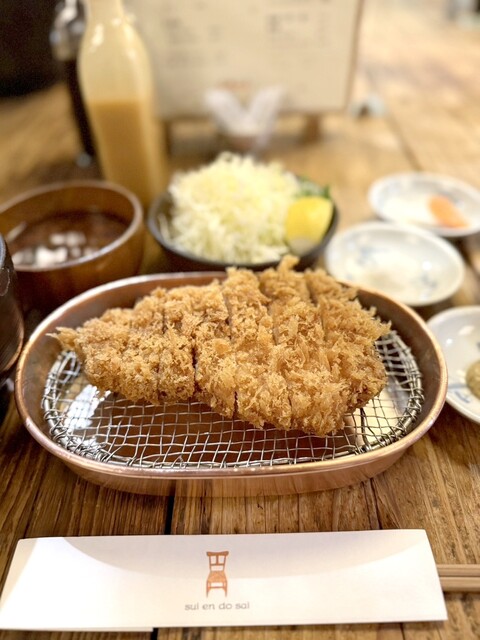
Approaching a house restaurant for tonkatsu changes the tempo before the first order is placed. The ritual is domestic in outline but professional in execution: remove the meal from spectacle, let the fry cook do the technical work, and give the diner a plate built around contrast. In Shizuoka, where seafood, tea country, and station-area dining often dominate outside attention, a serious pork cutlet address adds another register to the city’s food map.
Suien Dosai Honten belongs to the category of restaurants that explain why tonkatsu has never needed elaborate ceremony to hold critical interest. The format is compact: pork cutlet, rice, shredded cabbage, sauce, and the expectation that timing matters. A cutlet loses its argument quickly if it sits too long, so the meal rewards attention rather than lingering. That is the dining ritual here: order, eat while the crust has structure, reset the palate with cabbage and rice, repeat.
Tonkatsu as a Shizuoka dining ritual, not a luxury performance
Japan’s cutlet houses occupy a useful middle ground between everyday lunch counter and specialist craft. They do not ask for the long pacing of kaiseki or the interpretive language of a tasting menu. They ask whether the kitchen can manage moisture, fat, crust, and sequence. That makes recognition in a national tonkatsu list meaningful: it signals category discipline, not general glamour.
The restaurant was selected for Tabelog Tonkatsu 100 in 2022, 2024, and 2026, a stronger credential for this genre than broad praise would be. Tabelog’s category lists are useful because they separate tonkatsu from the noise of general restaurant rankings. A Shizuoka cutlet specialist appearing there across multiple editions suggests sustained relevance in a field where Tokyo and other large cities tend to absorb attention.
Within the city, the comparison is instructive. Chinese Muramatsu sits in a far higher price bracket, while Shizuoka Sichuan Hanten and Sabai Deal occupy different mid-range dining lanes. Ooyakiimo shares a casual budget tier, but the meal logic is completely different. Tonkatsu’s appeal is narrower and more exacting: the diner is not choosing variety so much as a single fried centerpiece judged against a familiar national standard.
The cutlet-house code: pace, restraint, and small decisions
A good tonkatsu meal is built from small acts of self-regulation. Do not smother the cutlet before tasting it. Use cabbage as a reset, not decoration. Let rice do its quiet work. In this style of dining, etiquette is less about formality than respect for timing. The kitchen has already made the high-risk decision, sending fried pork to the table at the point where crust and interior are meant to meet. The diner’s job is not to complicate it.
That is why the house-restaurant format matters editorially. It shifts the experience away from polished urban dining-room choreography and toward a local meal with specialist intent. The absence of private rooms also keeps the emphasis on the shared cadence of the room rather than enclosed occasion dining. Private use is available for groups up to 20, which places the restaurant in an interesting middle position: personal in scale, but not strictly solitary-counter dining.
For travelers building a Shizuoka itinerary, this is the kind of lunch or dinner that should be understood against the city’s range rather than isolated as a single stop. Kaiseki at Asaba (Kaiseki) speaks to ceremony and season. Chinese Muramatsu points toward high-spend Chinese dining. Aozora, Blue Label, and Chabo help round out the local restaurant field. The cutlet house, by contrast, is about a defined Japanese comfort form executed seriously enough to earn national category attention.
How to place it in a Shizuoka trip
The practical value is clear: this is a low-to-mid price tonkatsu meal with a stronger awards signal than its spend level might imply. That combination is useful in Japan, where some of the country’s disciplined specialist cooking happens outside luxury pricing. For visitors, the point is not to turn every meal into a reservation trophy. It is to understand when an everyday format has been sharpened enough to justify planning around it.
Shizuoka rewards that kind of planning. The city can support a day that moves from casual regional eating to formal cuisine, with bars, hotels, wineries, and experiences layered around the meal rather than competing with it. For broader planning, see our full Shizuoka restaurants guide, our full Shizuoka hotels guide, our full Shizuoka bars guide, our full Shizuoka wineries guide, and our full Shizuoka experiences guide.
The wider Japan file shows how specialist, casual, and regional formats sit beside higher ceremony without needing the same vocabulary. A traveler comparing meal types might look from sukiyaki at -Grilled beef Sukiyaki- KAMAKURA TANUKIAN 鎌倉 たぬき庵 in Kamakura to tuna and charcoal grilling at. 鮪と炭火焼き うお炭 秋葉原店 in Tokyo, casual cafe culture at.cafe in Osaka, bar-adjacent dining at.know in Kumamoto, Vietnamese cooking at (Shoku) Vietnam in Kawasaki, curry specialization at [Curry Senmon Ten] Maruyama Kyoju. in Sapporo, or Japanese food culture abroad through Jōdo Saké Bar in Los Angeles and Onigiri Time in Pasadena. Suien Dosai Honten fits that same editorial lesson: a focused format can carry as much meaning as a grander meal when the category is understood on its own terms.
Cuisine and Awards Snapshot
Nearby venues at a similar price tier for orientation.
| Venue | Cuisine | Price | Notes |
|---|---|---|---|
| Suien Dosai HontenThis venue — the venue you are viewing | Traditional Tonkatsu (Japanese Pork Cutlet) | $$ | Not listed |
| Seki Beya | Traditional Japanese wagashi & Abekawa mochi | $ | Aoi-ku |
| 成生 | Vegetarian Health Food | $$ | Autocity |
| Suehiro Zushi | Traditional Shimizu Sushi with Hagashi Tuna | $$$ | Shimizu Ward |
| Kawachi Ya | Dining | Not listed | Shizuoka |
| FUJI | Traditional Shizuoka Kaiseki Omakase | $$$$ | Aoi-Ku |
Recognition history
Dated appearances from independent guides and award organizations, with the underlying list record or original source where available.
Tabelog 100 #96 · No. 96
Tabelog · Tabelog 100 - Tonkatsu - 2026
Continue exploring
More in Shizuoka
Restaurants in Shizuoka
Browse all →
Hotels in Shizuoka
Browse all →
Wineries in Shizuoka
Browse all →
At a Glance
- Classic
- Cozy
- Family
- Group Dining
- Casual Hangout
- Solo
- Standalone
- Design Destination
- Historic Building
- Local Sourcing
Traditional tonkatsu specialist with a composed, classic atmosphere; the interior uses old sake barrels from a centuries‑old brewery, creating a warm, quietly bustling neighborhood feel rather than a flashy modern space.