
Tabelog 100 #58
Our verdict
Aozora gives Shizuoka’s diner culture a sharp local focus: Yui sakura shrimp, shirasu, counter seating, and a price tier that keeps the meal closer to everyday regional eating than destination tasting-menu theatre. Its Tabelog 100 Diner selections in 2024 and 2026 make it a useful reference point for how serious Japan’s humble shokudo format can be.

Pearl is the En Primeur Club membership app, where members save venues, book tables and use the concierge.
The menu
What to order
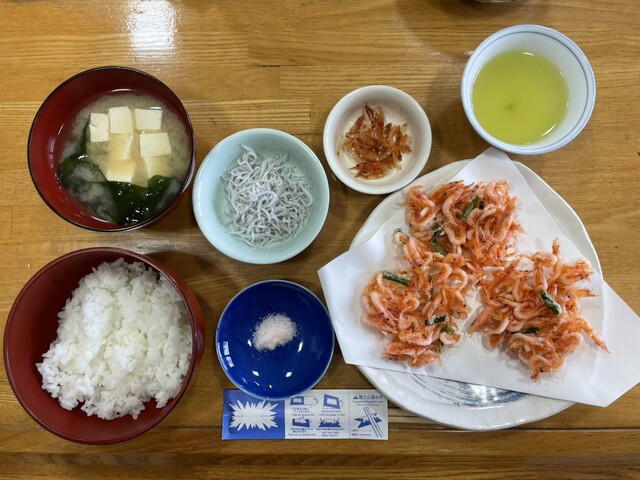
- Sakura shrimp and green onion tempura set meal
- Sakura shrimp tempura
- Boiled shirasu
- Dried sakura shrimp tsukudani
Yui is not the Shizuoka that appears in glossy hotel itineraries first. It is a fishing-town address on the JR Tokaido Line, where the meal logic starts with what comes from nearby water rather than with chef mythology or dining-room drama. That matters at Aozora because the appeal is rooted in ingredient origin: sakura shrimp from Yui, shirasu, fish-led set meals, and the compact discipline of a counter-seat shokudo.
Shizuoka’s dining identity often gets flattened into views of Fuji, tea fields, and coastal sushi, but its everyday restaurants tell a more useful story. Port towns along Suruga Bay have long treated small seafood as staple rather than garnish. Sakura shrimp, especially, is not a generic luxury ingredient; Yui is one of Japan’s defining names for it, and the difference between a local diner serving it as a set meal and a metropolitan restaurant turning it into a flourish is the difference between source and quotation.
Yui seafood gives the shokudo format its authority
The Japanese shokudo is often misunderstood by visitors who read value pricing as a signal of simplicity alone. In stronger regional examples, the format works because it compresses local supply, speed, and repetition into a short meal. Here, the public-facing description points directly to 100% Yui-produced sakura shrimp and green onion tempura, with a sakura shrimp set meal built around tempura, boiled shirasu, dried sakura shrimp tsukudani, rice, and miso soup. That is not tasting-menu construction; it is a coastal pantry arranged in a way that makes sense for lunch, solo dining, and repeat local use.
The Tabelog 100 Diner selections in 2024 and 2026 give the place a credential beyond neighbourhood affection. In Japan, diner recognition is particularly revealing because the category rewards consistency in ordinary formats rather than spectacle. A 3.66 Tabelog score also places it in a competitive public-rating band for a small regional cafeteria, where expectations are shaped less by ceremony and more by execution, sourcing, and regular-customer confidence.
That context separates it from higher-spend Shizuoka meals. Suehiro Zushi sits in a JPY 6,000 to JPY 7,999 bracket, while Chinese Muramatsu is listed at JPY 15,000 to JPY 19,999. Aozora occupies a different decision category: not the celebratory reservation, not the formal chef counter, but the regional meal that tells a sharper story about place because it has less incentive to perform.
Counter dining, small scale, and the value of restraint
The room is built around counter seating and only eight seats, a scale that changes the rhythm of the meal. Small diners in Japan can feel less like restaurants and more like local infrastructure, especially when the menu spans set meals, noodles, rice bowls, and a snack-shop register of sweets, bread, ice cream, and drinks. That breadth is not a lack of focus; it is how many regional cafeterias serve multiple needs across the day while keeping the seafood identity intact.
The payment and seating details also point to a place designed for everyday use rather than expense-account dining. Credit cards are not accepted, while electronic money and QR code payments are accepted. Private rooms and private use are unavailable, which keeps the experience in the public, compact register of a counter meal. The setting suits solo diners and friends better than a large-table occasion, and the small seat count makes group planning less forgiving.
For travellers building a Shizuoka food route, the point is to treat this as a coastal ingredient stop rather than a substitute for the city’s formal dining. Asaba (Kaiseki) belongs to a different hospitality tradition, while Blue Label, Chabo, and FUJI help map the wider restaurant field. For planning beyond one meal, see Our full Shizuoka restaurants guide, alongside Our full Shizuoka hotels guide, Our full Shizuoka bars guide, Our full Shizuoka wineries guide, and Our full Shizuoka experiences guide.
Where it fits in a Japan food itinerary
Aozora is useful for a reader who already understands that Japan’s serious eating is not confined to omakase counters and kaiseki rooms. The better comparison is with other tightly defined casual formats across the country: -Grilled beef Sukiyaki- KAMAKURA TANUKIAN 鎌倉 たぬき庵 in Kamakura for a single-dish beef tradition. 鮪と炭火焼き うお炭 秋葉原店 in Tokyo for tuna and charcoal cooking.cafe in Osaka for café-format urban dining.know in Kumamoto for a regional contemporary address, (Shoku) Vietnam in Kawasaki for everyday Vietnamese cooking, and [Curry Senmon Ten] Maruyama Kyoju. in Sapporo for a specialist curry shop.
Internationally, the same lesson applies. Japanese casual formats travel well when they preserve discipline rather than chase novelty: Jōdo Saké Bar in Los Angeles and Onigiri Time in Pasadena sit far from Suruga Bay, but they show how compact formats can carry cultural specificity. In Yui, the advantage is more direct. The ingredient and the place are close enough that the meal does not need explanation layered over it.
The editorial case is therefore clear: seek it for sakura shrimp and shirasu in their home context, not for ceremony. The award history supplies external validation, but the stronger reason is simpler: Shizuoka’s coastal food culture is easier to understand at a small counter with a fish-led set meal than in a dining room trying to summarize the prefecture for visitors.
Frequently asked questions
Does Aozora work for a family meal?
Aozora can work for a small family, but the room has only eight seats and the venue notes that groups of five or more may not be accommodated. The price range, JPY 1,000–JPY 1,999, keeps it approachable for a casual lunch in Shizuoka.
Is Aozora formal or casual?
It reads as casual rather than formal: counter seating, no private rooms, non-smoking, and payment by electronic money or QR code rather than credit cards. The setup matches a shokudo in Shizuoka more than a reservation-heavy dining room.
What price level is Aozora?
Pricing at Aozora is listed as JPY 1,000 - JPY 1,999 JPY 1,000 - JPY 1,999.
Is Aozora open every day?
Hours at Aozora: Mon: Closed; Tue: 10:30 AM–6 PM; Wed: 10:30 AM–6 PM; Thu: 10:30 AM–6 PM; Fri: Closed; Sat: 10:30 AM–6 PM; Sun: 10:30 AM–6 PM.
Where exactly is Aozora?
Aozora is located in Shizuoka.
What makes Aozora worth seeking out?
Aozora was selected for Tabelog 100 Diner 2026, and the listing highlights Yui-produced sakura shrimp and green onion tempura. Its position in Yui, near Yui Station in Shimizu Ward, makes it a focused stop for seafood driven by local supply rather than polish.
Quick Comparison
Comparable venues by cuisine and price in the same metro.
| Venue | Cuisine | Price | Awards | Notes |
|---|---|---|---|---|
| AozoraThis venue (the venue you are viewing) | Japanese cafeteria specializing in local sakura shrimp | $10–20 | Tabelog 100 #58 | Not listed |
| Suien Dosai Honten | Traditional Tonkatsu (Japanese Pork Cutlet) | $20–30 | Tabelog 100 #96 | Aoi Ward |
| Oomura | Shizuoka chicken wings & oden izakaya | $20–30 | Tabelog 100 #76 | Aoi-ku |
| Seki Beya | Traditional Japanese wagashi & Abekawa mochi | $1–10 | Tabelog 100 #47 | Aoi-ku |
| Ooyakiimo | Shizuoka oden & roasted sweet potato shop | $10–20 | Tabelog 100 #87 | Aoi-ku |
| Taihei | Traditional Japanese Izakaya & Seafood | $50–100 | Tabelog 100 #50 | Aoi Ward (Ryougaemachi) |
Recognition history
Dated appearances from independent guides and award organizations, with the underlying list record or original source where available.
Tabelog 100 #58 · No. 58
Tabelog · Tabelog 100 - Diner - 2026
Aozora
Featured Guides
Continue exploring
More in Shizuoka
Restaurants in Shizuoka
All restaurants in Shizuoka →
Hotels in Shizuoka
All hotels in Shizuoka →
Wineries in Shizuoka
All wineries in Shizuoka →
Details
- Cozy
- Classic
- Solo
- Casual Hangout
- After Work
- Standalone
- Sake Program
- Local Sourcing
- Street Scene
- Set Menu
- A La Carte
- Counter Dining
- Sake
- Soft Drinks
- Pescatarian Friendly
Current opening hours
- Monday
- Closed
- Tuesday
- 10:30 AM–6 PM
- Wednesday
- 10:30 AM–6 PM
- Thursday
- 10:30 AM–6 PM
- Friday
- Closed
- Saturday
- 10:30 AM–6 PM
- Sunday
- 10:30 AM–6 PM
Hours can change for holidays and private events. Hours as of .
Simple counter-style cafeteria with a cozy, traditional feel, non-smoking, and a relaxed, local-diner atmosphere that suits solo diners and small groups.