Stubbe's Haring
At the foot of the Singel canal, Stubbe's Haring has spent generations serving Amsterdam's most elemental street food: raw herring prepared to order from a small, open-fronted stall. The format is fixed and the ritual is non-negotiable, this is where the city's relationship with soused fish plays out in real time, without ceremony or a reservation system.
Pearl is the En Primeur Club membership app — saves, bookings, and concierge access live there. Same editors, same standards.
- Address
- Singel 8n, 1013 GA Amsterdam, Netherlands
- Phone
- +31 20 623 3212
- Website
- m.facebook.com
- Directions
- Get directions
 Saves & bookings on Pearl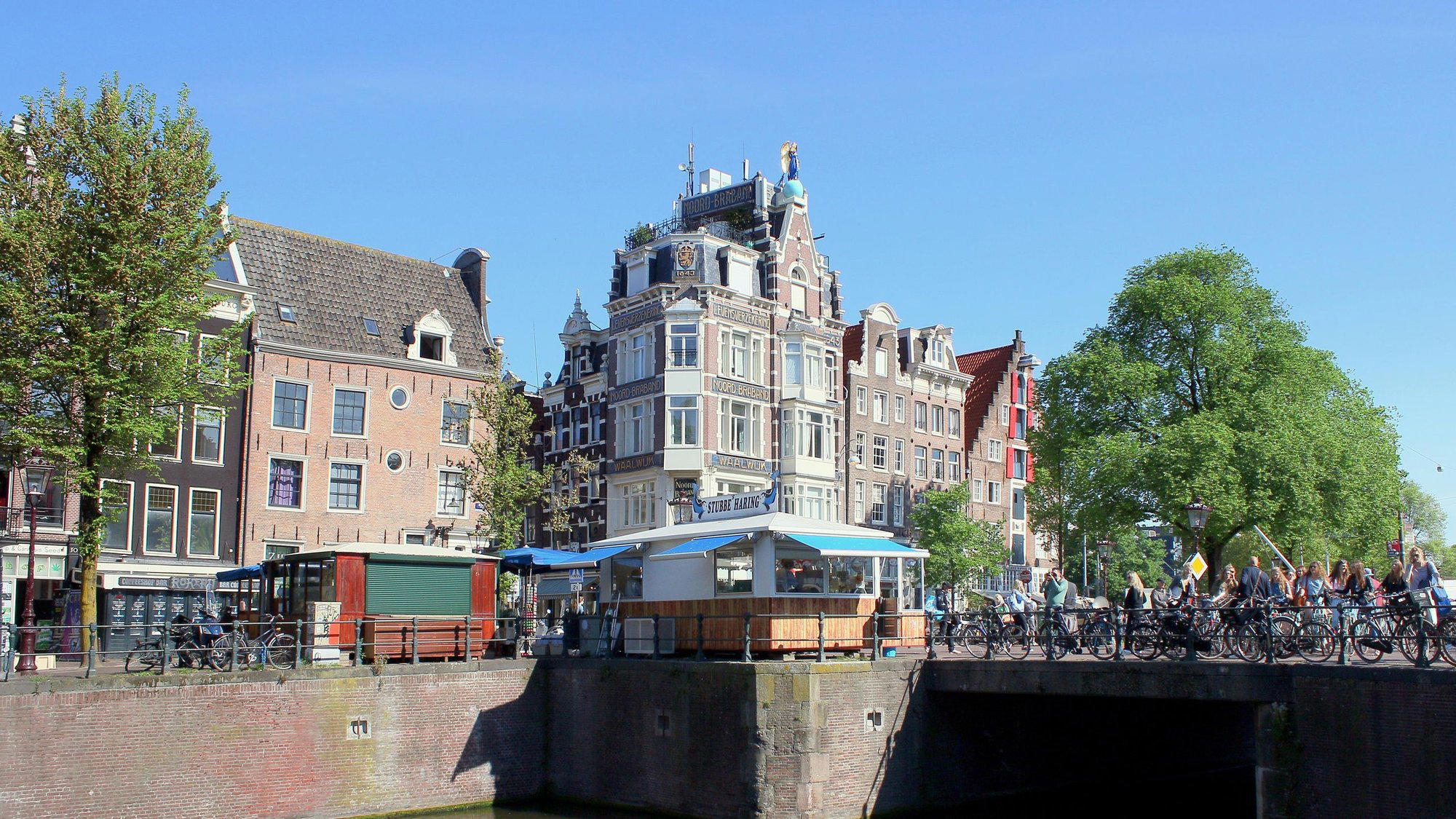
The Singel canal in central Amsterdam carries a particular kind of foot traffic: tourists crossing between the old city and the Jordaan, locals cutting through on bicycles, delivery riders threading between tram stops. At number 8n, almost flush with the water, a small white-tiled counter interrupts the canal wall. There are no seats. There is no awning to speak of. What there is, at Stubbe's Haring, is a glass case of Atlantic herring and a transaction that has been taking place here in some form for well over a century.
That physical container, the stall itself, deserves attention before anything else, because it shapes everything about how you eat here. The design imposes a specific social geometry: customers queue along the towpath, a step from the canal edge, and receive their fish at shoulder height across a narrow ledge. Nothing about the space encourages lingering beyond the time it takes to eat. That constraint is not a flaw. It is the whole point. Amsterdam's haringhandel tradition was built around exactly this kind of minimal infrastructure: a counter, a knife, and a supply chain that runs from the North Sea to the city within days of the catch. The stall form enforces the values of the food.
The Physical Logic of the Haringhandel
Dutch herring stalls occupy a specific category in the city's food infrastructure, distinct from both casual street food and sit-down dining. They are a holdover from a pre-restaurant urban food economy, when working canal districts required fast, high-protein food at low cost. The counter format at Stubbe's Haring is consistent with that lineage: white tile, stainless steel, glass refrigeration visible from the street, nothing obscured or theatrical. The stall's position on the Singel places it at the meeting point of several pedestrian currents, which means the queue is nearly always present during trading hours, particularly from late spring into summer when tourist volumes peak across the canal ring.
The space itself communicates clearly: this is a specialist operation with a single discipline. Compared to Amsterdam's higher register of dining, the creative tasting menus at Ciel Bleu, the contemporary Dutch ambition at Flore, or the precise kitchen work at Spectrum, Stubbe's Haring operates at the opposite end of both price and formality, without any sacrifice in seriousness. The fish is the argument. The stall is simply where the argument is made.
What Stubbe's Haring Is Famous For
The central product is Hollandse Nieuwe, the raw herring that arrives in Dutch waters from late May and is sold through summer under a protected designation. To qualify as Hollandse Nieuwe, the fish must be caught young, when fat content runs high, and processed quickly, typically gutted and partially cured at sea before sale. The result is soft, slightly sweet flesh with none of the sharpness associated with older preserved herring. The Dutch method of eating it, head tilted back, fish held by the tail, swallowed in sections, is a public performance the city has been staging for several hundred years. A more locally pragmatic variation involves chopping the fish and serving it on a small roll with raw onion and pickled gherkin, which is how most visitors approach it. Both formats are available at the counter.
At the broader level of Dutch food culture, the haringhandel sits alongside traditions like raw oysters at the Zeeland markets or aged gouda from specialist kaashandels, foods where the quality of sourcing and handling matters enormously but the preparation is deliberately minimal. Stubbe's Haring positions itself within that framework: the credibility of the stall rests on supply chain and craft, not culinary elaboration. For context on how that same philosophy plays out in more formal Dutch kitchens, the tasting menu at Vinkeles or the seafood-forward approach at Bistro de la Mer each reflect different expressions of the same Dutch instinct toward product quality over technique showmanship.
Amsterdam and the Street Food Tier
Amsterdam's street food scene operates in clearly defined tiers. The haringhandels sit at the most democratic level: low barrier to entry, no reservation, low price point, and deep historical legitimacy. This is not the same tier as the city's creative fine dining, nor the growing crop of international street food operators that have populated the Foodhallen and similar markets. The haringhandel is older and narrower than both, and Stubbe's occupies one of the more established addresses in that category on the Singel. For visitors who have been working through the full Amsterdam restaurants guide, Stubbe's Haring represents a different register entirely, not a counterpoint to fine dining, but a parallel system that has been running independently for longer.
The Netherlands has produced a number of kitchens that command serious international attention: De Librije in Zwolle, Inter Scaldes in Kruiningen, the plant-focused programme at De Nieuwe Winkel in Nijmegen, and a cluster of regional operators like De Lindenhof in Giethoorn, Tribeca in Heeze, De Groene Lantaarn in Staphorst, Brut172 in Reijmerstok, De Lindehof in Nuenen, De Bokkedoorns in Overveen, and De Treeswijkhoeve in Waalre. None of these share a category with Stubbe's Haring. They are useful comparators only in the sense that the haringhandel tradition represents the bedrock level of Dutch food culture from which those more complex kitchens have grown. Internationally, the closest structural parallel might be the raw bar counter format at Le Bernardin in New York City, not in price or format, obviously, but in the shared insistence that the quality of raw seafood sourcing is the only argument worth having, or the communal, fixed-format eating experience at Lazy Bear in San Francisco, where the physical container disciplines the experience in its own way.
Planning Your Visit
Stubbe's Haring at Singel 8n requires no reservation and no dress consideration, the transaction happens at the counter, outdoors, and is over in minutes. Timing matters primarily in terms of crowd management: the stall draws significant foot traffic from late morning into the early afternoon on weekdays, and queues run longer on weekends throughout the summer months. The Hollandse Nieuwe season runs from late May to early summer, so visiting during that window gives access to the season's first catch, which carries the highest fat content and the shortest time from sea to counter. The stall is located in the western section of the canal ring, walkable from most of the central city's major hotel concentrations and easily combined with a pass through the Jordaan district.
Continue exploring
More in Amsterdam
Restaurants in Amsterdam
Browse all →
Bars in Amsterdam
Browse all →
Hotels in Amsterdam
Browse all →
Wineries in Amsterdam
Browse all →
At a Glance
- Classic
- Well Known
- Casual Hangout
- Waterfront
- Historic Building
- Local Sourcing
- Waterfront
- Street Scene
Current opening hours
- Monday
- Closed
- Tuesday
- 10 AM–6 PM
- Wednesday
- 10 AM–6 PM
- Thursday
- 10 AM–6 PM
- Friday
- 10 AM–6 PM
- Saturday
- 10 AM–6 PM
- Sunday
- Closed
Hours can change for holidays and private events. Last verified .
Casual outdoor canal-side herring stand with a bustling, traditional street food atmosphere.
Know Before You Go
- Getting there
- Singel 8n, 1013 GA Amsterdam, Netherlands