
Michelin Plate
Our verdict
A Michelin Plate-recognised Korean address on a quiet Left Bank street, Sétopa brings the communal rituals of Korean grilling to the 6th arrondissement. Holding the Michelin Plate in both 2024 and 2025, it sits among a small cohort of Korean restaurants reshaping how Paris approaches East Asian dining at the table-grill format.

Pearl is the En Primeur Club membership app, where members save venues, book tables and use the concierge.
The menu
What to order
- Oyster ravioli
- Tofu root
- Chestnut and mugwort mochi
- Sétopa chicken
- Fermented yellow soybean crème brûlée
Korean Grilling Finds a Home in the 6th
Paris absorbed Japanese, Vietnamese, and Chinese cooking into its restaurant vocabulary decades ago, but Korean cuisine arrived more slowly and, when it did, concentrated first in the 13th arrondissement's Quartier Asiatique. The Left Bank's 6th arrondissement is a different proposition: a neighbourhood of literary cafés, legal booksellers on the Seine, and restaurants that tend toward the classic. That Sétopa has held a Michelin Plate in consecutive years, 2024 and 2025, while operating a Korean format on Rue Dupuytren says something about how the city's appetite for Korean cooking has broadened beyond its traditional geography.
The Michelin Plate, often misread as a consolation category, is in practice a quality signal from the same guide that awards stars to Mirazur in Menton, Troisgros in Ouches, and Flocons de Sel in Megève. It denotes cooking of sufficient quality to warrant inclusion, placing Sétopa in recognised company that also includes Paul Bocuse's Auberge du Pont de Collonges, Bras in Laguiole, and Auberge de l'Ill in Illhaeusern at higher tiers. For a Korean restaurant operating at the €€ price point in a neighbourhood that defaults to French, retaining that recognition two years running is a meaningful data point.
The Ritual at the Table
Korean barbecue is one of the few international dining formats that puts the cook at the table rather than behind a kitchen pass. The tabletop grill is not background theatre; it is the mechanism through which a meal is built, paced, and shared. In Seoul, this format is taken with great seriousness: the cut of meat determines the heat, the timing, and the sequence in which it meets the grill. Restaurants like Mingles and Kwonsooksoo represent the high-craft end of Korean dining in Seoul, but the barbecue ritual exists across every price tier because the technique itself carries cultural weight independent of cost.
That ritual travels intact when the format is executed with attention. The wrapping technique, placing grilled meat, fermented paste, sliced garlic, and occasionally raw chilli into a leaf of perilla or lettuce, compresses several flavour registers into a single bite. The balance of char from the grill, salt from the doenjang or gochujang, and freshness from the leaf is not accidental; it is a structure that Korean cooks have refined over generations. At a Michelin-acknowledged address at the €€ tier, the expectation is that this structure arrives coherent rather than approximated.
The communal dimension of the grill is equally deliberate. Korean barbecue is designed for groups: the shared cook, the rotating side dishes (banchan), and the back-and-forth of who tends the grill are all part of the format's social grammar. A solo diner at a tabletop grill is a category error; this is food that makes sense in the company of others, and the room at Rue Dupuytren is sized accordingly for that kind of table dynamic.
Where Sétopa Sits Among Paris's Korean Addresses
Paris has developed a small but increasingly coherent Korean dining scene across multiple price points and formats. Jium and Kwon represent one end of the range, while La Table de Mee, Mandoobar, and Mojju each anchor distinct sub-formats, dumplings, home-style cooking, and tasting-menu interpretations respectively. Sétopa's position within this field is defined partly by geography (the 6th rather than the 13th or 15th), partly by its Michelin recognition, and partly by its price point, which keeps it accessible to a broader audience than the higher-end Korean tasting counters.
New openings in Paris frequently accumulate early reviews that inflate ratings; a score that holds at 4.6 after 158 evaluations suggests the kitchen is producing reliably rather than trading on an opening moment. That consistency matters in a city where Korean cooking now has enough representation for diners to compare notes between addresses.
The comparison set for Sétopa within Paris is not the grand French tables, Flocons de Sel, L'Ambroisie, or Le Cinq, which operate in an entirely different register and price tier. The relevant peer group is the cluster of mid-range Korean and East Asian specialists with Michelin recognition, where the question is not whether the food is technically refined but whether the format is executed with understanding and the sourcing reflects the dish's requirements.
The Left Bank Address
Rue Dupuytren is a short street in the 6th arrondissement, close to the Odéon theatre district and within reach of the Luxembourg Gardens. The neighbourhood's density of bookshops, law schools, and older brasseries gives it a different energy from the tourist-facing stretches of Saint-Germain. A Korean grill in this context is not a curiosity filing into an Asian food district; it is a standalone address that earns its clientele on the quality of what it serves rather than the comfort of proximity to other Korean restaurants.
For visitors staying on or near the Left Bank, the logistics favour a visit over the cross-city journey to the 13th. For Parisians, the address is established enough, two Michelin Plates, a stable rating, to treat as a reliable option rather than a speculative one. The €€ price range makes it practical for a mid-week dinner as well as a dedicated evening.
Same-City Peers
| Venue | Cuisine | Price | Awards | Notes |
|---|---|---|---|---|
| SétopaThis venue (the venue you are viewing) | Modern Korean Gastronomy | $50–100 | Michelin Plate | Not listed |
| Alléno Paris au Pavillon Ledoyen | Modern French Fine Dining | $150–200 | 3 Michelin Stars · World's 50 Best #79 | Creative |
| Kei | Modern French with Japanese Influences | $300–500 | 3 Michelin Stars · World's 50 Best #93 | Contemporary French, Modern Cuisine |
| L'Ambroisie | Classic French Haute Cuisine | $300–500 | 2 Michelin Stars · World's 50 Best #23 | French, Classic Cuisine |
| Le Cinq - Four Seasons Hôtel George V | Modern French Fine Dining | $300–500 | 3 Michelin Stars · World's 50 Best #24 | French, Modern Cuisine |
| Plénitude | Modern French Sauce-Led Fine Dining | $300–500 | 3 Michelin Stars · World's 50 Best #14 | Contemporary French |
Recognition history
Dated appearances from independent guides and award organizations, with the underlying list record or original source where available.
Michelin Plate
Michelin
Full recognition history (3 entries)
Michelin Plate
Michelin
Michelin Plate
Michelin
Continue exploring
More in Paris
Restaurants in Paris
All restaurants in Paris →
Bars in Paris
All bars in Paris →



Details
- Intimate
- Elegant
- Sophisticated
- Modern
- Quiet
- Date Night
- Special Occasion
- Business Dinner
- Open Kitchen
- Standalone
- Design Destination
- Sommelier Led
- Tasting Menu
- A La Carte
- Set Menu
- Wine Pairings
- Non Alcoholic Infusions
- Soju
- Asian Inspired Cocktails
- Vegetarian Friendly
- Allergy Accommodating
Current opening hours
- Monday
- 12–2:30 PM, 7–10:30 PM
- Tuesday
- 12–2:30 PM, 7–10:30 PM
- Wednesday
- 12–2:30 PM, 7–10:30 PM
- Thursday
- 12–2:30 PM, 7–10:30 PM
- Friday
- 12–2:30 PM, 7–10:30 PM
- Saturday
- 12–2:30 PM, 7–10:30 PM
- Sunday
- Closed
Hours can change for holidays and private events. Hours as of .
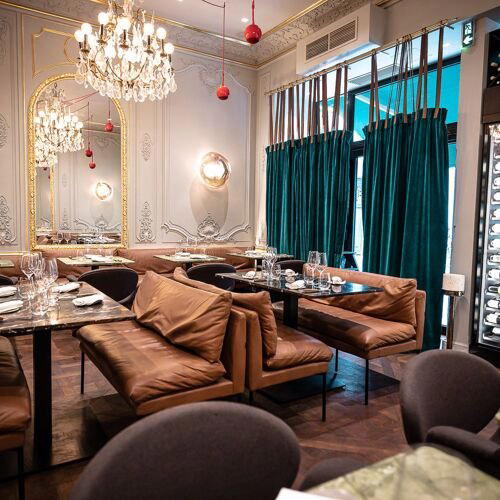
Serene and refined with natural woods, gentle dim lighting, cream-colored zellige tiles, and brown marble accents creating a quiet, meditative atmosphere.