St John





Open since 1994 in a converted Smithfield smokehouse, St John holds a Michelin star and spent a decade inside the World's 50 Best Restaurants. Fergus Henderson's nose-to-tail approach helped redirect British cooking away from continental imitation and toward its own larder. At £££, it sits well below London's formal tasting-menu tier while commanding equivalent critical authority.
Pearl is the En Primeur Club membership app — saves, bookings, and concierge access live there. Same editors, same standards.
- Address
- 26 St John St, Barbican, London EC1M 4AY, United Kingdom
- Phone
- +44 20 7251 0848
- Website
- stjohnrestaurant.com
- Directions
- Get directions
 Saves & bookings on Pearl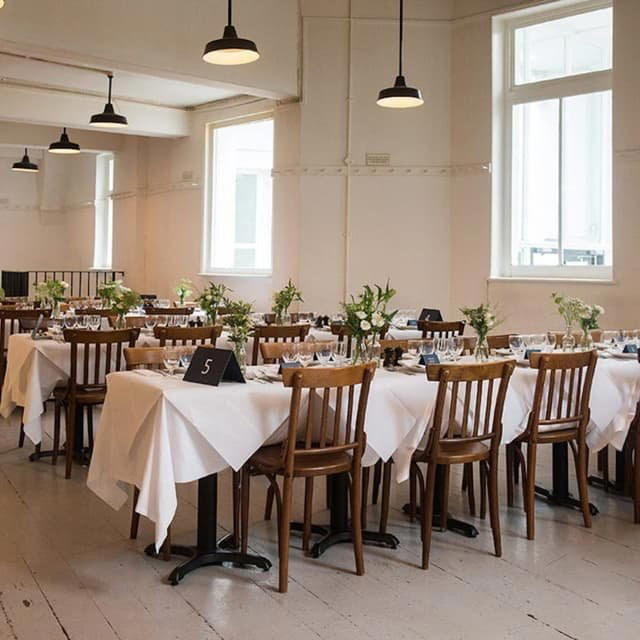
The Restaurant That Reframed British Cooking
St John is a one-Michelin-star restaurant in London, known for Traditional British Nose-to-Tail cooking. When St John opened at 26 St John Street in Clerkenwell in 1994, the dominant mode in ambitious British restaurants was still essentially French-inflected: classical technique, Continental references, the implicit assumption that native ingredients needed European framing to be taken seriously. What happened in that converted Smithfield smokehouse was something closer to a quiet act of cultural recalibration. By insisting that offal, secondary cuts, and unfashionable vegetables were not compromises but the actual point, St John helped establish the intellectual and aesthetic framework that later made British cooking a reference category for kitchens in New York, Copenhagen, and Sydney. The whitewashed walls and bare wood tables were not merely aesthetic choices; they were a declaration that the food did not need decoration to make its argument.
Three decades on, the restaurant holds a Michelin star and remains a fixture in the World's 50 Best at No. 10. Its World's 50 Best trajectory tells a particular story: entries from 2003 through to a peak of 10th place, a run that placed it alongside restaurants that had far larger production budgets and far more elaborate service formats. That positioning matters when you consider what the room actually looks like.
Clerkenwell, Smithfield, and the Address That Made Sense
The neighbourhood context is worth examining. Smithfield Market, the oldest meat market in London, operating on the same site since the 10th century, sits at the end of the street. The choice of address was not incidental. A restaurant committed to every part of the animal, run out of a building that once processed smoke-cured produce, in a neighbourhood defined by the trade in whole carcasses: the logic is explicit. Clerkenwell in the mid-1990s was still a working district rather than a cultural destination, which gave the restaurant a particular character. It was not opening into a scene; it was, in part, responsible for creating one.
For readers planning a London visit more broadly, the EC1 postcode also places St John within convenient reach of a cluster of serious eating, and it reads differently from the fine-dining corridor that runs through Mayfair and Chelsea, where Restaurant Gordon Ramsay, Sketch, The Lecture Room and Library, and CORE by Clare Smyth operate at ££££ price points with corresponding ceremony. The restaurant's £££ positioning, paired with its critical standing, represents a different proposition: authority without formality.
The Room as Third Place
The social function is an appropriate frame. The restaurant operates in a register closer to the French provincial bistro than to the destination restaurant, and that is entirely deliberate. Paper tablecloths rather than linen. One wine glass serving all purposes, water included. The room is long and undecorated in the manner of a canteen that has decided its only job is to hold people while they eat well. The effect, as critical writing about the restaurant consistently notes, is that eating there produces something closer to ease than occasion. There are dishes for two on the menu. There are magnums of wine. These are not incidental details; they describe a social structure that assumes you will be staying and talking rather than moving efficiently through a tasting sequence.
This is a less common proposition in London's serious restaurant tier than it might appear. The Michelin-starred end of the market trends toward formats built around individual progression: chef's counter, tasting menu, the meal as curated experience. The restaurant's room supports something more like a public house in its traditional function, the gathering of people who want to eat and drink without the architecture of the evening being managed for them. The warm madeleines sent with departing guests are the closest the operation comes to a parting gesture, and they arrive in a bag, for the journey home.
Nose-to-Tail at the Table: What the Menu Argues
The phrase "nose-to-tail" is now used broadly enough to have lost some of its original force, but the menu at the restaurant is a reminder of what it meant in practice. Bone marrow with parsley salad remains the signature; it is also, structurally, a provocation. The dish offers nothing by way of visual complexity. It asks the diner to do the work, to spread and season and eat without intermediary technique making the argument on behalf of the ingredient. That the dish has remained on the menu for thirty years while tasting menus at peer-set restaurants have cycled through dozens of signatures says something about the kind of confidence involved.
Seasonality is built into even the permanent fixtures. Potatoes and greens appear consistently, but the varieties shift with supply. A dish from the restaurant's 2007 cookbook, kohlrabi mandolined with olive oil, lemon, capers, and chervil, appeared on the daily menu when reviewed recently, at a price point that reflects 2025 London rather than 1994 Clerkenwell. The daily menu format means the kitchen retains discretion: wild boar terrine, mallard with parsnips and pickled walnut, sea bass with slow-cooked fennel in an anchovy-and-Pernod liquor. These are not dishes designed to photograph well. A food critic reviewing the restaurant noted that the sea bass arrived "battle-scarred from a hot pan" with fennel in a "state of near-collapse." The same critic noted the flavour was notable.
Fergus Henderson's name appears on this restaurant as chef, and his Kanesaka-equivalent lineage in the British context is the intellectual argument for nose-to-tail eating, codified, published, and now taught. But the editorial point is not about one person's philosophy; it is about what a restaurant committed to the whole animal did to the way British cooking understood its own ingredients over thirty years.
Where St John Sits in the London Picture
London's Michelin-starred field in 2024 includes restaurants that operate at sharply different price and format registers. At the ££££ end, The Ledbury and CORE by Clare Smyth represent modern European cooking with the full production apparatus of a destination restaurant. The restaurant, at £££ with a single star, sits in a tier that prioritises critical authority over ceremony. Its closest British peer outside London is a restaurant like Hand and Flowers in Marlow, which applies comparable anti-formalism to a different countryside setting, or the long-established Rules, which covers some of the same traditional British territory with a different service register.
For readers exploring British cooking beyond London, the starred field includes L'Enclume in Cartmel, Moor Hall in Aughton, and Gidleigh Park in Chagford, each of which represents a different regional expression of serious cooking. The Fat Duck in Bray and Le Manoir aux Quat' Saisons in Great Milton operate at higher price tiers with distinctly different kitchen philosophies. The restaurant's position in this field is consistent: it is the reference point for a particular strain of British cooking, not especially expensive or the technically complex, but the legible statement of what British ingredients can do when left largely to themselves. For those looking beyond British cooking and curious how the same absence of ceremony plays in other high-performing rooms internationally, Le Bernardin in New York City and Atomix in New York City offer contrasting models of how seriousness and format relate at the upper end of the market.
The wine list at the restaurant follows the same editorial logic as the food: a Parisian bistro model, structured around French regions with a house pour, the restaurant Rouge, acting as entry point into a broader selection. One wine glass for all purposes is less an eccentricity than a statement that the quality of what is in the glass matters more than the stemware presenting it.
Visiting St John
The restaurant opens Monday through Saturday from noon to 10:15 PM, and on Sundays from noon to 3:30 PM, making it one of the relatively rare Michelin-starred addresses in London with consistent lunch service across the week. The Sunday closing at 3:30 PM positions the Sunday lunch as its own format rather than a curtailed version of the dinner service. Given the critical attention the restaurant receives and the fact that it has held its place in the London conversation for thirty years, reservations should be secured in advance, particularly for weekend lunch. The address is 26 the restaurant Street, Barbican, EC1M 4AY.
- bone marrow with parsley salad
- deep fried rarebit
- devilled kidneys on toast
- roast pigeon
- pheasant and trotter pie
- madeleines
A Minimal comparable set
Comparable venues nearby, for context on price, style, and recognition.
| Venue | Cuisine | Price | Notes |
|---|---|---|---|
| St JohnThis venue — the venue you are viewing | British, Traditional British | $$$ | Not listed |
| Muse by Tom Aikens | Belgravia, Modern British Fine Dining | $$$$ | Not listed |
| KOL | Marble Arch, Modern Mexican Fine Dining | $$$$ | Not listed |
| Alain Ducasse at The Dorchester | Not listed | $$$$ | Mayfair, Contemporary French Haute Cuisine |
| Lyle's | Shoreditch, Dining | Not listed | Not listed |
| Hakkasan Mayfair | Mayfair, Modern Cantonese | $$$$ | Not listed |
Recognition history
Dated appearances from independent guides and award organizations, with the underlying list record or original source where available.
Michelin 1 Star
Michelin
National Restaurant Awards Top 100 #96 · No. 96
National Restaurant Awards · 2026 National Restaurant Awards Top 100
Opinionated About Dining Casual in Europe Ranked #132
Opinionated About Dining
Star Wine List
Star Wine List
Michelin 1 Star
Michelin
National Restaurant Awards Top 100 #99
National Restaurant Awards
The Good Food Guide GFG Very Good
The Good Food Guide
The Good Food Guide GFG Good
The Good Food Guide
Michelin 1 Star
Michelin
Opinionated About Dining Casual in Europe Ranked #304
Opinionated About Dining
Opinionated About Dining Casual in Europe Highly Recommended
Opinionated About Dining
World's 50 Best Best Restaurants #41
World's 50 Best
World's 50 Best Best Restaurants #43
World's 50 Best
World's 50 Best Best Restaurants #14
World's 50 Best
World's 50 Best Best Restaurants #16
World's 50 Best
World's 50 Best Best Restaurants #34
World's 50 Best
World's 50 Best Best Restaurants #35
World's 50 Best
World's 50 Best Best Restaurants #10
World's 50 Best
World's 50 Best Best Restaurants #16
World's 50 Best
World's 50 Best Best Restaurants #49
World's 50 Best
Continue exploring
More in London
Restaurants in London
Browse all →
Bars in London
Browse all →
Hotels in London
Browse all →


At a Glance
- Well Known
- Classic
- Sophisticated
- Rustic
- Group Dining
- Special Occasion
- Celebration
- Open Kitchen
- Historic Building
- Standalone
- Extensive Wine List
- Corkage Allowed
- Sustainable Seafood
- Local Sourcing
- Zero Waste
Current opening hours
- Monday
- 12–10:15 PM
- Tuesday
- 12–10:15 PM
- Wednesday
- 12–10:15 PM
- Thursday
- 12–10:15 PM
- Friday
- 12–10:15 PM
- Saturday
- 12–10:15 PM
- Sunday
- 12–3:30 PM
Hours can change for holidays and private events. Last verified .
Casual yet refined atmosphere with waiters in stark white butchers' garb; minimalist decor with chalkboard menus; warm lighting and intimate seating.