SHRI BARBARIK RESTAURANT CHITTORGARH - Rajasthani
Set within the walls of Chittorgarh Fort, Shri Barbarik Restaurant trades on one of Rajasthan's most charged settings: a working heritage village where Rajput history sits in the stonework above your head. The kitchen draws on the fort's desert-edge agricultural tradition, placing it inside a small cohort of dining experiences where provenance and place are genuinely inseparable.
 Discover on Pearl
Pearl is the En Primeur Club membership app — saves, bookings, and concierge access live there. Same editors, same standards.
- Address
- Inside Fort, near Ratan Singh Palace, Chittorgarh Fort Village, Chittorgarh, Rajasthan 312025, India
- Phone
- +917733967117
- Website
- chittorgarhrestaurant.com
Eating Inside a Living Fort
Chittorgarh Fort is not a museum. Roughly five thousand people live within its seven-kilometre perimeter, cultivating land that has been farmed under the same hot Rajasthani sky for centuries. Shri Barbarik Restaurant sits inside that inhabited heritage zone, near Ratan Singh Palace, which means the approach to a meal here involves passing through the same gate towers that Mughal armies once besieged. That context does not make the food taste different, but it does make the act of eating feel like participation in something with genuine historical weight rather than a curated approximation of it.
Restaurants located within active fort villages occupy a category that barely registers on India's broader fine-dining radar. The city-based critical conversation tends to orbit venues like Bukhara in New Delhi or Esphahan in Agra, where heritage is expressed through architecture and decoration rather than through a genuinely inhabited landscape. Shri Barbarik occupies a different position: the setting is not restored and presented, it is simply where the restaurant is, and the food that comes out of its kitchen reflects that less mediated relationship with place.
The Agricultural Logic Behind Rajasthani Cooking
Rajasthani cuisine is a direct answer to scarcity. The eastern Rajasthan plateau that surrounds Chittorgarh receives less than 650 millimetres of rainfall annually, which shapes what can be grown and therefore what ends up on a plate. The region's cooking tradition built itself around ingredients with long shelf lives and high caloric density: dried lentils, gram flour, dried chillies, and preserved dairy in the form of ghee and curd. Fresh vegetables were historically a luxury of season and geography, which is why the most architecturally complex dishes in the canon, like dal baati churma, are built from ingredients that can be stored rather than harvested fresh.
Understanding this agricultural history matters when reading a Rajasthani menu. The sourcing logic is not farm-to-table in the contemporary sense; it is something older and more constrained. Pulses tend to come from within the region. Ghee is typically produced locally rather than industrially. The chillies used, often the Mathania variety grown in nearby districts, carry a specific heat profile that mass-produced substitutes do not replicate. Venues operating in this tradition, in or near the fort, are drawing from that shorter, older supply chain. That proximity is not a marketing position; it is a practical consequence of location. For comparison, restaurants like Farmlore in Bangalore have made regional ingredient provenance an explicit statement, with sourcing from specific farms. The Chittorgarh fort-village context achieves something similar through geography alone, even without formalised sourcing language.
What the Kitchen Is Working With
Rajasthani restaurant cooking in this register typically anchors around a core set of preparations that have survived precisely because they encode the region's ingredient logic. Dal baati churma, the flagship dish of the cuisine, involves hard wheat dough baked in a clay oven, served with a spiced lentil preparation and a sweetened crushed wheat mixture, all brought together with generous volumes of ghee. The dish is calorie-dense and deeply regional, and its presence on a menu within Chittorgarh Fort carries a different weight than the same dish served at a Rajasthani-themed restaurant in a Delhi hotel lobby.
Gatte ki sabzi, gram flour dumplings simmered in a yoghurt-based gravy, represents another pillar of the tradition. The sourcing of the curd matters here: locally produced, full-fat dairy behaves differently from homogenised commercial product, both in texture and in the tang it brings to the sauce. Similarly, ker sangri, a preparation built around dried desert berries and beans, is specific enough to eastern Rajasthan that its quality varies enormously depending on whether the dried ingredients are sourced locally or industrially processed. Restaurants in Chittorgarh with direct access to regional producers are working with a different raw material than venues that import a Rajasthani aesthetic without the supply chain to support it. For context on how regional specificity can anchor a restaurant's identity, the approach taken by Naar in Kasauli, which draws on Himachali mountain-food traditions, shows how a strong geographic identity can function as the entire editorial premise.
The Setting as Practical Information
The address, inside the fort near Ratan Singh Palace, places Shri Barbarik within the upper reaches of the fort complex. Visitors arriving by road should account for the time required to ascend through the fort gates and locate the restaurant within what is an active residential and agricultural settlement rather than a signposted tourist circuit. The fort covers approximately seven hundred hectares, and orientation within it requires either a local guide or advance research into the specific palace landmark. The nearest town centre, Chittorgarh city, sits at the base of the fort plateau. Morning and early afternoon visits tend to coincide with fewer tourist groups; the fort draws significant day-trip traffic from Udaipur, roughly one hundred and twelve kilometres to the southwest.
Arriving without a reservation is the expected approach.
Where This Fits in the Wider Indian Context
India's premium restaurant conversation has consolidated around a handful of cities. The venues that receive sustained critical attention, from Americano in Mumbai to Le Cirque Delhi in Delhi, operate with formal kitchen brigades, documented sourcing programmes, and the editorial infrastructure that comes with metropolitan attention. Against that backdrop, a restaurant within a living Rajput fort represents something the metropolitan circuit cannot easily replicate: an absence of the performance of regionalism, because the region is simply present.
That is not a claim about quality in the technical kitchen sense. It is a claim about authenticity of context, which is a different and arguably harder thing to manufacture. The comparison is not with Atomix in New York City or Le Bernardin in New York City; those operate in entirely different registers of ambition and infrastructure. The relevant comparable set is the small category of Indian restaurants where the setting is not a frame for the food but a determinant of it. Other venues across India are finding their own versions of this formula: Leela Kerala Terrace in Trivandrum grounds its identity in regional specificity, as does Harvest Kitchen Somnath in Veraval. The Chittorgarh fort context simply applies that principle at an unusually concentrated geographic intensity.
For travellers whose India itinerary already includes heritage-fort destinations like Dragon in Orchha or vegetarian-focused regional cooking as seen at Dadi Ki Rasoi in Budaun, Shri Barbarik adds a further data point: a Rajasthani kitchen whose entire context is the fort above the city rather than the city below it.
Side-by-Side Snapshot
Comparable venues nearby, for context on price, style, and recognition.
| Venue | Cuisine | Price | Awards | Notes |
|---|---|---|---|---|
| SHRI BARBARIK RESTAURANT CHITTORGARH - RajasthaniThis venue — the venue you are viewing | Authentic Rajasthani | $$ | , | |
| The Pavillion | Indian, Chinese & Continental | $$ | , | Rajpur Road |
| Dilli StreEAT | Indian Street Food | $$ | , | Indira Gandhi International Airport |
| 5868 Restaurant | Pure Vegetarian Multicuisine Fine Dining | $$ | , | Adalaj |
| Swirl | Indian Pure Vegetarian | $$ | , | Vrindavan |
| Chandni | Traditional Indian Fine Dining | $$$$ | , | Lake Pichola waterfront |
At a Glance
- Cozy
- Rustic
- Historic
- Family
- Casual Hangout
- Historic Building
- Street Scene
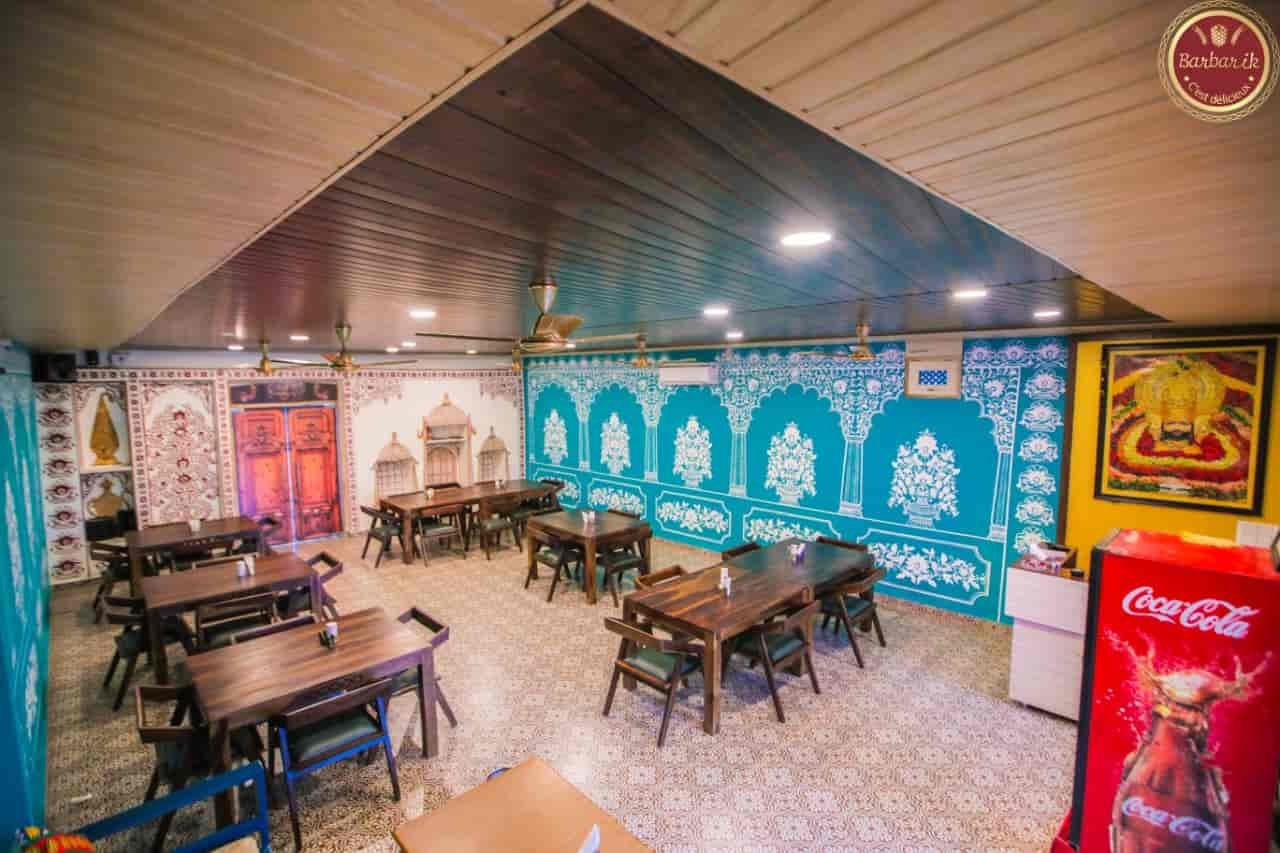
Cozy with local paintings on bright blue walls, spacious dining area, and clean facilities.