
Tabelog 100 #96
Our verdict
Sumibiyakitori Coquelet is a compact Fukushima-ku yakitori address for diners who care about charcoal work, counter pacing, and a drink list that treats sake and wine as part of the meal rather than an afterthought. Its repeated selection for Tabelog’s Yakitori 100 in West Japan places it in a serious regional conversation, while the scale keeps the experience closer to neighbourhood craft than luxury theatre.

Pearl is the En Primeur Club membership app, where members save venues, book tables and use the concierge.
The menu
What to order
- Assorted skewers
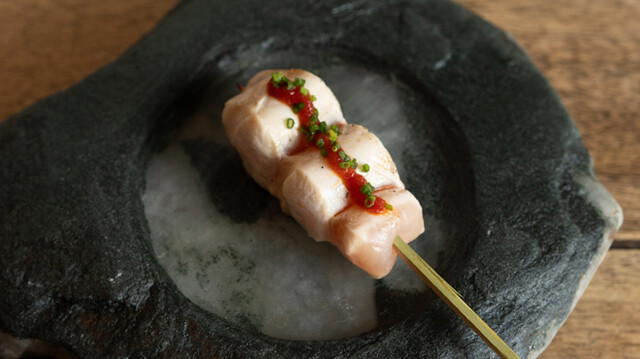
- Momo Meat Tataki
- Heart marinated in Shaoxing wine
Fukushima’s appeal is not grand-avenue dining. It is the tighter urban rhythm of Fukushima itself: railway edges, narrow side streets, small rooms, and restaurants built around one discipline done with conviction. In that setting, yakitori has an advantage. The format rewards proximity, timing, and ingredient handling, because the diner can read the cooking from close range: skewers moving over charcoal, heat adjusted by hand, drinks poured to match smoke, salt, fat, and tare.
Sumibiyakitori Coquelet belongs to that compact Fukushima genre rather than the ceremonial tasting-menu tier. The restaurant is listed for yakitori, and its published dinner band is JPY 5,000 to JPY 5,999. That matters editorially. In a neighbourhood where Oshima, Evoluer, and Cuisine Française Liaison give diners other reasons to plan ahead, this address occupies its own lane: ingredient-focused charcoal cooking without the financial posture of a long-form dégustation.
Charcoal yakitori as an ingredient test, not a luxury costume
Yakitori is often misread outside Japan as casual drinking food. In Fukushima, the serious versions are more demanding than that description allows. The craft depends on sourcing, portioning, seasoning, and heat control across cuts that behave differently over fire. Chicken, vegetables, salt, tare, and charcoal each ask for another pace; the room’s small scale is not decoration, it is a working condition that helps keep those decisions visible.
The restaurant’s recognition from Tabelog Hyakumeiten in 2025 gives the address a measurable trust signal in a category where visitors often need help separating everyday skewers from destination-calibre specialists. The listed Tabelog score of 3.66 also places it in a competitive local context, where ratings tend to move cautiously and category depth is high. None of that makes the meal formal. It simply signals that the cooking has been judged against a serious field.
The sourcing angle is important because yakitori exposes weak product quickly. Charcoal can amplify character, but it cannot disguise poor handling for long. A compact format narrows the distance between prep and service; it also places pressure on the restaurant to manage stock carefully. That is why the better yakitori rooms in Fukushima often feel more exacting than their prices suggest. Diners are paying for judgment: what to skewer, what to season lightly, what to push closer to the coals, what to hold back.
Drink structure can support that style. Contemporary yakitori has broadened beyond simple beer-and-highball convention, and the best pairings tend to respect salt, tare, smoke, and poultry fat rather than overwhelm them. Sake remains natural with grilled chicken, while wine can work when the grill leans into bitterness and texture. The point is not fusion; it is a pragmatic shift in how small Japanese rooms frame yakitori for diners who order across categories.
Fukushima's small-room advantage
Fukushima has become one of Osaka’s more rewarding dining areas precisely because it does not behave like a single-theme food quarter. Specialist Japanese formats and other local dining sit within a walkable urban rhythm, giving the area a layered, after-work character. For a broader look at the district, start with Our full Fukushima restaurants guide, then compare the way Sumibiyakitori Coquelet fits among other Fukushima dining rooms without treating the neighbourhood as one fixed genre.
That mix changes the way a yakitori counter reads. In more status-conscious dining zones, a small grill room can become a performance of occasion. In Fukushima, it tends to feel more embedded in the neighbourhood’s nightly circuit. Sumibiyakitori Coquelet benefits from that context: its appeal is not scale, spectacle, or chef mythology, but a disciplined charcoal format in a district that understands small specialist rooms. The grill-led setup reinforces the point. This is a meal built around the cooking, not around separation from it.
The comparison with Fukushima’s other recognised addresses is useful for planning expectations. Oshima, Evoluer, and Cuisine Française Liaison sit in the same broader dining map but serve different occasions. Yakitori at this level is more direct. It gives experienced diners access to craft without asking them to commit to the cost structure or formality often associated with a long tasting-menu format.
Who should choose this counter
This is the right call for diners who want Fukushima at close range: charcoal, sake or wine, and a room where timing matters. It is less suited to groups looking for privacy or a sprawling menu across unrelated categories. The experience is naturally focused, so the sensible approach is to treat it like a planned dinner rather than a casual fallback.
There is also a useful value argument. In a city where premium dining can climb quickly, serious yakitori in the JPY 5,000 to JPY 5,999 band remains one of Japan’s smarter formats for ingredient-led dining. The cooking is exposed, the pacing is immediate, and the difference between competent and compelling is visible from close range. That is why Tabelog Hyakumeiten recognition carries weight here: it identifies strength in a genre where the details are small but unforgiving.
For travellers building a wider Japan dining map, the contrast is instructive. Compare Sumibiyakitori Coquelet with other charcoal and grill formats elsewhere in Japan, or shift into other casual-specialist formats across the country and beyond. For non-restaurant planning around the same city page structure, see Our full Fukushima hotels guide, Our full Fukushima bars guide, Our full Fukushima wineries guide, and Our full Fukushima experiences guide.
Frequently asked questions
Where is Sumibiyakitori Coquelet in Fukushima?
Fukushima.
How much does it cost to eat at Sumibiyakitori Coquelet?
Pricing at Sumibiyakitori Coquelet is listed as JPY 5,000 - JPY 5,999.
Can I walk in to Sumibiyakitori Coquelet?
Given the focused yakitori format, it is sensible to check directly with the restaurant before planning around a visit.
What has Sumibiyakitori Coquelet built its reputation on?
Its case rests on charcoal-grilled yakitori and recognition from Tabelog Hyakumeiten in 2025. The price range sits at JPY 5,000–JPY 5,999, which places it in an accessible yakitori bracket rather than a formal tasting-menu tier.
In Context: Similar Options
Nearby venues at a similar price tier for orientation.
| Venue | Cuisine | Price | Awards | Notes |
|---|---|---|---|---|
| Sumibiyakitori CoqueletThis venue (the venue you are viewing) | Modern Yakitori Izakaya | $30–50 | Tabelog 100 #96 | Not listed |
| Spice Curry Tairiku | Osaka-style spice curry | $10–20 | Tabelog 100 #45 | Fukushima |
| Ramen Kozou | Rich Tonkotsu Ramen | $10–20 | Tabelog 100 #33 | Fukushima |
| Shoppe Shoppe | Japanese Ramen | $10–20 | Tabelog 100 #11 | Fukushima |
| Mitsuboshi Seimenjo Fukushima honten | Ramen & Tsukemen Shop | $1–10 | Tabelog 100 #25 | Fukushima-ku |
| KANNOSUKE | Yoshoku (Japanese-style Western cuisine) & Hamburg steak | $10–20 | Tabelog 100 #76 | Fukushima |
Recognition history
Dated appearances from independent guides and award organizations, with the underlying list record or original source where available.
Tabelog 100 #96 · No. 96
Tabelog · Tabelog 100 - Yakitori - WEST - 2025
Continue exploring
More in Fukushima
Restaurants in Fukushima
All restaurants in Fukushima →




Bars in Fukushima
Browse all →



Hotels in Fukushima
Browse all →



Wineries in Fukushima
Browse all →
Details
- Cozy
- Intimate
- Sophisticated
- Modern
- Date Night
- Group Dining
- Solo
- Casual Hangout
- Special Occasion
- After Work
- Chefs Counter
- Historic Building
- Standalone
- Sake Program
- Natural Wine
- Natural Wine
- A La Carte
- Counter Dining
- Sake
- Wine
- Natural Wine
A stylish, renovated traditional house with a spacious, high-ceiling interior that feels like a low-profile address for relaxed small-group dining.