
Tabelog 100 #73
Our verdict
Kyoto curry has a quieter register than its temple-district dining clichés suggest: small rooms, careful pacing, and a loyal local audience. Shinrin Shokudo belongs to that register, with Tabelog Curry WEST “Tabelog 100” recognition in 2024 and a compact house-restaurant format near Nijo that rewards diners who treat curry as a sit-down ritual rather than a quick refuel.

Pearl is the En Primeur Club membership app, where members save venues, book tables and use the concierge.
The menu
What to order
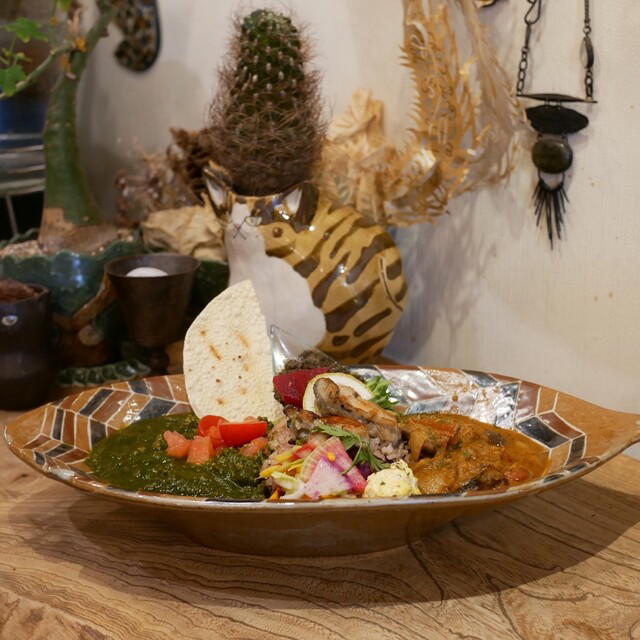
- Forest Curry
- Special Keema Spinach Curry
Approach this Kyoto curry restaurant with the expectations of a focused dining stop, not as a generic fast lunch fallback. The pace should be left to the venue, the category is clear, and the meal has etiquette: arrive ready to wait for the kitchen’s rhythm, settle into the experience, and let curry be the main event rather than a side note between shrines. Shinrin Shokudo fits a useful Kyoto pattern: specific, locally grounded, and closer to everyday Kyoto dining than anonymous station-front turnover.
That distinction matters in a city often reduced by visitors to kaiseki, tofu, sweets, and matcha. Kyoto’s curry culture sits in another lane: less ceremonial than kaiseki and less snack-driven than market eating, but still attentive to pacing. In restaurants like this, timing, payment habits, and seating style can shape the meal as much as the plate. Tabelog’s Curry recognition in 2024 places Shinrin Shokudo within a wider curry conversation rather than merely a local address, and its 3.85 score is a useful signal in a category where repeat local opinion carries weight.
Kyoto curry as a sit-down ritual, not a station snack
Japanese curry is often treated abroad as comfort food with one profile: thick sauce, rice, quick service. Kyoto complicates that. The city supports restaurants where curry can absorb home cooking, spice-shop culture, café dining, and izakaya habits without becoming a formal tasting menu. The ritual is not chef theatre, but the choreography of a focused meal: how diners arrive, how tables turn, what can be shared, and whether the experience feels rushed or allowed to hold its place in the day.
Shinrin Shokudo’s inclusion in 2024 Tabelog curry recognition suggests relevance in a field where trend-led curry shops can flare and fade. The useful comparison is not Kyoto’s most formal Japanese dining but casual restaurants with serious followings. Around the city, a traveller might read other Kyoto dining rooms as expressions of everyday appetite: convenient, specific, and judged by regulars as much as visitors. Curry belongs on that practical map, but with a table rhythm that deserves attention.
Kyoto changes the frame. This is not only the polished restaurant world of central hotel dining, nor only the dense tourist flow around the temples. Kyoto dining rewards people already moving through the city’s cafés, bakeries, and local restaurants. Reference points such as coneruya and panscape Nijou ekimae ten point to that daily-use city texture, while larger Kyoto dining itineraries may pull in contrasting rooms such as 大鵬, Ryori Rihaku, or Taiho. Curry here is not an alternative to Kyoto dining culture; it is part of the city’s less formal dining grammar.
The room style shapes the meal as much as the curry
Focused dining in Japan changes behaviour. A restaurant with a clear category identity does not function like a large casual hall. It rewards smaller parties, clear timing, and willingness to let the venue’s pace dictate the meal. Seating formats and service flow can matter, especially for solo diners, pairs, or friends planning around a specific stop rather than treating the restaurant as a quick backup.
Payment and logistics are part of the ritual in Japanese restaurants, where habits can differ from larger hospitality settings. The practical lesson is simple: arrive prepared, do not assume every modern payment method or seating preference will be available, and treat the restaurant’s operating style as part of the experience. That detail is often the difference between a smooth meal and an awkward end. Curry specialists can feel highly focused, but Shinrin Shokudo’s appeal is broader than a purely specialist stop.
The price band places lunch at JPY 2,000 to JPY 2,999 and dinner at JPY 4,000 to JPY 4,999. This is not convenience curry framed only by speed. It occupies the tier where diners can expect a meal worth planning around, enough structure to justify the spend, and a setting that can carry conversation. In Kyoto terms, it is an intelligent counterweight to formal meals: a restaurant for the day when precision matters but ceremony does not.
How to place it in a Kyoto itinerary
For travellers building a food-led Kyoto trip, the sharper move is not treating curry as filler between reservations. Pairing a Kyoto curry meal with broader city coverage in Our full Kyoto restaurants guide gives a more balanced picture of how the city eats beyond the shorthand of kaiseki and wagashi. The same applies across categories: Our full Kyoto hotels guide, Our full Kyoto bars guide, Our full Kyoto wineries guide, and Our full Kyoto experiences guide help separate city logistics from pure appetite.
Kyoto also benefits from lateral eating. A curry meal can sit alongside other Kyoto dining rooms, confectionery customs, or a longer Japan itinerary that moves between different cities and everyday formats. For readers tracking Japanese drinking and casual food culture abroad, similar everyday formats show how simple rituals travel and mutate outside Japan. The point is not to flatten everything into one category, but to notice how a curry restaurant can carry as much local meaning as a more obviously formal reservation.
The reason to prioritise Shinrin Shokudo is not spectacle. It is the discipline of a Kyoto curry meal with recognition, a clear category identity, and city grounding to justify planning around it. In a city where visitors chase formality, this is the quieter correction: curry treated seriously, eaten at the venue’s pace, and understood as part of Kyoto’s daily dining intelligence.
Frequently asked questions
What part of town is Shinrin Shokudo in?
Kyoto.
Is Shinrin Shokudo more mid-range or high-end?
Pricing at Shinrin Shokudo is listed as JPY 4,000 - JPY 4,999 JPY 2,000 - JPY 2,999 View spending breakdown.
How hard is it to get a table at Shinrin Shokudo?
Availability should be treated as part of the planning. The 2024 Tabelog curry recognition suggests steady interest rather than a venue to treat as an afterthought.
What is Shinrin Shokudo known for?
Shinrin Shokudo is known as a Kyoto curry restaurant, with Tabelog curry recognition in 2024 and a listed score of 3.85.
Cuisine-First Comparison
Comparable venues by cuisine and price in the same metro.
| Venue | Cuisine | Price | Awards | Notes |
|---|---|---|---|---|
| Shinrin ShokudoThis venue (the venue you are viewing) | Japanese curry house | $10–20 | Tabelog 100 #73 | Not listed |
| Aburi Mochi Honke Nemoto Kazariya | Traditional Kyoto Japanese sweets (Aburi Mochi) | $1–10 | Tabelog 100 #54 | Kita |
| Ichiwa Ichimonjiya Wasuke | Traditional Kyoto wagashi & aburi-mochi teahouse | $1–10 | Tabelog 100 #66 | Kita |
| Chuka Soba Takayasu | Kyoto tonkotsu ramen shop | $10–20 | Tabelog 100 #7 | Sakyō |
| Mogu Mogu Bakery | Tea-infused Japanese bakery | $1–10 | Tabelog 100 #78 | Uji |
| Kyoto Kuriya | Traditional Kyoto wagashi and chestnut sweets | Not listed | Tabelog 100 #59 | Nakagyō |
Recognition history
Dated appearances from independent guides and award organizations, with the underlying list record or original source where available.
Tabelog 100 #73 · No. 73
Tabelog · Tabelog 100 - Curry - WEST - 2024
Continue exploring
More in Kyoto
Restaurants in Kyoto
All restaurants in Kyoto →
Bars in Kyoto
All bars in Kyoto →

Hotels in Kyoto
All hotels in Kyoto →

Wineries in Kyoto
Browse all →
Details
- Cozy
- Rustic
- Solo
- Casual Hangout
- Family
- Group Dining
- Late Night
- Standalone
- Design Destination
- Private Dining
- A La Carte
- Counter Dining
- Sake
- Wine