
Saunsunda Hiroko gives Nagakute a focused West Javanese address rather than a generic Indonesian menu. Its Tabelog 100 selection for Asian and ethnic cuisine in EAST 2024, 12-seat scale, halal options, and health-conscious set-meal format make it a serious detour for travelers reading Aichi beyond Nagoya’s usual circuits.
Pearl is the En Primeur Club membership app — saves, bookings, and concierge access live there. Same editors, same standards.
- Address
- 愛知県長久手市北熊16
- Phone
- +81561582253
- Website
- facebook.com
 Saves & bookings on Pearl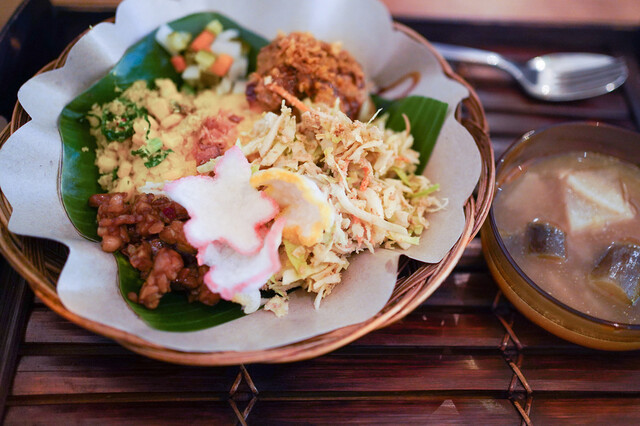
Approach Nagakute from the Linimo side and the dining map changes quickly: university edges, family roads, park traffic, and small independent rooms rather than dense station-front blocks. In that setting, Indonesian cooking reads differently from how it often appears in Japan’s larger cities. The interest is not resort-Bali shorthand or pan-Asian compromise, but the narrower grammar of West Javanese home cooking: rice, sambal, vegetables, tempe, souring agents, and side dishes arranged around everyday balance.
Saunsunda Hiroko belongs in that smaller category of regional Asian restaurants where sourcing and repertoire matter more than restaurant theatre. The public menu language points toward Sunda-region dishes, daily changing side plates, halal options, and health-and-wellness framing, which places the meal closer to household cooking than to banquet Indonesian. That distinction matters. West Java’s table tends to give vegetables, fermented soybean products, aromatics, and condiments real structural work, not garnish status, and that is where a specialist kitchen earns its authority.
West Javanese cooking in a city better known for regional Japanese detours
Nagakute sits within Aichi’s broader dining orbit, where many visitors default to Nagoya for miso katsu, hitsumabushi, kishimen, and izakaya density. The better reason to look outward is range. Suburban Aichi can support specific, low-capacity restaurants that would be easy to miss on a station-to-station itinerary, and Saunsunda Hiroko turns that geography into an advantage: a 12-seat room, Indonesian and cafe categorisation, and a repeated appearance on Tabelog’s Asian and ethnic cuisine EAST list in 2022, 2023, and 2024.
The award signal is useful because ethnic-cuisine recognition in Japan is uneven. Many restaurants serving Southeast Asian food are judged by familiarity, spice level, or value; fewer are rewarded for regional focus. A Tabelog 100 listing does not make a restaurant formal, and it does not imply luxury. It does suggest that enough diners recognised a coherent point of view in a category often flattened into greatest-hits menus.
Ingredient logic is the stronger lens. Sambal is not a side condiment in this tradition; it can determine the rhythm of the plate. Sayur asem brings sour vegetable broth into the meal’s centre of gravity. Orek tempe puts tempe into everyday rotation rather than treating it as a vegetarian substitute. Those named dishes are publicly attached to the restaurant’s own description, and they explain why the address attracts attention beyond Nagakute. The format points to set meals with several changing sides, a structure that suits a cuisine built on contrast rather than a single main-course spectacle.
A small-room restaurant, not a grand occasion address
The 12-seat scale changes expectations. This is not the kind of Aichi dining room built for corporate entertaining, and private-room language is absent. The better comparison within Nagakute is less about cuisine than price tier and intent: Yakiniku Mizuno sits in a similar dinner spend band, but the two answer different cravings, one around beef-focused Japanese dining, the other around regional Indonesian home cooking and daily side-dish composition.
That makes Saunsunda Hiroko particularly useful for travelers who have already eaten the obvious Aichi classics and want a meal that says something about contemporary Japanese dining habits. Japan’s regional suburbs increasingly support narrow specialist kitchens, from curry counters to Vietnamese rooms and small sake-led bars, where diners are not chasing spectacle so much as accuracy, comfort, and repeatability. For broader planning, our full Nagakute restaurants guide is the natural companion, while overnight logistics sit separately in our full Nagakute hotels guide.
The city context also helps set the mood. Nagakute is not a late-night drinking district, so visitors looking for a bar crawl should read our full Nagakute bars guide before assuming urban density. Wine-focused travelers can cross-check our full Nagakute wineries guide, and culture-led itineraries belong with our full Nagakute experiences guide. The restaurant makes better sense as part of a daytime or early-evening Aichi plan than as a stand-alone night out built around ceremony.
Where it fits in Japan's wider specialist dining map
The useful parallel is national rather than local. Japan’s serious casual dining scene has become more precise: single-subject beef rooms, small curry specialists, regional Vietnamese kitchens, cafe formats with technical ambition, and bars that treat rice, sake, or fermentation as a central idea. That is why a Nagakute West Javanese restaurant can sit in the same editorial conversation as (Shoku) Vietnam in Kawasaki, [Curry Senmon Ten] Maruyama Kyoju. in Sapporo, and [ki:] in Kyoto: not because the cuisines overlap, but because each rewards diners who care about a defined lane.
That same lens reaches beyond Japan. Jōdo Saké Bar in Los Angeles and Onigiri Time in Pasadena show how Japanese food culture travels through focused formats abroad, while domestic addresses such as -Grilled beef Sukiyaki- KAMAKURA TANUKIAN 鎌倉 たぬき庵 in Kamakura. 鮪と炭火焼き うお炭 秋葉原店 in Tokyo.cafe in Osaka.know in Kumamoto, #肉といえば松田 奈良本店 in Kashihara, 1/3 HAMBURGER FACTORY in Kanazawa, and 1000 in Yokohama point to the same reader habit: follow specificity, not category labels.
The editorial case for the restaurant is clear. It gives Nagakute a small, regionally specific Indonesian table with recognised standing in Japan’s Asian and ethnic dining category, and its ingredient vocabulary offers a sharper lesson than another generic lunch stop. Come for the West Javanese frame, not for luxury cues; judge it by the balance of rice, vegetables, tempe, sambal, and changing side dishes.
A Quick Peer Check
Comparable venues by cuisine and price in the same metro.
| Venue | Cuisine | Price | Notes |
|---|---|---|---|
| Saunsunda HirokoThis venue — the venue you are viewing | Indonesian – West Javanese home-style cooking | $$ | Not listed |
| Yakiniku Mizuno | Japanese BBQ / Yakiniku | $$ | Nagakute |
| Jiyuken | Japanese Izakaya with Western Fusion | $$ | Motomachi |
| Akaishi Shokudou | Okinawan Yaeyama Soba | $$ | Ibaruma |
| Grill The Butcher Nagano (グリル ザ ブッチャー 長野) | Shinshu Beef Steakhouse | $$ | Nagano Station |
| Kirakutei (器楽亭) | Seafood Izakaya | $$ | Kugayama |
Recognition history
Dated appearances from independent guides and award organizations, with the underlying list record or original source where available.
Tabelog 100 #70 · No. 70
Tabelog · Tabelog 100 - Asian cuisine / Ethnic cuisine - EAST - 2024
Continue exploring
More in Nagakute
Restaurants in Nagakute
Browse all →
At a Glance
- Cozy
- Lively
- Casual Hangout
- Group Dining
- Family
- Solo
- Standalone
Described as an exotic, atmospheric space in a warehouse-district setting, with a cozy, homely feel that matches its West Java home-style cooking focus.