Tabelog 100 #93
Our verdict
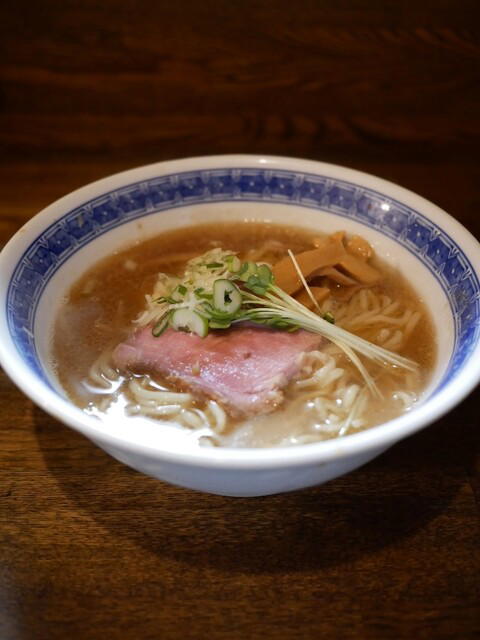
Sansanto is a compact Higashi-Jujo ramen counter with seven seats, a no-reservations format, and repeated selection in Tabelog’s Ramen TOKYO 100 from 2017 through 2025. Its draw is not luxury coding but concentration: ramen, tsukemen, abura-soba, and maze-soba in a low-price bracket that keeps Tokyo’s serious noodle culture close to daily eating.

Pearl is the En Primeur Club membership app, where members save venues, book tables and use the concierge.
The menu
What to order
- Tonkotsu-gyokai ramen
- Tsukemen (dipping noodles)
- Abura-soba / maze-soba
Tokyo changes the tempo before the bowl arrives. The setting for a noodle stop can be practical rather than polished, built around quick decisions, close attention, and the kind of meal where the format matters because it forces attention back onto the food. In Tokyo ramen, that context is not incidental. Many of the city’s serious noodle shops are judged through concise menus and repeat comparison rather than ceremony.
Sansanto belongs in that Tokyo noodle conversation. The experience is best understood through bowl, pace, and format rather than dining-room performance. Its listed categories are ramen, tsukemen, abura-soba, and maze-soba, which places it in the broader Tokyo field where broth, tare, noodle texture, and fat management can define a shop more than decorative service language. Its Tabelog Ramen TOKYO 100 selection for 2025 gives Sansanto a clear signal in a city where noodle reputations can rise quickly and fade just as fast.
Tokyo ramen at counter scale, judged by concentration rather than polish
Tokyo’s ramen culture is unusually good at separating price from seriousness. A low spend does not imply casual technique; it often means the restaurant is being evaluated for focus, repeatability, and ingredient concentration rather than an expanded service model. That is why a shop can sit in a modest bracket and still be assessed against a demanding noodle field. Sansanto’s Tabelog score of 3.85 and inclusion in the 2025 Ramen TOKYO 100 put it inside that conversation, not as a broad hospitality play, but as a specialist address measured by bowl-by-bowl consistency.
The sourcing angle in ramen is less visible than in sushi or kaiseki, but no less decisive as a general principle. Ramen depends on extracting value from staple inputs: wheat for noodles, stock elements, tare for seasoning depth, and aromatic fats for finish. Tsukemen adds another variable because the dipping format exposes noodle texture more directly; abura-soba and maze-soba shift the judgment toward seasoning balance without the cover of broth. A listing that spans all four categories asks diners to think across formats, not just order a single house style.
This is where Tokyo’s noodle shops can differ from many overseas ramen rooms. The city’s specialists often keep the frame narrow and let small changes in noodle thickness, sauce adhesion, and broth weight carry the identity. In that context, the absence of a luxury frame is not a weakness. The meal becomes a focused reading of noodles, seasoning, and timing. Sansanto fits that logic as a Tokyo ramen, tsukemen, abura-soba, and maze-soba specialist, and its Tabelog recognition suggests that the shop has been judged within the city’s own competitive grammar rather than by novelty.
Tokyo's value argument is part of the appeal
Tokyo’s central dining map can overemphasize polished destination districts, but the city’s noodle culture has always drawn strength from everyday dining. Tokyo is useful precisely because ramen is not confined to luxury dining settings. The economics are different: concise service, clear ordering, and repeat traffic often matter. For ramen, that can produce a sharper kind of accountability than the destination-restaurant circuit, because the food has to justify itself without the insulation of a high-spend occasion.
Among comparison points in Tokyo’s low-price specialist tier, Ittoan works the soba lane, Sanuki Udon Iwai points toward udon, and Niboshi Soba Ru. signals the dried-fish intensity that has shaped many modern ramen conversations. Kuromatsu Honpo Sogetsu and Darumaya Mochigashi Ten show how Tokyo’s low-price food culture also extends beyond noodles into sweets and everyday craft. Sansanto sits with the noodle specialists rather than the dessert or snack addresses, and its distinction is breadth within ramen-adjacent formats: soup, dipping, oil-coated, and mixed noodles under one name.
For a traveler, that matters because Tokyo dining research can become distorted by scarcity signals. Ramen does not need a private room, a long tasting menu, or a formal beverage program to be worth seeking out. The better question is whether a shop gives a clear reading of a specific local idiom. Here, the case rests on a focused noodle range, a Tokyo setting, and local recognition rather than decorative dining-room language.
How to place it within a Tokyo eating itinerary
Sansanto works well as a targeted ramen stop rather than a general night out. Pairing it with broader Tokyo dining research helps clarify the trade-off: the point is not variety across courses, but a concentrated read on noodle craft in a Tokyo setting. Readers mapping a wider schedule can use Our full Tokyo restaurants guide for restaurant planning, with adjacent city coverage through Our full Tokyo hotels guide, Our full Tokyo bars guide, Our full Tokyo wineries guide, and Our full Tokyo experiences guide.
For contrast inside Tokyo’s broader casual-dining map, compare the noodle focus here with other Tokyo dining rooms in different everyday registers. Different casual formats ask for different expectations, and Sansanto’s strength is that it keeps the comparison tightly focused on noodles.
Beyond Tokyo, the same question of format and place applies to other casual and specialist venues in Japan and abroad. The useful comparison is not cuisine alone, but how a venue’s format shapes the way ingredients are presented.
Frequently asked questions
What's the pricing like at Sansanto?
Pricing at Sansanto is listed as - JPY 999.
What days is Sansanto closed?
Specific opening days and hours are not provided here; confirm current service details before visiting.
What part of town is Sansanto in?
Tokyo.
What's the standout thing about Sansanto?
The clearest signal is its Tabelog 100 Ramen TOKYO selection in 2025, alongside a Tabelog score of 3.85. Add the listed - JPY 999 pricing and its range across ramen, tsukemen, abura-soba, and maze-soba, and the appeal is clear: a focused noodle shop in Tokyo.
Price and Recognition
Comparable venues in the metro at similar price points.
| Venue | Cuisine | Price | Awards | Notes |
|---|---|---|---|---|
| SansantoThis venue (the venue you are viewing) | Tonkotsu-gyokai ramen & tsukemen shop | $10–20 | Tabelog 100 #93 | Not listed |
| Sanuki Udon Kuranosuke | Sanuki udon noodle shop | $10–20 | Tabelog 100 #60 | Toshima, Sanuki udon noodle shop |
| Chonan Hosono Takashi | Tsukemen & ramen | $10–20 | Tabelog 100 #53 | Nerima, Tsukemen & ramen |
| Mitsuru Akebonobashi honten | Japanese neighborhood bakery | $1–10 | Tabelog 100 #43 | Shinjuku, Japanese neighborhood bakery |
| Higashi Shinjuku Sanrasa | Japanese Curry | Not listed | Tabelog 100 #13 | Shinjuku, Japanese Curry |
| Kanda Yabu Soba | Edo-Style Soba | $10–20 | Not listed | Chiyoda, Edo-Style Soba |
Recognition history
Dated appearances from independent guides and award organizations, with the underlying list record or original source where available.
Tabelog 100 #93 · No. 93
Tabelog · Tabelog 100 - Ramen - TOKYO - 2025