
Rice Curry Manten belongs to Jinbocho’s unfussy curry culture: counter seating, sub-¥1,000 pricing, and recognition on Tabelog’s Curry TOKYO 100 list for 2024. Its appeal is less about luxury than concentration: a small-format Tokyo curry shop where the sourcing question is practical, not performative, and value remains part of the point.
Pearl is the En Primeur Club membership app — saves, bookings, and concierge access live there. Same editors, same standards.
- Address
- 1 Chome-54 Kanda Jinbocho, Chiyoda City, Tokyo 101-0051, Japan
- Phone
- +81 3-3291-3274
- Website
- tabelog.com
 Saves & bookings on Pearl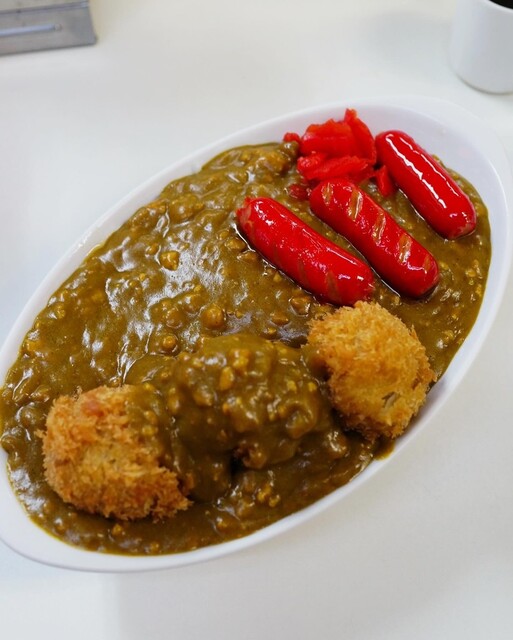
Jinbocho announces itself through paper, railway exits, and lunch queues, not grand dining rooms. Around bookshops and university edges, curry has long served as weekday fuel: fast, filling, and priced for repeat visits. Rice Curry Manten fits that grammar exactly: a 14-seat, counter-only curry shop in Kanda Jinbocho whose scale explains the format before the menu does.
Tokyo curry is often called comfort food, but procurement is the sharper lens. Imported spices, Japanese rice, stock bases, fried toppings, and counter-service economics meet in a category that rewards disciplined costs without cafeteria sameness. The sub-JPY 999 bracket is unforgiving: little room for decoration, and every ingredient must justify itself through volume, speed, and consistency.
Jinbocho curry, built for repeat eating rather than ceremony
Jinbocho’s curry identity is not accidental. Secondhand bookshops, student traffic, publishing offices, and transit links created demand for compact restaurants serving meals eaten alone, quickly, and often. Curry suits that ecosystem: rice as anchor, sauce as house identity, toppings as variable. The sourcing story is not farm-name provenance; it is how a kitchen turns everyday inputs into a dependable plate under a price ceiling many Tokyo restaurants have left behind.
Rice Curry Manten’s Tabelog score of 3.73 and selection for Tabelog Curry TOKYO 100 in 2024 place it in a useful part of the city’s curry conversation: recognised by local diners and category lists, yet still small-shop and low-spend. Tokyo curry ranges from specialty spice shops and South Asian regional cooking to Japanese-style rice curry counters; the Jinbocho model prizes throughput, concentration, and familiarity. Compared with ando suriranka toukyou, in a higher listed spend band, or PANCH MAHAL, also above sub-JPY 999, this address keeps the economic argument unusually sharp.
Inexpensive curry is not rare in Tokyo; recognition at this price changes expectations. A bowl under JPY 1,000 cannot rely on ceremony, service choreography, or a long drink list. It must succeed through rice texture, sauce density, spice balance, portion logic, and counter pace. Those are the metrics for judging Jinbocho curry.
The counter format makes the sourcing argument visible
Counter-only restaurants compress the distance between cooking and eating. In curry shops, that matters: the category depends on heat, rice condition, sauce management, and fast assembly. A 14-seat counter limits theatre but increases pressure on consistency. There is no private-room escape, sprawling dining room, or elaborate wine program to distract from the central plate.
Ingredient sourcing in this style is expressed through function rather than provenance language. Rice must hold structure under sauce. The curry base needs seasoning and body that survive service without dullness. Toppings must work with the sauce rather than become separate performance. Tokyo curry regulars remember texture and ratio more than garnish. The plate succeeds when purchasing and prep decisions disappear into rhythm.
The cash-only, no-reservations counter format is therefore not just logistical. It signals everyday demand rather than destination-dining convention. For travellers mapping Tokyo through food, this is a different value from sushi counters, kaiseki rooms, or cocktail bars. It belongs in the same itinerary logic as other focused city addresses: 3 Chome no Curry Ya San for another curry reference point, . 鮪と炭火焼き うお炭 秋葉原店 for a different casual Japanese register, or 124. KAGURAZAKA (Yakitori) when evening turns toward skewers and smoke.
The awards context matters. Tabelog’s Curry TOKYO 100 is a category signal, not a luxury badge. It shows local traction within a specialised field, often more useful for curry than international fine-dining recognition. In this segment, repeated local approval teaches more than a polished room. Rice Curry Manten appeared in Tabelog Curry selections across 2022, 2023, and 2024, giving the recognition continuity.
How to place it within a Tokyo eating day
Use Jinbocho curry as a hinge meal: before an afternoon in the book district, between museum stops, or as a low-cost counterpoint to a high-spend dinner. Jimbocho station puts the shop inside a central network rather than a special detour. Suidobashi is also walkable, making it easy to pair the area with university-town wandering, secondhand browsing, or a later move across central Tokyo.
For broader city planning, this meal keeps Tokyo from becoming only reservation trophies. The city’s dining intelligence often sits in narrow formats: ramen counters, curry shops, yakitori counters, kissaten, and standing bars. 12/10 Shinjuku ten, 2D Cafe, and Our full Tokyo restaurants guide frame that neighbourhood spectrum. For longer itineraries, Our full Tokyo hotels guide, Our full Tokyo bars guide, Our full Tokyo wineries guide, and Our full Tokyo experiences guide keep the map from collapsing into restaurants alone.
The comparison set clarifies the choice. Tsukesoba Kanda Katsumoto and Coffee Sha Kura share the low-price bracket but answer different cravings: noodles in one case, coffee-shop rhythm in the other. KHAO moves toward Thai cooking at a higher price. The restaurant is for travellers seeking Tokyo curry in compact, rice-led, working-neighbourhood form, not a tasting-menu interpretation of spice.
It also belongs to a wider Japanese and global conversation about casual formats with serious local meaning. Contrast it with [Curry Senmon Ten] Maruyama Kyoju. in Sapporo for regional curry context, [ki:] in Kyoto for a different Kyoto register, -Grilled beef Sukiyaki- KAMAKURA TANUKIAN 鎌倉 たぬき庵 in Kamakura for beef-centred tradition, or (Shoku) Vietnam in Kawasaki for another casual format shaped by migration and urban appetite. Outside Japan, Jōdo Saké Bar in Los Angeles and Onigiri Time in Pasadena show how Japanese everyday foods travel, while.cafe in Osaka and.know in Kumamoto widen the domestic frame.
The verdict is simple: this is not the address for spectacle. It is the address for understanding why Tokyo’s everyday curry culture deserves the attention travellers often reserve for higher-priced counters. Recognition, price discipline, counter scale, and neighbourhood fit all point to Jinbocho curry at its most direct.
Category Peers
Comparable venues by cuisine and category.
| Venue | Cuisine | Price | Notes |
|---|---|---|---|
| Rice Curry MantenThis venue — the venue you are viewing | Japanese Curry House | $ | Not listed |
| Nezu no Taiyaki | Traditional Taiyaki Shop | $ | Bunkyō |
| Oniyanma Ningyouchou ten | Standing Udon Noodle Bar | $ | Chūō |
| Japanese Supaisu Curry Karisshu | Japanese Spice Curry | $ | Chūō |
| MENSHO | Modern Japanese ramen | $ | Bunkyō |
| Mitsuru Akebonobashi honten | Japanese neighborhood bakery | $ | Shinjuku |
Recognition history
Dated appearances from independent guides and award organizations, with the underlying list record or original source where available.
Tabelog 100 #22 · No. 22
Tabelog · Tabelog 100 - Curry - TOKYO - 2024








At a Glance
- Cozy
- Lively
- Classic
- Solo
- After Work
- Casual Hangout
- Late Night
- Standalone
Current opening hours
- Monday
- 11 AM–8 PM
- Tuesday
- 11 AM–8 PM
- Wednesday
- 11 AM–8 PM
- Thursday
- 11 AM–8 PM
- Friday
- 11 AM–8 PM
- Saturday
- 11 AM–4 PM
- Sunday
- Closed
Hours can change for holidays and private events. Last verified .