
Michelin Bib Gourmand
Our verdict
Restaurant Litoral in Taipa is one of Macau's most consistent addresses for Macanese cooking, holding the Michelin Bib Gourmand in both 2024 and 2025. Set in the old quarter of Taipa Village, it serves the Portuguese-Chinese hybrid cuisine that defines the territory's food identity, at accessible mid-range prices that make it a reliable entry point into the canon.

Pearl is the En Primeur Club membership app, where members save venues, book tables and use the concierge.
The menu
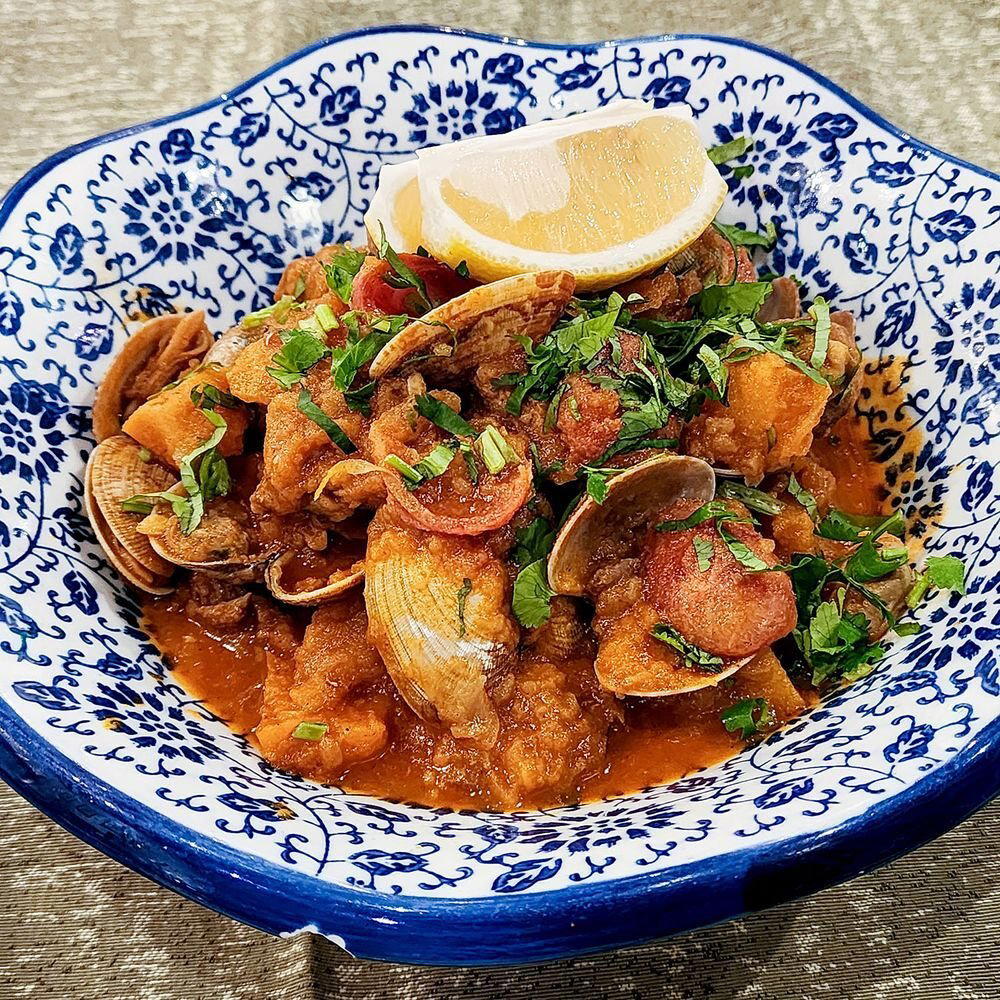
What to order
- Arroz de Pato
- African Chicken
- Seafood Rice
- Sauteed Clams
- Cod Fish Cakes
Taipa Village and the Architecture of Macanese Cuisine
The old streets of Taipa Village move at a different pace from the casino corridors that dominate the peninsula. Tiled facades, narrow lanes, and neighbourhood restaurants operating on decades-long routines define this quarter, and it is precisely this environment that frames what Macanese cooking means as a living tradition rather than a museum piece. Macanese cuisine is one of the world's most specific hybrid forms: a convergence of Portuguese colonial technique, Cantonese ingredient literacy, and the accumulated spice vocabulary of Goa, Malacca, and East Africa gathered across five centuries of Portuguese maritime trade. It does not sit cleanly inside either European or Chinese culinary categories, and that structural ambiguity is the point.
Restaurant Litoral occupies a ground-floor address in the Rua do Regedor stretch of old Taipa, a street that retains enough of its residential character to feel genuinely local. The approach is not theatrical. There are no grand entrances or designer interventions. What greets you is the kind of low-key permanence that signals a kitchen more interested in its pots than its aesthetics, which in this price bracket, in this neighbourhood, is a reasonable place to start.
Where Litoral Sits in the Macanese Restaurant Tier
Macau's restaurant hierarchy runs from the casino-attached fine dining rooms, where multi-starred French kitchens like Robuchon au Dôme and Alain Ducasse at Morpheus operate at the territory's ceiling, down through Cantonese mid-market operations and street-level snack culture. Macanese cooking as a category sits somewhat apart from this hierarchy, partly because it has no equivalent elsewhere and partly because the restaurants serving it are rarely casino-backed. Litoral belongs to the accessible mid-market within that category, priced at the $$ tier and therefore positioned as a neighbourhood-grade operation rather than an occasion restaurant.
The Michelin Bib Gourmand awarded consecutively in 2024 and 2025 is the most legible trust signal Litoral carries. The Bib Gourmand designation specifically tracks quality-to-value ratio rather than technique-at-any-cost, which makes it a more precise fit for what this type of restaurant is actually doing. For comparison, Macau's starred Cantonese rooms such as Chef Tam's Seasons and Jade Dragon operate in a categorically different price register and competitive set. Litoral is not competing with those rooms. It is competing, implicitly, with the handful of other Macanese restaurants in Taipa that have managed to maintain consistency over time, and the consecutive Bib recognition suggests it is doing so credibly.
For those exploring the wider dining scene across the region, the contrast is instructive. The hybrid logic that makes Macanese food distinctive in Macau has loose parallels in cities like Shanghai or Hangzhou, where restaurants such as 102 House in Shanghai and Ru Yuan in Hangzhou work with historically layered Chinese culinary traditions. In Beijing and Chengdu, addresses like Xin Rong Ji and Xin Rong Ji in Chengdu each reflect regional food culture in their own mode. Macanese cooking is narrower in geographic origin than any of these, which is part of why it warrants specific attention when visiting the territory.
The Cuisine Itself: What the Hybrid Means in Practice
Understanding what is on a Macanese menu requires stepping back from the idea that fusion is a modern invention. Macanese cooking predates the concept by centuries. Dishes like African chicken, a preparation with roots in Portuguese colonial Africa adapted through Macau kitchens, or caldo verde adapted with local greens, or prawn dishes built on a base of shrimp paste alongside European aromatics, are not experiments in combining cuisines. They are the settled result of communities eating together across generations. The cuisine reflects Portuguese cooking's openness to outside ingredients, which itself came from its seafaring history, filtered through Cantonese culinary technique and the spice routes that made Macau a trading hub.
Chef Patrick Lieffroy's name appears in the record. Without additional sourced detail on his background or training it would be speculative to characterise his personal approach, but the professional context matters: Macanese cooking has historically been home cooking, passed through family lines and domestic kitchens rather than formal culinary institutions. The restaurants that do it credibly are those that have maintained proximity to those domestic roots rather than over-formalising the cuisine into something it was never designed to be. Litoral's placement in a neighbourhood street, at accessible prices, with sustained Michelin recognition, suggests a kitchen calibrated toward that preservation rather than reinvention.
How Litoral Fits a Broader Macau Visit
Taipa Village is walkable and historically dense. A meal at Litoral pairs naturally with time in the surrounding streets: the Portuguese-era architecture, the temples, the quieter café and bakery culture that makes this quarter feel distinct from the Cotai Strip a few kilometres away. For visitors whose Macau itinerary is dominated by the casino hotels and their attached dining, Litoral offers an access point into the city's other food identity, the one that predates the gaming economy by several centuries.
At the $$ price tier with consistent Bib Gourmand recognition, booking ahead is advisable, particularly for weekend lunches and evenings when Taipa Village draws both local families and visitors from the peninsula. The format appears to be a conventional table-service operation rather than a counter or tasting menu format, which suits the cuisine's share-and-pass ethos.
Those who want to extend their research across the territory can consult our full Macau restaurants guide, which covers the range from Macanese neighbourhood restaurants through to the casino-attached fine dining tier. For accommodation planning, our Macau hotels guide addresses the options across both Taipa and the peninsula. Broader itinerary planning is supported by our Macau bars guide, our Macau experiences guide, and our Macau wineries guide. Within this neighbourhood, the UTM Educational Restaurant represents a different institutional approach to Macanese cuisine and is worth noting as a complementary visit for those building a more thorough picture of what the territory's food culture holds. For reference points further afield, Imperial Treasure Fine Chinese Cuisine in Guangzhou and Dai Yuet Heen in Nanjing demonstrate how Chinese culinary tradition operates in contrasting regional registers. Internationally, the precision of technique that drives sustained Michelin recognition at restaurants like Le Bernardin in New York City or the creativity of Atomix in the same city illustrates the broader global context within which Litoral's Bib Gourmand should be understood, a different tier of recognition but the same inspectorate applying consistent standards of quality-to-value assessment.
Frequently asked questions
at Restaurant Litoral (Taipa)?
Can I walk in to Restaurant Litoral (Taipa)?
A Quick Peer Check
| Venue | Cuisine | Price | Awards | Notes |
|---|---|---|---|---|
| Restaurant Litoral (Taipa)This venue (the venue you are viewing) | Macanese-Portuguese | $20–30 | Michelin Bib Gourmand | Not listed |
| Aji | Asian Bistronomy (Nikkei Fusion) | $50–100 | 1 Michelin Star · Wine Spectator Best of Award of Excellence | Nikkei, Innovative |
| Ying | Modern Cantonese Fine Dining | Not listed | 1 Michelin Star · La Liste Top Restaurants | Cantonese |
| Five Foot Road | Modern Sichuan Fine Dining | Not listed | 1 Michelin Star · La Liste Top Restaurants | Sichuan |
| Robuchon au Dôme | Contemporary French Fine Dining | $150–200 | 3 Michelin Stars · La Liste Top Restaurants | French Contemporary |
| Feng Wei Ju | Refined Hunan & Sichuan Chinese | Not listed | 2 Michelin Stars · La Liste Top Restaurants | Hunan-Sichuan, Hunanese |
Recognition history
Dated appearances from independent guides and award organizations, with the underlying list record or original source where available.
Michelin Bib Gourmand
Michelin
Full recognition history (3 entries)
Michelin Bib Gourmand
Michelin
Michelin Bib Gourmand
Michelin
Continue exploring
More in Macau
Restaurants in Macau
All restaurants in Macau →

Details
- Classic
- Cozy
- Intimate
- Family
- Group Dining
- Casual Hangout
- Standalone
- A La Carte
Current opening hours
- Monday
- 11:30 AM–3 PM, 6–9:30 PM
- Tuesday
- 11:30 AM–3 PM, 6–9:30 PM
- Wednesday
- 11:30 AM–3 PM, 6–9:30 PM
- Thursday
- 11:30 AM–3 PM, 6–9:30 PM
- Friday
- 11:30 AM–3 PM, 6–9:30 PM
- Saturday
- 11:30 AM–3 PM, 6–9:30 PM
- Sunday
- 11:30 AM–3 PM, 6–9:30 PM
Hours can change for holidays and private events. Hours as of .
Relaxing and comfortable with warm yellow lighting, wooden tables, spacious seating, and nostalgic Portuguese bistro decor.