Restaurant Harder-Kulm
Perched above Interlaken at 1,322 metres on the Harder Kulm summit, Restaurant Harder-Kulm offers one of the Bernese Oberland's most immediate juxtapositions: an Alpine dining room with panoramic views across two lakes and the Eiger, Mönch, and Jungfrau massif. Reached exclusively by the historic Harderbahn funicular, it sits in a distinct tier of Swiss mountain dining where the journey and the setting shape the meal as much as the food does.
Pearl is the En Primeur Club membership app — saves, bookings, and concierge access live there. Same editors, same standards.
- Address
- Harder Kulm, 3800 Interlaken, Switzerland
- Phone
- +41 33 828 73 11
- Website
- restaurantharderkulm.ch
- Directions
- Get directions
 Saves & bookings on Pearl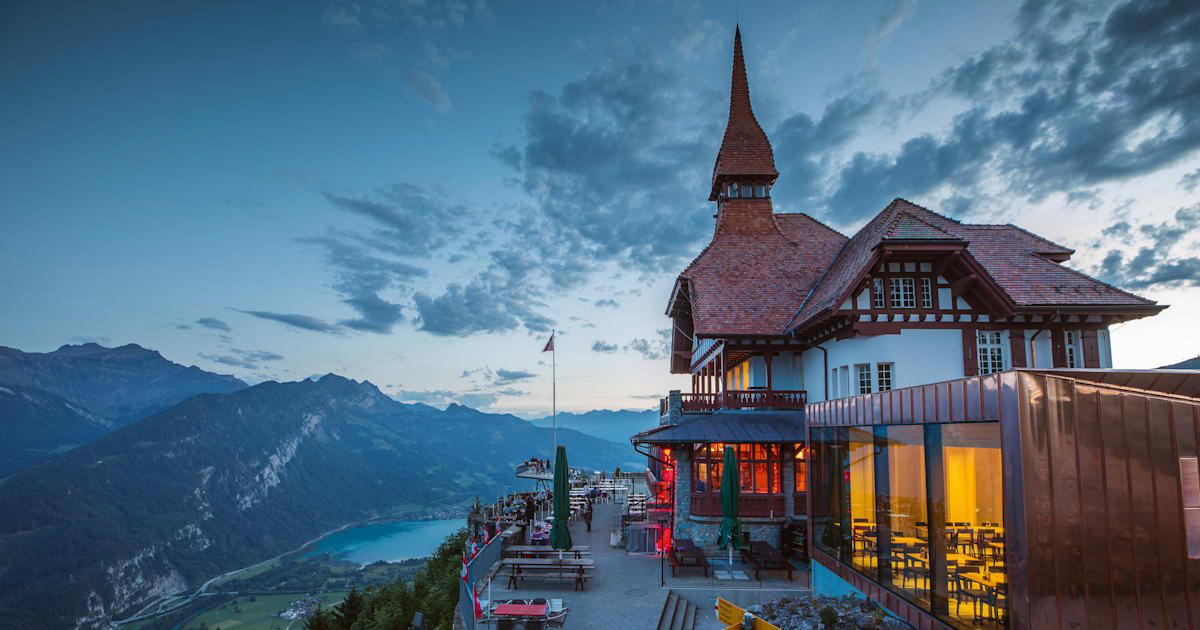
The Approach Defines the Meal
Most restaurants begin at the door. At Restaurant Harder-Kulm, the experience starts at the valley floor in Interlaken, where the Harderbahn funicular has been hauling visitors up 740 vertical metres since 1908. The ten-minute ascent through dense forest is not preamble; it is structure. By the time the car crests the ridge and the summit station comes into view, the psychological shift from town to mountain is complete. What follows in the dining room is understood through that lens: this is a meal taken at altitude, with two glacial lakes visible below and the Eiger's north face directly across the valley.
That physical framing puts Harder-Kulm in a specific Swiss dining tradition. Across the Alps, a category of summit restaurants has emerged whose primary credential is geography rather than culinary technique. These summit restaurants occupy a separate register entirely, where the ritual of arrival and the drama of the view carry weight that a ground-floor room simply cannot replicate. Harder-Kulm sits in this tradition, and understanding that distinction is the starting point for any honest assessment.
The Ritual of a Summit Table
Swiss mountain dining at this altitude has its own pacing. The funicular schedule structures arrival times, which in turn shapes how guests settle into the space. There is no drifting in off the street; every guest has made a deliberate ascent, and the dining room reflects this shared context. Tables tend to orient toward the terrace and the panoramic windows, because the view at 1,322 metres over Lake Thun and Lake Brienz is the dominant event. Dishes and drinks arrive as punctuation within that larger experience rather than as the headline themselves.
This is a pattern found at comparable Alpine rooms across Switzerland and Austria: the meal functions as a long, unhurried pause at the summit of something. The etiquette is informal by the standards of, say, Cheval Blanc by Peter Knogl in Basel or Memories in Bad Ragaz, but the pace is slower than a valley café precisely because leaving requires the funicular and no one is rushing that. Sunset bookings extend this dynamic further, as the light shifts across the Bernese Alps and the two lakes below change colour in succession.
Where Harder-Kulm Sits in Interlaken's Dining Spread
Interlaken's restaurant scene is geographically compact but tiered by register and purpose. At the more ambitious end, Radius by Stefan Beer operates in the regional cuisine bracket, placing it among the more serious dining options in the immediate area. The mid-range is populated by venues like Brasserie 17 and Asllanis Corner, while more casual options include Hüsi Bierhaus and El Azteca.
Harder-Kulm does not compete within any of those tiers in a direct sense. Its access via the Harderbahn funicular creates a separate category: a destination that requires commitment and planning, charges for transport as well as food, and delivers an experience whose value proposition is built around place rather than plate. Within the broader context of Swiss Alpine dining, its comparable set is other summit restaurants at comparable altitudes, not the valley-level competition.
The Swiss Mountain Dining Tradition in Context
Switzerland has refined the summit restaurant format over more than a century. The country's network of cogwheel railways, aerial tramways, and funiculars, built from the late nineteenth century onward, created the infrastructure for a genre of hospitality that has few close equivalents elsewhere in Europe at the same scale. At the upper technical end of Swiss dining, rooms like 7132 Silver in Vals, focus ATELIER in Vitznau, and IGNIV Zürich by Andreas Caminada in Zurich represent what Swiss fine dining has become in recent decades. The summit restaurant tradition operates parallel to that, more accessible in culinary terms but no less deliberate as an experience.
Harder-Kulm's longevity in this format reflects the durability of the Bernese Oberland as a destination. The Jungfrau region draws visitors from across Europe and Asia year-round, and the Harder Kulm summit functions as one of the area's most direct vantage points over the valley floor. A table here is positioned within that tourist geography in a way that rooms like Colonnade in Lucerne, Einstein Gourmet in Sankt Gallen, or Da Vittorio in St. Moritz are not: it is inextricably linked to a specific geological moment above a specific valley.
For international travellers arriving from cities like New York, where rooms such as Le Bernardin and Atomix set expectations around culinary technique and tasting menu formality, the shift to summit dining requires a different sort of reading. The register is different, not lesser. The pleasure is calibrated to landscape and altitude rather than to kitchen precision.
Planning the Visit
Access to Restaurant Harder-Kulm runs through the Harderbahn funicular, which departs from a station near Interlaken Ost and takes approximately ten minutes to reach the summit. The funicular operates seasonally, typically from spring through autumn, with closure during winter months. Guests should confirm current operating hours and funicular schedules before planning a visit, as mountain transport schedules shift with weather and season. The summit itself is at 1,322 metres, which means light layers are sensible even in summer, when valley temperatures can be misleading. One sought-after window is the late afternoon into early evening, when the light on the Jungfrau massif is at its most direct and the two lakes below reflect the sky. Arriving before peak evening service and staying through the light change takes full advantage of the pacing that the summit format allows.
Cuisine Lens
Comparable venues nearby, for context on price, style, and recognition.
| Venue | Cuisine | Price | Awards | Notes |
|---|---|---|---|---|
| Restaurant Harder-KulmThis venue — the venue you are viewing | Swiss Alpine with Panoramic Views | $$$ | Not listed | Not listed |
| La Terrasse Brasserie | Modern Swiss Brasserie | $$$ | Michelin Plate | Interlaken Center |
| Sapori | Italian Ristorante & Pizzeria | $$$ | Michelin Plate | Interlaken |
| Brasserie 17 | Lively Brasserie with Ribs & Wings | $$ | Not listed | central Interlaken |
| Vivis Wok | Authentic Chinese Wok | $$ | Not listed | center |
| Asllanis Corner | Halal American Burgers | $$ | Not listed | Interlaken Center |
Continue exploring
More in Interlaken
Restaurants in Interlaken
Browse all →
Bars in Interlaken
Browse all →

Hotels in Interlaken
Browse all →

At a Glance
- Scenic
- Elegant
- Special Occasion
- Celebration
- Family
- Panoramic View
- Terrace
- Hotel Restaurant
- Mountain
- Waterfront
Current opening hours
- Monday
- 9:30 AM–9 PM
- Tuesday
- 9:30 AM–9 PM
- Wednesday
- 9:30 AM–9 PM
- Thursday
- 9:30 AM–9 PM
- Friday
- 9:30 AM–9 PM
- Saturday
- 9:30 AM–9 PM
- Sunday
- 9:30 AM–9 PM
Hours can change for holidays and private events. Last verified .
Bright and airy with magnificent panoramic mountain and lake views from indoor seating and large terrace, creating a magical alpine atmosphere especially at sunset.