
RANDIWA puts Sri Lankan and South Asian cooking into Joso’s small-city dining conversation rather than treating it as a side category. Its repeated Tabelog Asian cuisine / Ethnic cuisine EAST “Tabelog 100” selections in 2022, 2023, and 2024 give the restaurant a clear signal beyond local word-of-mouth, especially for travelers tracking regional curry culture outside Tokyo.
Pearl is the En Primeur Club membership app — saves, bookings, and concierge access live there. Same editors, same standards.
- Address
- 899-3 Mukoishige, Joso, Ibaraki 300-2742, Japan
- Phone
- +81 297-42-1222
- Website
- instagram.com
- Directions
- Get directions
 Saves & bookings on Pearl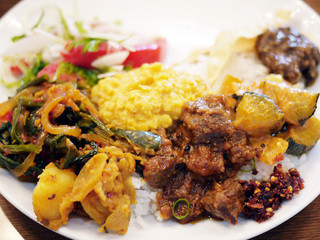
Approaching a South Asian restaurant in Joso changes the usual rhythm of eating in Ibaraki. This is not the dense station-front curry circuit of Tokyo, where lunch sets turn over quickly and menus often flatten several countries into one generic category. The appeal here is more specific: Sri Lankan cooking sitting inside a semi-rural Kanto city, drawing attention because sourcing, spice structure, and rice-and-curry culture travel differently when they land outside a metropolitan food district.
RANDIWA belongs to that quieter but increasingly visible tier of regional ethnic restaurants in Japan: modest in scale, serious in reputation, and easier to misunderstand if viewed only through the lens of convenience dining. Tabelog selected it for the Asian cuisine / Ethnic cuisine EAST “Tabelog 100” in 2022, 2023, and 2024, a useful marker because the category cuts across a crowded field of Indian, South Asian, Southeast Asian, and other non-Japanese kitchens in eastern Japan. In Joso, that recognition carries extra weight. The city is not a default dining stop for international travelers, so a restaurant in this category has to earn attention through repeat local use and specialist interest rather than foot traffic alone.
Sri Lankan cooking in Ibaraki depends on spice, rice, and regional context
Sri Lankan food in Japan often gets filed under “curry,” but that label misses the point. The cuisine is built around contrast: rice as the anchor, multiple curries or vegetable preparations around it, coconut used for body, chile and black pepper for heat, and souring agents that create lift rather than heaviness. When done with care, the pleasure is cumulative. Each component changes the next spoonful.
That matters in Ibaraki because regional Japan gives immigrant and diaspora cuisines a different operating logic from the capital. Tokyo can sustain narrow specialization through density; smaller cities depend on a mix of regulars, destination diners, and flexible menus. RANDIWA’s categories, South Asian, Indian curry, and Sri Lankan, show that wider frame. The editorial point is not purity for its own sake, but how a restaurant can keep a Sri Lankan identity legible while remaining accessible to diners who may arrive expecting the broader Japanese curry-house format.
Ingredient sourcing sits at the center of that balance. Sri Lankan cooking relies on dried spices, legumes, rice, coconut products, and vegetables that can travel or be adapted locally. In Japan, the question is rarely whether imported ingredients are present; it is how they meet domestic produce, rice preferences, and the Japanese expectation of clear value. At this level, the stronger restaurants avoid making spice into spectacle. Heat should serve rhythm: one curry deepens, another sharpens, a sambol or vegetable element resets the palate. Specific dishes are not publicly fixed enough to treat as constants, but the category itself tells informed diners what to look for.
Why the recognition matters outside Tokyo
The Tabelog “Tabelog 100” selections are not equivalent to a luxury award circuit, and that distinction is useful. They point toward restaurants that have achieved category credibility among users and editors in a given field. For ethnic cuisine in eastern Japan, the list tends to surface places where repeatability matters as much as polish. A 20-seat room in Joso competing for attention in that field says something about the spread of serious South Asian cooking beyond the usual urban corridors.
Comparisons inside Joso are more revealing than grand claims. MAFHH RESTAURANT sits in the same city and price band, which makes it a useful reference point for readers mapping value-led dining rather than ceremony-led dining. Out-of-metro comparisons such as DROOL DINER, ラ・スタッラ, La Stalla, and Seiyo Ryori Ten Escoffier show a different spread of formats and budgets; RANDIWA’s significance comes from sitting in an ethnic-cuisine category where recognition depends less on décor or tasting-menu structure and more on repeat demand for a specific food tradition.
That is also why Joso is part of the story. The city is better understood as a working regional base than a polished dining district. Restaurants here serve residents first, then curious travelers second. A Sri Lankan and South Asian address with multi-year category recognition shifts the map: it gives food-focused visitors a reason to treat Joso as more than a stop between larger destinations.
How to read the room and the meal
The sensible expectation is casual, compact, and food-led. With 20 seats, the experience is closer to a small neighborhood restaurant than a long-form destination dining room. That scale usually rewards diners who arrive with a clear purpose: eat the cooking for its spice logic, not for theatrical service. The restaurant’s smoking status is listed as smoking allowed, so travelers sensitive to smoke should factor that into the decision rather than assuming the non-smoking norms of newer urban restaurants.
RANDIWA is better framed as a specialist regional stop than a ceremonial evening. The value is in the combination of Sri Lankan cooking, small-city setting, and repeated category recognition. For travelers building a broader Joso itinerary, it pairs naturally with a wider scan of the area’s dining and stay options: Our full Joso restaurants guide, Our full Joso hotels guide, Our full Joso bars guide, Our full Joso wineries guide, and Our full Joso experiences guide give the city more context than a single-meal detour can.
Readers comparing wider Japan dining notes may also want adjacent reference points across categories and cities: -Grilled beef Sukiyaki- KAMAKURA TANUKIAN 鎌倉 たぬき庵 in Kamakura, . 鮪と炭火焼き うお炭 秋葉原店 in Tokyo, .cafe in Osaka.know in Kumamoto, (Shoku) Vietnam in Kawasaki, [Curry Senmon Ten] Maruyama Kyoju. in Sapporo, [ki:] in Kyoto, #肉といえば松田 奈良本店 in Kashihara, 1/3 HAMBURGER FACTORY in Kanazawa, 1000 in Yokohama, Jōdo Saké Bar in Los Angeles, and Onigiri Time in Pasadena. The through-line is not similarity of cuisine, but the way smaller formats and specific food identities shape a trip more sharply than generic dining checklists.
A Quick Peer Check
Comparable venues by cuisine and price in the same metro.
| Venue | Cuisine | Price | Notes |
|---|---|---|---|
| RANDIWAThis venue — the venue you are viewing | Sri Lankan Curry & Sunday Buffet | $$ | Not listed |
| MAFHH RESTAURANT | Dining | Not listed | Joso |
| Masala Curry Shop | Indian Curry House | $$ | Shunan |
| Tandoor Bar Kamal 2 Go | Creative Indian curry & tandoor bar | $$ | Kōtō |
| KHAN KEBAB BIRYANI | Halal Indian & Pakistani Curries, Kebabs and Biryani | $$ | Chūō |
| YOGORO | Japanese Curry | $$ | Shibuya |
Recognition history
Dated appearances from independent guides and award organizations, with the underlying list record or original source where available.
Tabelog 100 #17 · No. 17
Tabelog · Tabelog 100 - Asian cuisine / Ethnic cuisine - EAST - 2024
Continue exploring
More in Joso




Bars in Joso
Browse all →





At a Glance
- Lively
- Cozy
- Family
- Group Dining
- Casual Hangout
- Celebration
- Standalone
- Beer Program
Current opening hours
- Monday
- 11:30 AM–10 PM
- Tuesday
- 11:30 AM–10 PM
- Wednesday
- 11:30 AM–10 PM
- Thursday
- 11:30 AM–10 PM
- Friday
- 11:30 AM–10 PM
- Saturday
- 11:30 AM–10 PM
- Sunday
- 11 AM–10 PM
Hours can change for holidays and private events. Last verified .
Casual and homely Sri Lankan dining room with simple decor, a relaxed local feel, and a bustling, lively atmosphere during the popular Sunday buffet service.