
Ramenya Mitsuba puts Nara’s ramen culture in a tight counter format rather than a tourist-district setting. The Tomio shop is selected for Tabelog Ramen WEST “Tabelog 100” 2025, with ramen and tsukemen priced in the JPY 1,000–1,999 bracket, making it a serious local stop without fine-dining theatre.
Pearl is the En Primeur Club membership app — saves, bookings, and concierge access live there. Same editors, same standards.
- Address
- 奈良県奈良市富雄元町3丁目3-15-1
- Website
- ramenya-mitsuba.com
 Saves & bookings on Pearl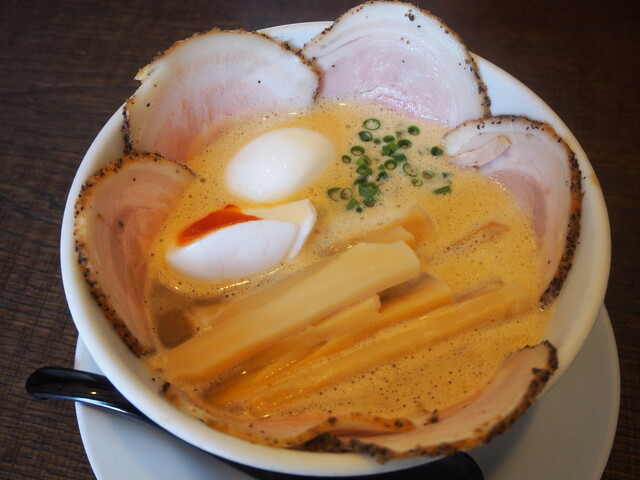
Tomio is not the postcard version of Nara. The approach is suburban, practical, and commuter-fed, which suits a ramen counter better than a temple-side address would. At Ramenya Mitsuba, the room is built around counter seating, and that format matters: ramen in Japan is judged at close range, bowl by bowl, with little distance between kitchen rhythm and diner. The appeal here sits in that immediate exchange, not in ceremony.
Nara’s dining conversation often tilts toward historic settings, tea sweets, kaiseki-adjacent meals, and polished Japanese rooms. Ramen occupies a different register. It is faster, cheaper, and more dependent on repetition. Ramenya Mitsuba’s inclusion in Tabelog Ramen WEST “Tabelog 100” 2025 places it inside the Kansai ramen conversation rather than only the Nara city conversation, a meaningful distinction in a region where Osaka and Kyoto tend to pull attention first.
A counter-led ramen shop in a city better known for slower meals
The useful way to read this address is as a corrective to the idea that Nara dining begins and ends around heritage tourism. The shop’s categories are ramen and tsukemen, a pairing that signals two related but different eating logics: soup noodles for immediacy, dipping noodles for concentration and pacing. Without inventing a house specialty, the format alone says plenty. Tsukemen shops live or die by noodle texture, broth density, and how the two hold together across the meal; ramen shops are judged by balance, temperature, and repeatability.
Ingredient sourcing is not publicly framed here through farm names or producer lists, so the sharper editorial point is structural: ramen sourcing is often expressed through stock, tare, noodle specification, fat, and garnish rather than the restaurant-language of provenance. In the Kansai ramen tier recognized by Tabelog’s 100 selections, a low price does not mean casual technique. It means a narrow product, high turnover, and a kitchen that has to make small decisions consistently under queue pressure.
That price band, JPY 1,000–1,999 for lunch and dinner, also separates the shop from Nara’s more formal Japanese dining. Wa Asuka, for instance, occupies a higher Japanese category in the city, while Unagino Toyokawa sits in a focused eel tradition. Those are different kinds of meals. Ramenya Mitsuba belongs to the compact, specialization-led side of Nara dining, closer in spirit to the way a patisserie such as Patisserie Chocolaterie Emera narrows attention to a specific craft rather than offering a broad restaurant evening.
Why the Tabelog 100 signal matters in Nara
Tabelog’s Ramen WEST “Tabelog 100” list is not a decorative badge in this category. Ramen is one of Japan’s densest food fields, with small shops competing through tiny differences in soup structure, noodle choice, and service flow. Selection in 2025, along with prior selections listed back through 2017, gives the shop a stronger trust signal than a single-year burst of attention. It suggests durable local demand and consistency across changing ramen trends.
The room’s 10 counter seats sharpen that point. A small counter cannot absorb demand the way a larger casual restaurant can, and ramen queues tend to form early because service is short and capacity is fixed. Numbered tickets may be distributed when lines build, with Saturdays and busy seasons drawing particularly heavy opening crowds. This is practical intelligence, but it also explains the cultural rhythm: the meal itself may be brief, while the decision to eat there can shape the morning.
For travellers building a Nara food itinerary, the comparison is less about finding a single category winner and more about choosing the city they want to taste. The broader scene includes contemporary cooking at akordu, French dining at A VOTRE SANTE, and Japanese rooms such as Ajinokaze Nishimura and Ajinotabibito Roman. The restaurant adds a different register: inexpensive, counter-based, and tightly focused. For broader planning, EP Club’s full Nara restaurants guide maps those choices across the city, with companion guides for Nara hotels, Nara bars, Nara wineries, and Nara experiences.
How to fit it into a serious Nara eating day
The shop is in Tomio Motomachi, with Tomio Station as the nearest rail anchor, so it works better as a planned detour than a casual add-on between central Nara sights. Hours are lunch-weighted, with weekday service listed from late morning into early afternoon and Saturday service starting earlier and running longer; Sundays and public holidays are listed as closed. Because temporary closures can occur, the sensible move is to confirm the current schedule before making the trip.
Reservations are unavailable, which keeps the experience in ramen’s walk-up tradition rather than the booking economy of tasting menus. Credit cards and several QR payment options are accepted, while electronic money is not. Parking is not provided, and the shop asks diners not to use the Lawson parking lot across the street; paid parking is available within a few minutes’ walk. The room is non-smoking, children are welcome, and the counter-only setup includes a counter at wheelchair height.
The restaurant is not trying to compete with Nara’s temple-adjacent hospitality or formal Japanese dining. Its value is narrower and, for the right diner, more useful: a recognized ramen and tsukemen counter where the city’s everyday eating culture can be read through queue discipline, compact seating, and a sub-JPY 2,000 bowl. That makes it a strong stop for travellers who care about how Nara eats beyond the expected historic frame.
Related Nara dining notes: 37+1 - Sanjuhachi, A VOTRE SANTE (French), Ajinokaze Nishimura (Japanese), Ajinotabibito Roman (Japanese), and akordu (Spanish, Innovative). For wider Japan and overseas context, see -Grilled beef Sukiyaki- KAMAKURA TANUKIAN 鎌倉 たぬき庵 in Kamakura. 鮪と炭火焼き うお炭 秋葉原店 in Tokyo.cafe in Osaka.know in Kumamoto, (Shoku) Vietnam in Kawasaki, [Curry Senmon Ten] Maruyama Kyoju. in Sapporo, Jōdo Saké Bar in Los Angeles, and Onigiri Time in Pasadena.
How It Stacks Up
Comparable venues by cuisine and price in the same metro.
| Venue | Cuisine | Price | Notes |
|---|---|---|---|
| Ramenya MitsubaThis venue — the venue you are viewing | Modern foamy ramen shop | $ | Not listed |
| Wakakusa Curry Honpo | Japanese Curry House with Vegan & Gluten-Free Options | $ | Nara |
| Menya K | Ramen & Tsukemen Shop | $ | Nara |
| Menya Eguchi | Ramen & Tsukemen Shop | $ | Nara |
| 焼鳥 望月(予約制) | Kaiseki | $ | Nara |
| Kanakana | Japanese cafe with healthy set meals and curry | $ | Nara |
Recognition history
Dated appearances from independent guides and award organizations, with the underlying list record or original source where available.
Tabelog 100 #41 · No. 41
Tabelog · Tabelog 100 - Ramen - WEST - 2025
Continue exploring
More in Nara




Bars in Nara
Browse all →

Hotels in Nara
Browse all →



Wineries in Nara
Browse all →
At a Glance
- Lively
- Cozy
- Solo
- Casual Hangout
- After Work
- Chefs Counter
- Standalone
A small, counter-only ramen shop with an energetic yet relaxed atmosphere, where guests sit shoulder-to-shoulder at a simple counter watching bowls of creamy, frothy ramen being prepared in a casual neighborhood setting.