
Tabelog 100 #64
Our verdict
Ramen Jiro Oomiya kouen ekimae ten brings the Jiro idiom to Saitama in a compact counter setting near Omiya Koen. Selection for Tabelog Ramen EAST “Tabelog 100” in 2024 and 2025 places it in a serious regional conversation, while its low-price ramen format keeps the experience closer to everyday Japanese eating than ceremony.

Pearl is the En Primeur Club membership app, where members save venues, book tables and use the concierge.
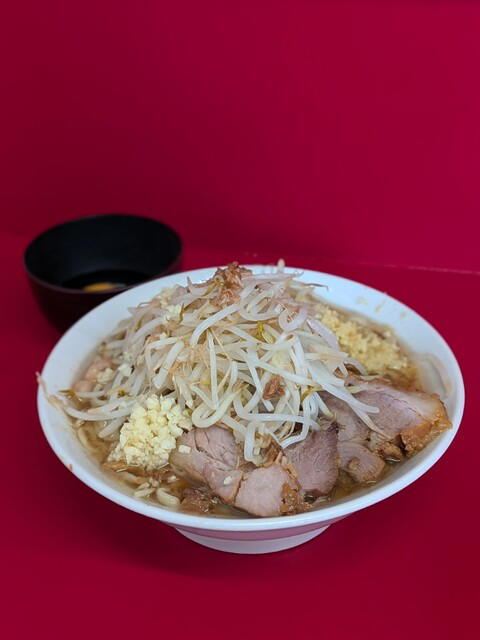
The menu
What to order
- Jiro-style ramen with strong non-emulsified pork broth
- Sho buta (pork-topped ramen)
- Jiro-style soupless (汁なし) ramen
Approaching a ramen shop in a focused local dining context is less about décor than tempo: the line, the quick decisions, the handover, and the concentrated silence once bowls land. In Saitama, that culture has a particular charge because it sits outside Tokyo’s densest ramen corridors yet speaks the same language of volume, ritual, and repeat custom. Ramen Jiro Oomiya kouen ekimae ten belongs to that stripped-back world, where the appeal depends on a diner’s appetite for a specific ramen experience rather than on restaurant theatrics.
Ramen has long occupied a category of its own within Japanese noodle culture. It is not defined by luxury cues or elaborate service, but by repetition, preference, and the way regulars read a room before ordering. Ramen Jiro Oomiya kouen ekimae ten’s listing in the 2025 Tabelog Hyakumeiten selection, with a published score of 3.72, gives it a public benchmark inside the Japanese ramen conversation, a field where modest formats can carry as much weight as polished dining rooms.
Ramen in Saitama is about format as much as flavor
The useful way to read this venue is through format. A ramen stop changes the social contract: diners arrive prepared, eat with focus, and make room for the next person. That compactness of purpose is not incidental. It is part of why ramen remains culturally potent, built around direct meals where the experience is intense, functional, and relatively democratic. In a city where dinner can range from casual noodle shops to higher-spend formats, this sits in the low-cost, high-commitment lane.
The price position matters. Ramen Jiro Oomiya kouen ekimae ten is listed in the JPY 1,000 to JPY 1,999 range for both lunch and dinner, which explains why ramen remains one of Japan’s sharpest value propositions: the meal can carry local identity without requiring fine-dining pricing. Within Saitama, it can be considered alongside allowed local names such as Noroshi Honten, Beach Story, Hibi Shushu, Ningyocho, and Yakiniku Kushin, but its natural frame is serious ramen rather than tasting-menu dining.
That distinction is important for travelers planning Saitama around food rather than sightseeing alone. Ramen here is not necessarily a soft landing; it is a cultural format with its own etiquette. The defining idea is the ramen itself: a focused bowl, direct service, and a rhythm that rewards attention. Specific ordering habits can vary by shop, so the smarter approach is to observe the room and keep the first order simple unless already fluent in the genre.
Saitama adds a local frame to the bowl
Saitama is not a single trophy-dining district, and that works in the restaurant’s favor. The setting gives the experience a local, everyday feel rather than a destination-restaurant mood. Saitama’s food map often rewards this kind of specificity: ramen counters, casual specialists, and other focused dining rooms dispersed across the city. For a wider look at that pattern, Our full Saitama restaurants guide is the natural starting point.
The city’s range is broader than ramen. Other Saitama dining rooms show different sides of the city’s everyday precision, from sweet-focused stops to casual specialist formats. Beach Story underlines how much of Saitama’s appeal can come from modest formats executed with focus, while the broader local scene gives travelers room to build a day around more than one kind of meal.
Travelers building a fuller Saitama stay should separate food planning from lodging and evening drinking, because the city does not behave like a single walkable dining quarter. Our full Saitama hotels guide, Our full Saitama bars guide, Our full Saitama wineries guide, and Our full Saitama experiences guide help place the ramen stop inside a wider itinerary rather than treating it as an isolated errand.
Where this fits in a Japan ramen itinerary
For visitors comparing ramen across Japan, the draw is not novelty but fluency. Ramen teaches a different lesson from sushi counters, kaiseki rooms, or broader casual dining: Japan’s dining culture prizes specialization at every price level. The 2025 Tabelog Hyakumeiten recognition signals that this is not merely a convenient bowl; it has been selected within a competitive ramen field. That is a meaningful credential in a cuisine where everyday customers often set the bar higher than guidebook readers expect.
The practical implication is simple: treat the visit as a focused ramen stop, not a lingering restaurant meal. The published category is ramen, the listed budget is modest, and the experience is best approached with appetite and attention. Solo dining can suit this kind of format well, but the main point is the public ritual of ramen eating, where the bowl takes precedence over conversation and the pace is set by the shop rather than by ceremony.
For readers mapping Japanese casual dining beyond Saitama, the contrast is useful. Other cities and regions have their own formats, price expectations, and service rhythms, while Saitama’s ramen culture rewards a more direct reading of value and repetition. Regional dining across Japan and Japanese-adjacent dining overseas can look very different once price, counter culture, and local habits are taken seriously, which is why this stop is best understood on its own terms.
Ramen Jiro Oomiya kouen ekimae ten is for diners who want Saitama’s ramen culture without translation into luxury cues. Its case rests on a recognized place in the 2025 Tabelog Hyakumeiten selection, a published score of 3.72, and a style of eating that asks for appetite and attention rather than ceremony.
Frequently asked questions
What's the pricing like at Ramen Jiro Oomiya kouen ekimae ten?
Pricing at Ramen Jiro Oomiya kouen ekimae ten is listed as JPY 1,000 - JPY 1,999 JPY 1,000 - JPY 1,999.
How do I find Ramen Jiro Oomiya kouen ekimae ten?
Ramen Jiro Oomiya kouen ekimae ten is located in Saitama.
Do they take walk-ins at Ramen Jiro Oomiya kouen ekimae ten?
Treat it as a focused ramen stop in Saitama and check the venue's latest official information before visiting.
What's the defining dish or idea at Ramen Jiro Oomiya kouen ekimae ten?
The point here is ramen: a focused bowl served in Saitama with little ceremony. That reading fits the venue’s listed category and its 2025 Tabelog Hyakumeiten recognition.
Do they accommodate allergies at Ramen Jiro Oomiya kouen ekimae ten?
Those details are not published. For severe allergies, this is a place where caution is sensible before ordering. Check the venue's official channels for the latest details.
Cost Snapshot
Nearby venues at a similar price tier for orientation.
| Venue | Cuisine | Price | Awards | Notes |
|---|---|---|---|---|
| Ramen Jiro Oomiya kouen ekimae tenThis venue (the venue you are viewing) | Jiro-style Ramen Shop | $10–20 | Tabelog 100 #64 | Not listed |
| Fujidana Udon | Traditional Saitama Musashino Udon | $10–20 | Tabelog 100 #55 | Nishi-ku, Traditional Saitama Musashino Udon |
| Inakaya Irori | Traditional Japanese Izakaya with Irori Hearth | Not listed | Tabelog 100 #69 | Urawa-ku, Traditional Japanese Izakaya with Irori Hearth |
| Holland Ken | Ramen | Not listed | Tabelog 100 #68 | Higashi Iwatsuki, Ramen |
| Teuchi Udon Matsuna | Handmade Udon | $1–10 | Tabelog 100 #49 | Urawa, Handmade Udon |
| かねかつ | Ramen & Tsukemen Shop | $10–20 | Tabelog 100 #9 | 北浦和 (Kita-Urawa), Traditional Shoyu Ramen & Abura Soba |
Recognition history
Dated appearances from independent guides and award organizations, with the underlying list record or original source where available.
Tabelog 100 #64 · No. 64
Tabelog · Tabelog 100 - Ramen - EAST - 2025
Continue exploring
More in Saitama
Restaurants in Saitama
All restaurants in Saitama →



Bars in Saitama
Browse all →







Details
- Lively
- Energetic
- Well Known
- Cozy
- Solo
- Casual Hangout
- Late Night
- After Work
- Standalone
- A La Carte
- Counter Dining
Compact, counter-only Jiro-style ramen shop with a busy, energetic atmosphere focused on quick solo meals rather than lingering; functional rather than design-driven.