Professor Pizza - Old Town
Our verdict
On North Wells Street in Old Town, Professor Pizza occupies the quieter, neighborhood-facing end of Chicago's pizza conversation, a counter away from the deep-dish tourist circuit. The address puts it within walking distance of the city's serious dining belt, while the format signals something more focused than casual. For visitors assembling a Chicago eating itinerary, it belongs on the same list as the neighborhood's broader culinary offerings.

Pearl is the En Primeur Club membership app, where members save venues, book tables and use the concierge.

The menu
What to order
- Grandma-style Deluxe Pepperoni
- Mozzarella Onion Rings
- Sicilian Sausage Pizza
Old Town's Pizza Counter in Context
North Wells Street has long functioned as one of Chicago's more livable commercial strips: bookshops, independent bars, and restaurants that serve the neighborhood before they serve the tourist map. At 1610 N Wells St, Professor Pizza sits in that tradition, a pizza address in a part of the city where the competition is defined less by deep-dish spectacle and more by the regulars who walk over from Eugenie Street or Schiller. Chicago's pizza conversation is famously loud, but the most interesting arguments rarely happen at the tourist-facing flagships. They happen at smaller, neighborhood-embedded counters where the format is stripped of theater.
That neighborhood character matters when orienting Professor Pizza against the wider Chicago dining picture. The city's upper tier, places like Alinea, Smyth, and Oriole, operates in an entirely different register, with tasting menus, multi-month booking windows, and price points that place them alongside Le Bernardin in New York City or The French Laundry in Napa. Professor Pizza is not in that tier. It occupies the everyday-but-considered slot, the kind of address that earns its neighborhood reputation through consistency rather than critical ceremony.
The Sensory Register of a Pizza Neighborhood
Pizza at this price and format level communicates through smell first. A wood or deck oven running at high heat for hours saturates the surrounding block, char, flour, and the faint sweetness of caramelized cheese edge out from the door before the sign registers. In Old Town, that olfactory signal carries particular weight because the block otherwise reads as residential: greystone facades, mature trees, a rhythm set by foot traffic rather than cab drop-offs.
Inside, the sensory argument shifts to sound and light. Pizza counters at the neighborhood end of the market tend toward the informal: hard surfaces, ambient noise that reflects off tiled or bare-concrete walls, the percussion of a peel sliding across a stone surface. This is the acoustic register of a working kitchen operating without acoustic management, an honesty that the more composed dining environments of places like Kasama or Next Restaurant deliberately foreclose. For diners arriving from a heavier evening schedule, that contrast is part of the appeal.
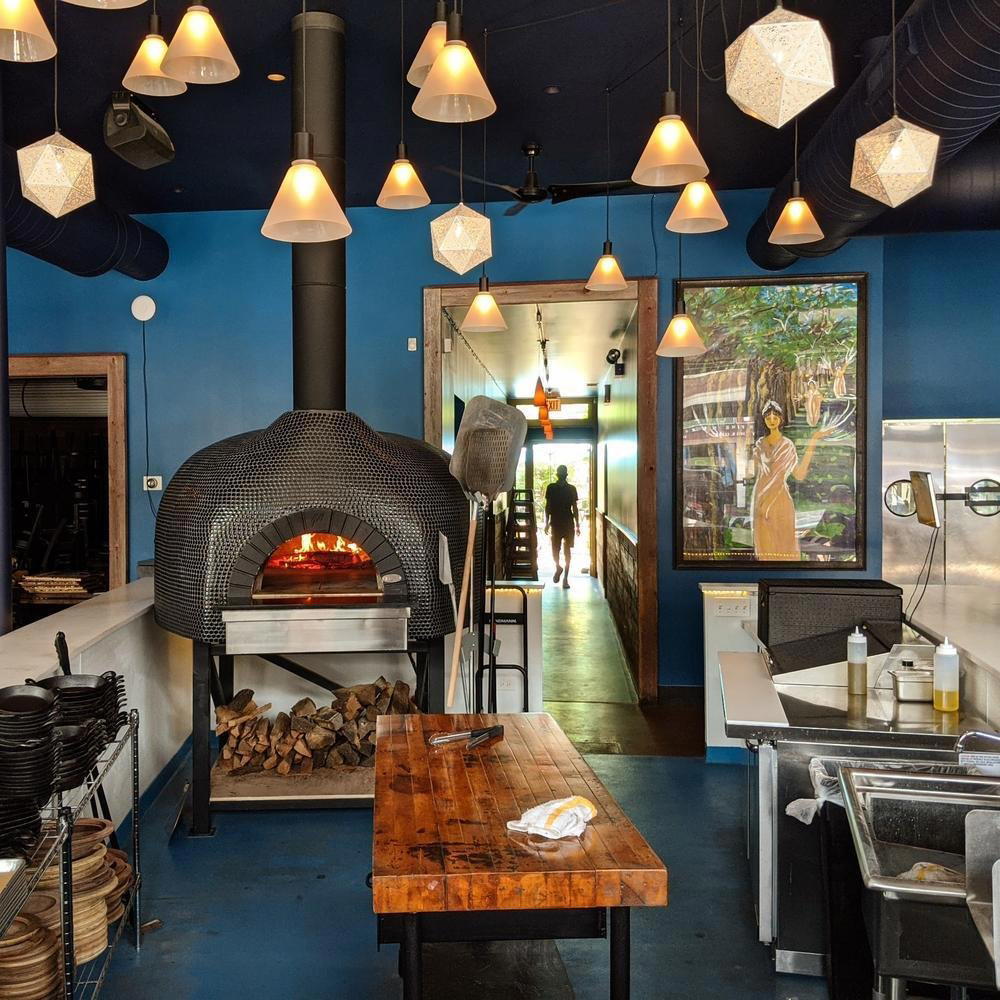
The visual language of a well-run pizza counter is itself a kind of argument: dough in visible stages, toppings prepped in hotel pans at the make line, the dome of a crust blistering under direct heat. These are signals that operate below conscious evaluation, they tell a diner, before a single bite, whether the fundamentals are being respected. A poorly maintained make line or a pale, steam-soft crust communicates as clearly as any review.
Where Professor Pizza Sits in Chicago's Pizza Conversation
Chicago's relationship with pizza is more complicated than the deep-dish shorthand suggests. The city has a functioning thin-crust tradition (the tavern-cut square, served room-temperature at the bar) that predates the tourist-facing deep dish by decades, and a growing cohort of Neapolitan and New York-influenced counters that have arrived over the past fifteen years. Professor Pizza addresses itself to that newer tier, the pizza-as-craft segment that has expanded in neighborhoods like Logan Square, Wicker Park, and, increasingly, Old Town.
Within that segment, the positioning question is always between the fast-casual slice shop (high volume, low dwell time) and the sit-down table-service format with a focused menu and longer per-cover averages. Old Town supports both models; the Wells Street corridor has seen both come and go.
For a richer sense of how Chicago's restaurant map has developed across neighborhoods and price points, the full Chicago restaurants guide provides context across categories. Comparable craft-focused operators in other American cities, Lazy Bear in San Francisco, Bacchanalia in Atlanta, Providence in Los Angeles, illustrate how neighborhood-anchored restaurants with a point of view tend to outperform their address over time. The category and price tier are different, but the underlying logic is the same: specificity earns loyalty.
Planning Your Visit
Old Town is accessible by the Brown and Purple Lines (Sedgwick station is the closest CTA stop, approximately four blocks south of the address). The neighborhood runs dense with foot traffic on weekend evenings, particularly in the stretch between North Avenue and Armitage. Arriving earlier in the evening generally means shorter waits and a quieter room, if the format supports table seating.
For visitors building a longer Chicago eating itinerary, Professor Pizza functions as a lower-commitment evening, the kind of meal that pairs well before or after a visit to the nearby Second City theater, which sits one block east on North Wells. That proximity shapes the dinner-hour crowd and the pace of service.
| Venue | Category | Price Tier | Booking Lead Time | Neighbourhood |
|---|---|---|---|---|
| Professor Pizza - Old Town | Pizza / Casual | Not confirmed | Walk-in likely | Old Town, Chicago |
| Kasama | Filipino / $$$$ | $$$$ | Weeks in advance | Ukrainian Village, Chicago |
| Next Restaurant | American / $$$$ | $$$$ | Months in advance | West Loop, Chicago |
| Smyth | Progressive American / $$$$ | $$$$ | Months in advance | West Loop, Chicago |
Frequently asked questions
What dish is Professor Pizza - Old Town famous for?
The name references pizza specifically, placing it in Chicago's craft-pizza segment rather than the deep-dish or tavern-cut traditions that dominate the city's wider reputation. No specific signature dish is confirmed in the available record, but the address and format point toward a focused, pizza-forward menu. Context from Alinea and other Chicago operators illustrates how differently the city's restaurants approach their core product.
Do I need a reservation for Professor Pizza - Old Town?
Given the casual, neighborhood-counter format and Old Town's weekend foot traffic, walk-in availability on busy evenings cannot be assumed. Arriving before peak dinner hours (before 7pm on weekends) is the practical hedge. Venues at the award-holding end of the Chicago market, Oriole, Smyth, require advance booking of weeks to months; Professor Pizza operates at a different tempo, but confirmation from the venue directly is the only reliable source for current policy.
What has Professor Pizza - Old Town built its reputation on?
No awards or named critical recognition appear in the available record. The reputation, to the extent it is documentable, is neighborhood-level: the kind of sustained local patronage that a Wells Street address in Old Town accumulates through consistent product rather than ceremony. The craft-pizza segment across American cities, from Chicago to San Francisco, tends to build this way, below the Michelin line but above the commodity slice tier. Cuisine specifics beyond the pizza category are not confirmed.
What if I have allergies at Professor Pizza - Old Town?
No phone number or website is confirmed in the available record, which limits pre-visit verification options. For allergy-related queries, the most reliable approach is visiting the address directly during off-peak hours to speak with staff before committing to a meal. Chicago's food safety ordinances require disclosure of major allergens, which sets a baseline, but flour-heavy pizza kitchens present cross-contamination considerations that vary by operation. Other Chicago venues with confirmed digital contact points, including those in our full Chicago guide, may be easier to verify remotely.
Is Professor Pizza - Old Town suitable for a casual dinner before a show at Second City?
The Wells Street address places Professor Pizza approximately one block from Second City, making it a practical pre-show option for the Old Town neighborhood's most visited evening destination. The format, a neighborhood pizza counter rather than a table-service dining room, supports a dinner that can be completed within a predictable time window, which matters when working around fixed show times. The pairing is a logical one for visitors combining Chicago's comedy and dining scenes in a single evening.
A Lean Comparison
Comparable venues nearby, for context on price, style, and recognition.
| Venue | Cuisine | Price | Notes |
|---|---|---|---|
| Professor Pizza - Old TownThis venue (the venue you are viewing) | Chicago-Style Pizza | $20–30 | Not listed |
| The Bellevue | Contemporary American | $30–50 | Gold Coast, Contemporary American |
| Mirella's Tavern | Modern American Tavern | $20–30 | Wicker Park, Modern American Tavern |
| Sanders BBQ Prime | Texas-Style BBQ | $20–30 | Beverly, Texas-Style BBQ |
| Chicago Chefs Cook | Midwest Seasonal Cuisine | Not listed | Chicago, Midwest Seasonal Cuisine |
| Hoyt's Chicago | Modern American Tavern | $30–50 | Loop, Modern American Tavern |
Continue exploring
More in Chicago
Restaurants in Chicago
All restaurants in Chicago →
Bars in Chicago
All bars in Chicago →
Details
- Lively
- Trendy
- Casual Hangout
- Group Dining
- Open Kitchen
- Beer Program
- Craft Cocktails
- A La Carte
- Gluten Free Options
Current opening hours
- Monday
- 4–10 PM
- Tuesday
- 4–10 PM
- Wednesday
- 4–10 PM
- Thursday
- 4–10 PM
- Friday
- 11 AM–12 AM
- Saturday
- 11 AM–12 AM
- Sunday
- 11 AM–10 PM
Hours can change for holidays and private events. Hours as of .
Moderate noise level with a casual, energetic pizza spot atmosphere.