
A Michelin Plate recipient on Queen Street, Pondok Makan Indonesia sits in the small tier of Singapore hawker stalls where Indonesian home-cooking registers against the city's broader recognition infrastructure. Priced at the dollar-sign floor, it draws a crowd that values direct Indonesian flavour at hawker speed.
Pearl is the En Primeur Club membership app — saves, bookings, and concierge access live there. Same editors, same standards.
- Address
- 270 Queen St, Singapore 180270
- Directions
- Get directions
 Saves & bookings on Pearl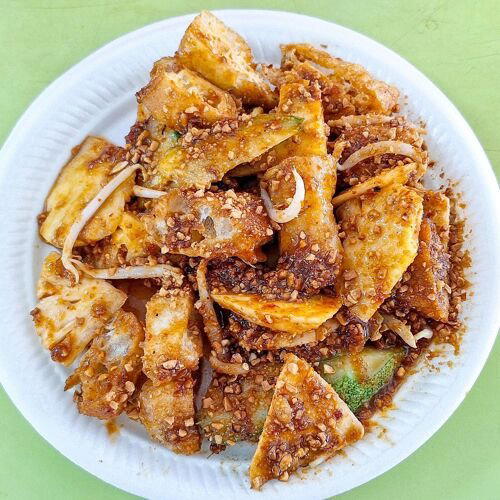
Queen Street and the Indonesian Hawker Register
Singapore's hawker scene has accumulated more Michelin recognition than almost any other street-food system in the world, and the awards have done something interesting to the geography of the city's eating. Stalls that once existed purely in local neighbourhood memory now pull cross-town queues. The stretch around Queen Street, running alongside the Bugis corridor and close to the edge of Little India, sits in a part of the city where the lunch population is dense and the cooking tends to be functional rather than theatrical. There is no ambient lighting to speak of, no curated playlist, and no front-of-house briefing. The sensory experience is the food itself: the heat rolling off woks, the layered funk of fermented shrimp paste, the sharp lift of fresh sambal catching the back of the throat before anything hits the table.
Pondok Makan Indonesia, at 270 Queen Street, occupies this context. The 2024 Michelin Plate places it in a tier of recognition that the Guide reserves for kitchens cooking carefully and consistently, one step below the starred category but clearly above the city's anonymous baseline.
The Sensory Register of Indonesian Street Cooking
Indonesian food communicates differently from the Cantonese or Hokkien traditions that dominate much of Singapore's hawker infrastructure. Where a bowl of prawn noodles from a stall like 545 Whampoa Prawn Noodles derives its character from a slow-reduced shellfish stock, Indonesian cooking tends to build flavour through pastes ground from fresh aromatics: lemongrass, galangal, turmeric, candlenut. The process is more upfront in its signalling. You smell a kitchen cooking Indonesian food before you see the dishes arrive.
The visual grammar is also distinctive. Dishes arrive in shades of ochre, amber, and dark mahogany from the long braises of rendang and semur. Coconut milk clouds broths and enriches sauces without the clear-stock transparency of, say, the pork noodle tradition that earns places like Hill Street Tai Hwa Pork Noodle its own Michelin attention. The textural range runs from the yielding collapse of slow-cooked protein to the crunch of fried shallots scattered over rice. At hawker pace, these components arrive quickly, without the deliberate sequencing of a tasting format. The food lands and you eat it hot.
In the broader Southeast Asian street-food context, this style of cooking is well represented across Penang, Phuket, and the Thai-Malaysian border corridor, where hawker stalls built around a single dominant dish or regional tradition hold their ground across generations. Stalls like 888 Hokkien Mee in George Town or A Pong Mae Sunee in Phuket operate on a similar logic: a narrow focus, a consistent technique, and a customer base built on repetition rather than novelty. Pondok Makan Indonesia reads in that tradition.
Where It Sits in Singapore's Recognition Tiers
The gap between a Michelin Plate and a starred listing in Singapore is not always a gap in quality; it is often a gap in format scalability and consistency of supply. The city's starred hawker stalls, from the fish soup counters to the char kway teow specialists, have typically demonstrated the capacity to sustain quality across hundreds of covers over years. The Plate category catches kitchens doing the cooking correctly without yet meeting that additional threshold. It is the category where most of Singapore's serious hawker cooking actually lives.
At the price point Pondok Makan Indonesia occupies, it prices against the same competitive set as A Noodle Story and 91 Fried Kway Teow Mee, both of which have their own Michelin histories. The comparison is useful: those stalls built recognition around Singaporean-Chinese hawker categories with broad name recognition. Indonesian cooking in Singapore occupies a smaller niche, which means the Michelin Plate here carries slightly different weight. It signals that the Guide's inspectors are tracking Indonesian cuisine at hawker level, not just the Cantonese and Hokkien formats that dominate the starred tier.
The wider Singapore dining picture, where Adam Rd Noo Cheng Big Prawn Noodle and comparable institutions hold their ground through sheer consistency, suggests that the Plate award at this end of the market is earned through the same mechanism: repetition and reliability rather than creative reinvention. That is the correct framework for reading the restaurant's credential.
Planning Your Visit
The Queen Street address places the stall within walking distance of Bugis MRT and the Bras Basah precinct, making it accessible without requiring a dedicated trip to an outer residential neighbourhood. Lunch hours at hawker operations in this part of the city tend to produce the longest queues; arriving outside the 12pm to 1:30pm window typically reduces wait time. No booking infrastructure exists at this price tier and format.
For readers building a broader Singapore eating itinerary, our full Singapore restaurants guide covers the range from hawker to fine dining. If you are planning beyond restaurants, our Singapore hotels guide, bars guide, wineries guide, and experiences guide cover the city's other categories in comparable depth.
For comparison in the regional street-food context, the George Town stalls including Ah Boy Koay Teow Th'ng, Air Itam Duck Rice, Air Itam Sister Curry Mee, and Ali Nasi Lemak Daun Pisang operate in a similar register of heritage cooking with long local track records. Further afield, Anuwat in Phang Nga and Banana Boy in Hong Kong illustrate how the street-food format holds across different city contexts in the region.
Quick reference: 270 Queen Street, Singapore 180270. Michelin Plate 2024. Price range: $.2 (99 reviews). Walk from Bugis MRT.
Side-by-Side Snapshot
Comparable venues nearby, for context on price, style, and recognition.
| Venue | Cuisine | Price | Awards | Notes |
|---|---|---|---|---|
| Pondok Makan IndonesiaThis venue — the venue you are viewing | Indonesian Hawker | $ | Michelin Plate | Not listed |
| Chomp Chomp Satay | Singaporean Satay | $ | Michelin Plate | SERANGOON GARDEN |
| R&B Express | Singaporean Hawker BBQ | $ | Michelin Plate | NEWTON CIRCUS |
| Sungei Road Laksa | Traditional Singapore Laksa | $ | Not listed | SUNGEI ROAD |
| Unforgettable Carrot Cake | Singaporean Fried Carrot Cake (Chai Tow Kway) | $ | Michelin Plate | HENDERSON HILL |
| Killiney Kopitiam | Traditional Singaporean Kopitiam | $ | Not listed | OXLEY |
Recognition history
Dated appearances from independent guides and award organizations, with the underlying list record or original source where available.
Michelin Plate
Michelin
Continue exploring
More in Singapore
Restaurants in Singapore
Browse all →
Bars in Singapore
Browse all →
At a Glance
- Lively
- Casual Hangout
- Standalone
Current opening hours
- Monday
- 8 AM–7 PM
- Tuesday
- 8 AM–7 PM
- Wednesday
- 8 AM–8 PM
- Thursday
- 8 AM–8 PM
- Friday
- 8 AM–8 PM
- Saturday
- 8 AM–8 PM
- Sunday
- 8 AM–8 PM
Hours can change for holidays and private events. Last verified .
Casual hawker centre atmosphere with bustling energy from food centre crowds.