
A Michelin Plate-recognised satay stall at Chomp Chomp Food Centre in Serangoon Gardens, operating at the $ price point Singapore's hawker tradition was built on. Rated 4.5 on Google across 26 reviews, it occupies a specific slot in the city's street food hierarchy: serious enough for Michelin notice, casual enough for a Tuesday night. Find it at #01-34, Kensington Park Road.
Pearl is the En Primeur Club membership app — saves, bookings, and concierge access live there. Same editors, same standards.
- Address
- 557269Singapore, Kensington Park Rd, 20号#01-34
- Directions
- Get directions
 Saves & bookings on Pearl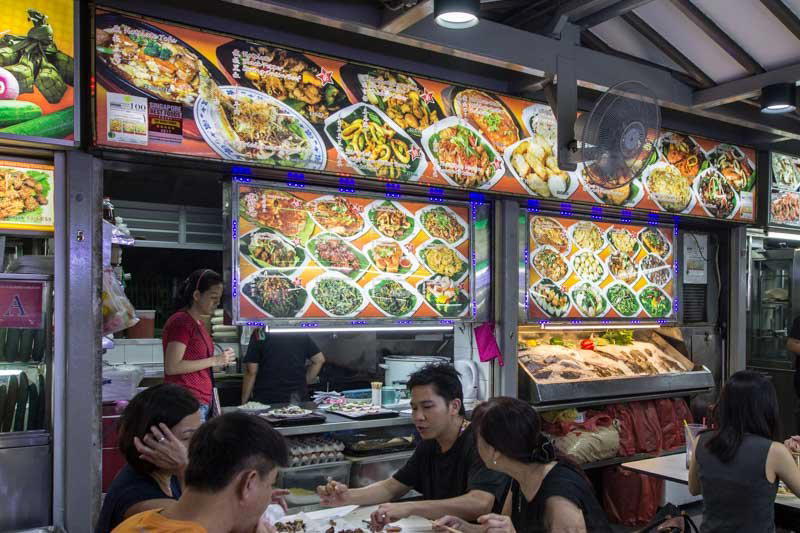
The Hawker Setting: Open-Air, Functional, and Intentionally Unglamorous
Chomp Chomp Food Centre in Serangoon Gardens operates according to the logic that has governed Singapore's hawker ecosystem for decades. Plastic chairs. Laminate tables. Overhead fans that circulate warm evening air without quite defeating it. The physical space is a deliberate non-event — which is precisely the point. Singapore's hawker centres were designed by the state in the 1970s to consolidate itinerant street vendors into permanent, hygienic structures, and the architecture has changed very little since. The format strips away every distraction and focuses attention on the food.
Chomp Chomp itself occupies an open-air format typical of older neighbourhood centres: a broad, shed-like roof over an expanse of shared seating, with stalls arranged around the perimeter. Stall #01-34 is where Chomp Chomp Satay operates, and the address is less a luxury coordinates system than a practical grid reference for a space where navigation happens on foot, by smell, and by following the smoke.
That smoke matters. Satay is grilled over charcoal, and the haze that drifts across the seating area at Chomp Chomp on a busy evening is one of those sensory markers that distinguishes hawker satay from anything produced in a restaurant kitchen. The physical setting — open sides, moving air, no acoustic control, means the experience arrives as a full-environment event, not a contained dining room transaction.
Where Chomp Chomp Satay Sits in Singapore's Street Food Hierarchy
Singapore's food awards structure has a specific mechanism for recognising hawker stalls: the Michelin Plate, a designation that signals cooking worth seeking out without the price-tier implications of a star. Chomp Chomp Satay holds a Michelin Plate for 2024, placing it in a cohort of hawker operators that have cleared a formal quality threshold. For context, that cohort includes stalls operating at the $ price point across Singapore's neighbourhood centres, the same bracket as Hill Street Tai Hwa Pork Noodle, 545 Whampoa Prawn Noodles, and 91 Fried Kway Teow Mee.
The Michelin Plate does not rank stalls against each other. What it does is mark them as operating above the general baseline, a useful filter in a city where the baseline is already high.
Across Southeast Asia, satay's regional variations are significant. Singapore's version typically involves marinated skewers of chicken or mutton grilled over charcoal and served with a peanut sauce that tends toward sweetness, accompanied by compressed rice cakes and raw onion. The technique prioritises a slightly charred exterior and a moist interior, a balance that separates competent satay from the version worth seeking out. For comparison, the broader street food tradition across the region includes 888 Hokkien Mee in George Town and A Pong Mae Sunee in Phuket, each operating within their own hawker or market formats with similarly specific regional logics.
Serangoon Gardens and What the Neighbourhood Contributes
Serangoon Gardens is a mid-century residential estate in the northeast of Singapore, built originally for civil servants and still characterised by landed housing, a village-scale commercial strip, and a pace that reads as deliberately unhurried relative to the city centre. Chomp Chomp Food Centre sits at the heart of that neighbourhood identity. It is not a tourist destination in the way that Newton or Lau Pa Sat are; it functions primarily as a local eating ground, which gives the visitor a different kind of experience from Singapore's more trafficked hawker sites.
The neighbourhood context shapes who eats here and when. Weekend evenings at Chomp Chomp run dense, with families and groups occupying tables across the centre for long, multi-stall meals. The format encourages that kind of grazing: one party member holds a table while others circulate between stalls, assembling a meal from several vendors simultaneously. Satay is well-suited to this model, it arrives by the stick, priced accessibly, and holds reasonably well while other dishes are gathered.
The Stall Format and What It Signals
Hawker stalls in Singapore's Michelin-recognised cohort tend to share a structural characteristic: they are single-operator or small family-run enterprises where the physical setup is minimal and the cooking is concentrated. The stall at #01-34 operates within that model. There is no interior design consideration beyond function. The counter, the grill, and the workflow are the architecture.
This is worth stating as an editorial point: the design philosophy of Singapore's hawker tradition is one of radical reduction. The stall exists to produce one thing well, repeatedly, at volume. The physical container communicates exactly that. Visitors accustomed to curated dining environments should recalibrate expectations accordingly, the experience at Chomp Chomp Satay is defined by the food and the setting's communal energy, not by the space itself. That reduction is a feature, not a limitation.
Other Michelin-recognised Singapore hawker operators in the noodle category follow a similar physical logic: A Noodle Story and Adam Rd Noo Cheng Big Prawn Noodle both operate from small stall formats where queues and turnover define the rhythm of service. Chomp Chomp Satay fits that pattern.
Planning a Visit
Chomp Chomp Food Centre is located at 20 Kensington Park Road, Singapore 557269. Stall #01-34 is Chomp Chomp Satay's position within the centre. The price tier is $, consistent with hawker-centre pricing across Singapore. No booking method is listed, which is standard for hawker stalls; arrival, queue management, and table-finding operate on the informal systems that govern all of Chomp Chomp's vendors.
The centre draws its heaviest crowds on weekend evenings, so visitors prioritising a lower-pressure experience should consider early weekday dinners. Singapore's hawker centres generally operate on a cash or local payment basis; carrying cash remains useful at older neighbourhood centres. For a broader orientation to what Singapore's food scene covers at every price tier, from this $ bracket through to the $$$$ end occupied by the likes of Zén and Jaan by Kirk Westaway, see our full Singapore restaurants guide. For hotels, bars, and experiences across the city, the respective guides are available: Singapore hotels, Singapore bars, and Singapore experiences.
Readers interested in the hawker street food tradition across the broader region will find useful comparison points in George Town's stall culture: Ah Boy Koay Teow Th'ng, Air Itam Duck Rice, Air Itam Sister Curry Mee, and Ali Nasi Lemak Daun Pisang each represent the Penang variant of the hawker model, with its own distinct culinary register. Further afield, Anuwat in Phang Nga and Banana Boy in Hong Kong illustrate how street food formats adapt to different urban contexts across the region. A Singapore wineries guide is also available for those extending their visit.
What to Order at Chomp Chomp Satay
The stall's name and Michelin Plate designation point directly at the satay. Singapore's hawker satay typically offers chicken and mutton as the core options, served in multiples of five or ten sticks alongside peanut sauce, compressed rice cakes (ketupat), and raw cucumber and onion. The peanut sauce is the variable that most distinguishes one satay stall from another: its sweetness level, texture, and depth of spice are what Michelin assessors and regular customers are both calibrating when they return. Given the Plate recognition and the 4.5 rating, the satay here performs at the upper range of what the hawker format produces. Order in quantity, at $ pricing, the economics of ordering broadly are firmly in the visitor's favour.
How Chomp Chomp Satay Singapore compares with similar nearby venues.
| Venue | Cuisine | Price | Awards |
|---|---|---|---|
| Chomp Chomp Satay | Street Food | $ | Michelin Plate (2024) |
| Ah Hock Fried Hokkien Noodles | Street Food | $ | Not listed |
| Sin Huat Seafood Restaurant | Street Food | $$ | Not listed |
| Song Kee Teochew Fish Porridge | Street Food | $ | Not listed |
| Ah Ter Authentic Teochew Fish Ball Noodles | Street Food | $ | Not listed |
| Fu He Turtle Soup | Street Food | $ | Not listed |
Recognition history
Dated appearances from independent guides and award organizations, with the underlying list record or original source where available.
Michelin Guide Plate
Michelin Guide
Michelin Plate
Michelin
Continue exploring
More in Singapore
Restaurants in Singapore
Browse all →
Bars in Singapore
Browse all →
At a Glance
- Lively
- Energetic
- Casual Hangout
- Family
- Group Dining
- Open Kitchen
Current opening hours
- Monday
- 5:30–9 PM
- Tuesday
- 5:30–9 PM
- Wednesday
- 5:30–9 PM
- Thursday
- 5:30–9 PM
- Friday
- 5:30–9 PM
- Saturday
- 5:30–9 PM
- Sunday
- 5:30–9 PM
Hours can change for holidays and private events. Last verified .
Bustling hawker centre atmosphere with lively crowds, sizzling grills, and communal seating under open-air conditions.
Know Before You Go
- Getting there
- 557269Singapore, Kensington Park Rd, 20号#01-34