Air Itam Sister Curry Mee

Michelin Plate
Our verdict
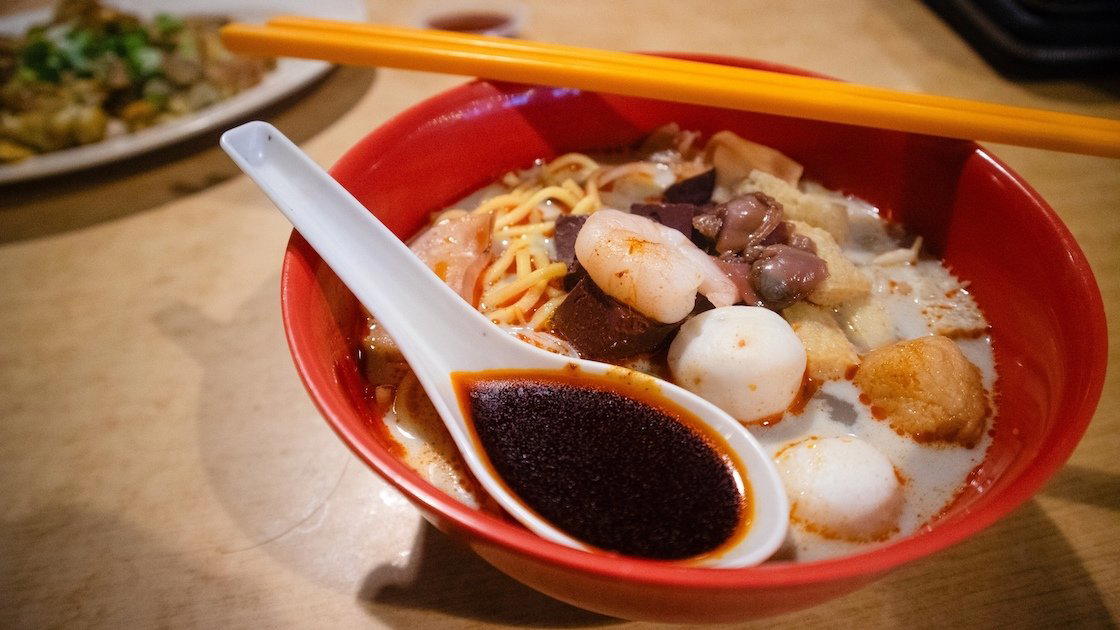
A Michelin Plate recipient operating out of a market stall in Ayer Itam, this George Town institution serves Penang-style curry mee cooked over charcoal in a soup built from spices, chilli paste, and coconut milk. Tofu puffs and spring squid add textural contrast. Prices sit firmly in the single-dollar tier, making it one of the most accessible entry points into serious Penang hawker cooking.

Pearl is the En Primeur Club membership app, where members save venues, book tables and use the concierge.
The menu
What to order
- Curry Mee
- Curry Mee with Cuttlefish Sambal
A Market Stall at the Edge of George Town
Ayer Itam sits west of George Town's heritage core, past the shophouse rows and tourist-facing coffee shops, in a part of Penang where the food still answers primarily to the people who live nearby. The market at Jalan Air Itam runs on its own schedule, and Air Itam Sister Curry Mee operates inside that rhythm. The setting is functional: stalls, shared tables, the noise of a working market rather than the curated atmosphere of a heritage-district hawker centre. Approaching the stall, the first signal is the charcoal heat. Penang curry mee cooked over charcoal produces a different base character than gas-fired versions, a slower, more sustained heat that affects how the coconut milk integrates with the spice paste. That physical detail explains much of what arrives in the bowl.
Penang Curry Mee and What the Bowl Actually Represents
Curry mee is one of Penang's most contested noodle formats. Unlike char kway teow, which has a reasonably defined wok-breath and ingredient logic, curry mee varies significantly between stalls: some lean toward a thinner, more broth-dominant soup; others build a richer, coconut-forward base. The version served here sits in the latter category. The soup is built from spices, chilli paste, and coconut milk, and the Michelin inspectors who awarded the stall a Plate recognition in 2024 noted its balance specifically. Tofu puffs soak the broth and add a soft, yielding texture against the noodles; spring squid provides a firmer counterpoint. These are not decorative additions, they are load-bearing elements in a bowl calibrated for textural contrast.
Comparing formats across George Town helps locate what this stall represents. Duck Blood Curry Mee approaches the same format with a different set of toppings and a bolder iron note from its namesake ingredient. Ah Boy Koay Teow Th'ng works in the lighter, clearer broth register of koay teow th'ng rather than the coconut-based curry mee tradition. Each represents a distinct strand of Penang noodle cooking; Air Itam Sister Curry Mee is firmly anchored in the richer, spice-paste-driven lineage.
What the Michelin Plate Signals in This Context
Michelin began including Penang in its Malaysia guide, and the Plate designation, awarded to restaurants serving food of good quality, one tier below a star, carries a specific meaning at street food level. It does not claim that a stall is producing food comparable to a starred kitchen. What it signals is that inspectors found consistent technique and a distinct identity. For a curry mee stall in a local market, that recognition functions primarily as an external quality anchor. It does not change the format, the pricing, or the audience. The stall still serves the Ayer Itam neighbourhood first.
For context on what Michelin recognition at street food level looks like across the region, Hill Street Tai Hwa Pork Noodle in Singapore holds a full star and operates at a similar counter format. 545 Whampoa Prawn Noodles and 91 Fried Kway Teow Mee occupy the Plate tier in Singapore's hawker scene. The Plate category has become Michelin's mechanism for acknowledging the quality depth inside Southeast Asia's street food formats without forcing those formats into a fine-dining comparison. Air Itam Sister Curry Mee sits inside that broader regional acknowledgment.
The Ayer Itam Context and Why Location Matters
The address at 612-T, Jalan Air Itam places this stall in Pekan Ayer Itam, the commercial and market district of Ayer Itam rather than in the UNESCO-listed heritage zone that most first-time visitors to Penang default to. That distinction matters for the experience. The clientele skews local; the surrounding stalls serve the market's working population; the physical space is not optimised for visitors. This is not a criticism. It is the condition that makes the food credible. Penang's hawker tradition has always been most intact in its neighbourhood-serving iterations rather than in the high-traffic zones where presentation has started to shade toward the performative.
Within Ayer Itam itself, Air Itam Duck Rice represents another strong anchor in the same geographic cluster, a different format, but equally rooted in the neighbourhood rather than the tourist circuit. The concentration of serious hawker cooking in this part of Penang is not accidental. Ayer Itam's market infrastructure has supported specialist food producers for decades, and the stalls that survive in that environment do so through repeat local custom, not through visitor traffic.
Practical Information for Visitors
Getting to Ayer Itam from central George Town requires a short drive or a grab ride west; it is not walkable from the heritage district. The market setting means arriving with some tolerance for the functional conditions of a working market stall: shared seating, ambient noise, no air conditioning. Prices sit at the single-dollar tier, consistent with the stall's local-market context and well below the pricing of George Town's mid-range sit-down restaurants. If the visit is part of a broader George Town food itinerary, the full George Town restaurants guide maps the city's hawker, casual, and fine-dining layers across neighbourhoods. Those planning a longer stay can consult the George Town hotels guide for accommodation context, and the bars guide and experiences guide for the rest of the city's offer.
For those building a regional comparison across Malaysia, Bee See Heong in Seberang Perai represents the hawker tradition on the mainland side of the strait, while Dewakan in Kuala Lumpur and The Planters at The Danna in Langkawi mark the upper end of Malaysian restaurant dining, a useful frame for understanding how wide the country's recognised food range now extends. And for visitors connecting to Penang from Thailand, A Pong Mae Sunee in Phuket offers a point of comparison in how hawker-adjacent street cooking earns recognition across the region. Closer to home, Ali Nasi Lemak Daun Pisang and 888 Hokkien Mee on Lebuh Presgrave fill out George Town's recognised hawker circuit alongside the curry mee stalls. The A Noodle Story entry in Singapore provides a further regional reference point for what contemporary noodle cooking looks like when it moves toward a more chef-driven format.
Frequently asked questions
What should I expect atmosphere-wise at Air Itam Sister Curry Mee?
This is a working market stall in Pekan Ayer Itam, roughly 10 to 15 minutes west of George Town's UNESCO heritage district by car or Grab. Seating is shared, the setting is functional, and the crowd is predominantly local. There is no reservation system and no front-of-house formality, the draw is the bowl, not the room.
Is Air Itam Sister Curry Mee award-winning?
Air Itam Sister Curry Mee has received recognition including: This shop in a market serves Penang-style curry mee at friendly prices. The mee is cooked over charcoal, in a well-balanced soup with spices, chilli paste and coconut milk; tofu puffs and spring squid add contrasting textures.; This shop in….
What do regulars order at Air Itam Sister Curry Mee?
The menu centres on Penang-style curry mee: a coconut-milk and spice-paste soup cooked over charcoal, topped with tofu puffs and spring squid for textural contrast. The Michelin Plate citation (2024) specifically references the balance of spices, chilli paste, and coconut milk as the kitchen's defining strength. Prices sit at the $ tier, keeping this firmly in daily-meal territory for Ayer Itam regulars.
A quick peer list to put this venue’s basics in context.
| Venue | Cuisine | Price | Awards | Notes |
|---|---|---|---|---|
| Air Itam Sister Curry MeeThis venue (the venue you are viewing) | Penang Curry Mee | $1–10 | Michelin Plate | Not listed |
| Au Jardin | Modern European with Local Accents | $200–300 | 1 Michelin Star · World's 50 Best #39 | European Contemporary |
| Auntie Gaik Lean's Old School Eatery | Peranakan (Nyonya) | $10–20 | 1 Michelin Star | Peranakan |
| Ah Boy Koay Teow Th'ng | Teochew Koay Teow Th'ng | $1–10 | Michelin Bib Gourmand | Street Food |
| Aria | Modern American | Not listed | Not listed | Not listed |
| Communal Table by Gēn | Modern Malaysian Fusion | $30–50 | Michelin Bib Gourmand · Star Wine List | Malaysian |
Recognition history
Dated appearances from independent guides and award organizations, with the underlying list record or original source where available.
Michelin Plate
Michelin
Full recognition history (3 entries)
Michelin Plate
Michelin
Michelin Plate
Michelin
Continue exploring
More in George Town
Restaurants in George Town
All restaurants in George Town →
Bars in George Town
All bars in George Town →
Details
- Well Known
- Rustic
- Lively
- Casual Hangout
- Brunch
- Solo
- Open Kitchen
- Historic Building
- A La Carte
Current opening hours
- Monday
- 6:30–11:30 AM
- Tuesday
- Closed
- Wednesday
- 6:30–11:30 AM
- Thursday
- 6:30–11:30 AM
- Friday
- 6:30–11:30 AM
- Saturday
- 6:30 AM–12 PM
- Sunday
- 6:30 AM–12 PM
Hours can change for holidays and private events. Hours as of .
Simple open-air kiosk with corrugated steel roof and wooden stools, bustling morning market atmosphere with local diners, casual and unpretentious.