Poivre Noir
Poivre Noir occupies a considered address at Place de la Gare 9 in Braine-l'Alleud, a commune south of Brussels where serious dining sits outside the capital's spotlight. The restaurant draws on French culinary tradition in a town better known for its proximity to the Waterloo battlefield than its restaurant scene, placing it among a small cohort of destination tables in Walloon Brabant.
Pearl is the En Primeur Club membership app — saves, bookings, and concierge access live there. Same editors, same standards.
- Address
- Pl. de la Gare 9, 1420 Braine-l'Alleud, Belgium
- Phone
- +3223851412
- Website
- poivrenoir.be
- Directions
- Get directions
 Saves & bookings on Pearl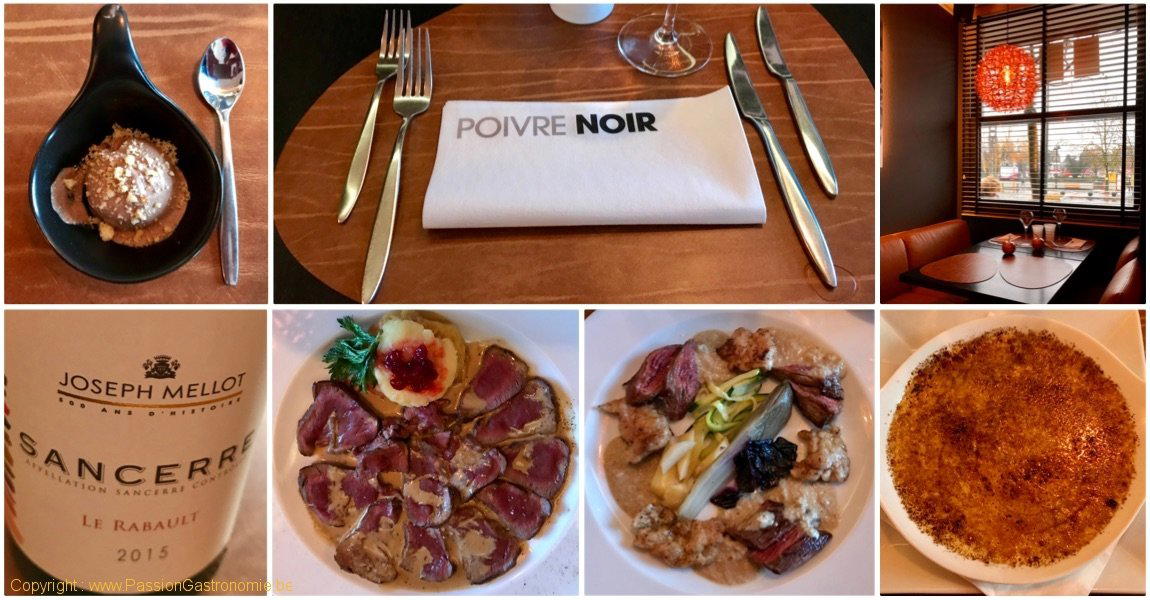
A Railway Square and What It Signals
Place de la Gare in Braine-l'Alleud is the kind of address that frames expectations before you arrive. Station squares in Belgian provincial towns tend toward functional rather than atmospheric: commuter traffic, a brasserie or two, the geometry of platform schedules. Poivre Noir, at number 9 on that square, works against that template. The name itself, French for black pepper, is a small editorial statement: a single, precise ingredient, anchoring a cuisine rooted in classical French technique rather than the broader Franco-Belgian hybrid that dominates much of Wallonia's mid-range dining.
Braine-l'Alleud sits roughly 20 kilometres south of Brussels, in Walloon Brabant, a province whose culinary identity is less clearly defined than Flemish Belgium's increasingly international restaurant culture or Brussels' dense concentration of recognized addresses. That relative obscurity is partly geographical and partly a matter of critical attention: the Michelin Guide and the Belgian food press have traditionally concentrated their coverage on the capital and on Flanders, leaving a tier of serious provincial tables in Wallonia operating with less visibility than their cooking might otherwise command.
French Tradition in a Provincial Belgian Setting
Belgium's relationship with French cuisine is long and, at its better end, reciprocal rather than derivative. The country's kitchen culture has historically absorbed French classical technique and then inflected it with local produce, Flemish pragmatism, and a certain bourgeois preference for generous portions over architectural minimalism. The French-Belgian dining tradition that shapes addresses like Le Chalet de la Forêt in Uccle or the long-established Bozar Restaurant in Brussels represents one pole of that relationship: formal, technically exacting, and anchored in a canon that stretches back through Escoffier to the grandes cuisines of nineteenth-century France.
Provincial tables like Poivre Noir occupy a different register within this tradition. Removed from the pressure of capital-city competition and the gravitational pull of international tourism, they tend to serve a more consistent local clientele, which in practice means cooking that is less subject to trend and more accountable to repeat custom. A table that cannot rely on rotating visitors needs to sustain quality across seasons and years, not just across a single tasting menu cycle. That accountability is, in the view of many serious Belgian diners, a more reliable indicator of kitchen quality than any single award cycle.
The comparison with destinations across the Belgian fine-dining map is instructive. At the far end of the ambition spectrum, addresses like Hof van Cleve in Kruishoutem or Willem Hiele in Oudenburg operate as destination restaurants drawing guests from across the country and beyond. At a different register, places like Castor in Beveren or De Jonkman in Sint-Kruis have built reputations on creative modern Flemish cooking with strong local sourcing credentials. Poivre Noir's position within this map is shaped by geography as much as by cooking style: in Walloon Brabant, proximity to Brussels matters, but so does the willingness to offer something more considered than the capital's brasserie mainstream.
The Local Dining Context
Within Braine-l'Alleud itself, Poivre Noir sits alongside a small cohort of addresses that represent the town's restaurant offer. Brasserie de l'Alliance and Maoline fill different parts of the local dining spectrum, covering the brasserie register and Asian cuisine respectively. Against that local backdrop, a French-rooted table operating at a more ambitious pitch represents a distinct category proposition: not the casual meal after a Waterloo battlefield visit, but a considered evening requiring planning and attention.
The broader Walloon dining scene has produced serious addresses that reward the drive out of Brussels: L'air du temps in Liernu, with its French-Asian creative synthesis, and d'Eugénie à Emilie in Baudour demonstrate that the province can sustain destination-level cooking. La Table de Maxime in Our and La Durée in Izegem represent further points on a map of serious Belgian provincial tables where the cooking often outpaces the public profile. Poivre Noir belongs to this broader pattern of under-covered provincial seriousness rather than to the highly visible capital circuit. For readers building a fuller picture of our full Braine-l'Alleud restaurants guide is the most efficient starting point.
Why French Classical Technique Travels Well to the Provinces
The durability of French classical cuisine in Belgian provincial settings is not accidental. The technique is transferable, the product sourcing is well-established across Wallonia's agricultural regions, and the clientele in towns like Braine-l'Alleud tends to value continuity and craft over novelty. In this respect, the name Poivre Noir gestures toward something specific: pepper has been a marker of serious French cuisine since the mediaeval spice trade shaped European cooking hierarchies, and a restaurant that places it front and centre is making an implicit claim about its orientation toward classical rigour rather than fusion experimentation.
That positioning places Poivre Noir at a different point on the ambition axis from, say, the French-Asian creative cooking at L'air du temps or the Korean-French synthesis at Atomix in New York City. The classical French reference point is a choice with consequences: it narrows the stylistic range but deepens the expectation of technical execution. When a table signals classicism, the kitchen's credibility rests on sauce work, sourcing precision, and the kind of consistency that only comes from disciplined repetition rather than from seasonal reinvention.
For visitors arriving from Brussels or passing through Walloon Brabant, the practical logistics favour Poivre Noir as an evening destination rather than a quick lunch stop: the address at Place de la Gare 9 is walkable from Braine-l'Alleud station, which sits on the Brussels-Namur rail line and makes it accessible without a car in under 30 minutes from the capital's Midi station.
How Poivre Noir Braine-l'Alleud compares with similar nearby venues.
| Venue | Cuisine | Price |
|---|---|---|
| Maïnoï | Thai | €€ |
| Philippe Meyers | Modern French | €€€ |
| Max & Moi | Modern Cuisine | €€€ |
Continue exploring
More in Braine-l'Alleud
Restaurants in Braine-l'Alleud
Browse all →
Bars in Braine-l'Alleud
Browse all →
Hotels in Braine-l'Alleud
Browse all →
Wineries in Braine-l'Alleud
Browse all →
At a Glance
- Intimate
- Cozy
- Elegant
- Date Night
- Special Occasion
- Open Kitchen
- Extensive Wine List
- Local Sourcing
Current opening hours
- Monday
- Closed
- Tuesday
- Closed
- Wednesday
- Closed
- Thursday
- Closed
- Friday
- Closed
- Saturday
- Closed
- Sunday
- Closed
Hours can change for holidays and private events. Last verified .
Intimiste et conviviale with warm, charming interior and family-run personal service.
Know Before You Go
- Getting there
- Pl. de la Gare 9, 1420 Braine-l'Alleud, Belgium