Playa de los Artistas
Our verdict
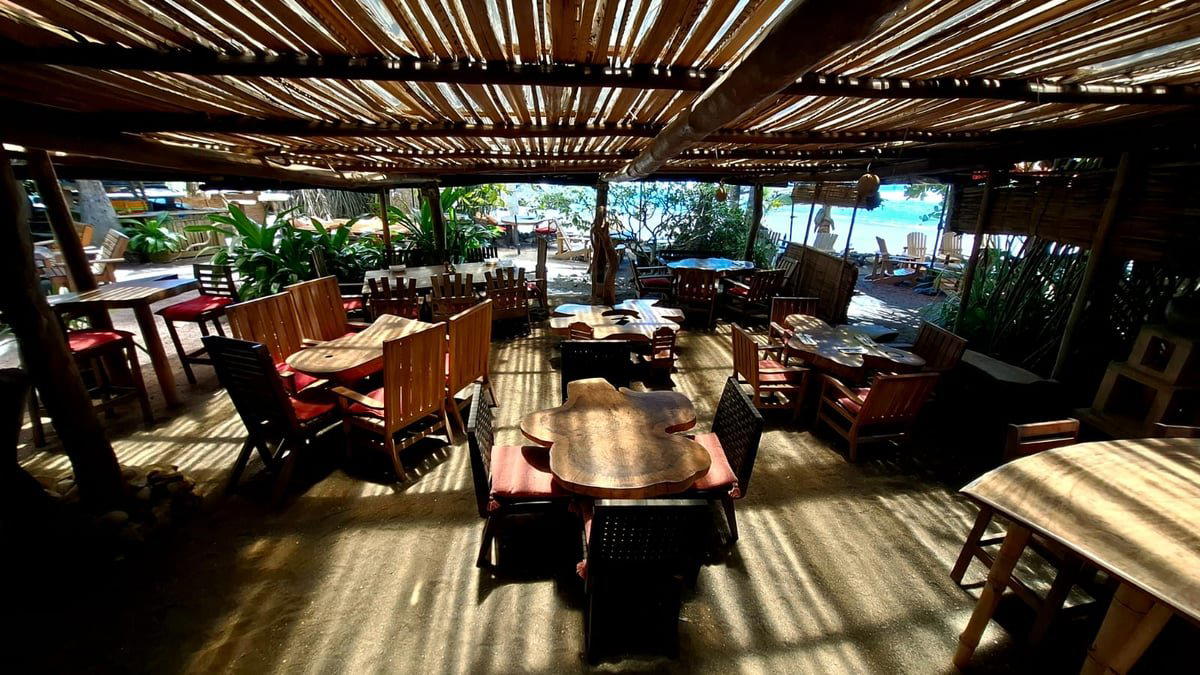
Playa de los Artistas sits directly across from Hotel Los Mangos in Montezuma, on the southern Nicoya Peninsula, where the open-air format and beach-side position have made it a reference point among Montezuma's casual dining options. The kitchen draws from the Pacific coastline, and the setting, tables on sand beneath open sky, does most of the atmospheric work before the food arrives.

Pearl is the En Primeur Club membership app, where members save venues, book tables and use the concierge.
The menu
What to order
- Tuna carpaccio
- Octopus salad
- Lobster carpaccio
- Wood-oven pizza
Where the Nicoya Coast Sets the Table
Montezuma operates on a different register from Costa Rica's more developed Pacific resort towns. The village has resisted the resort-scale buildout that transformed parts of Guanacaste, and its dining scene reflects that resistance: smaller, more informal, and almost entirely oriented around what arrives from the water each day. Along that coastline, open-air restaurants that place tables close to the tide line have become a format unto themselves, where the physical environment does as much editorial work as anything on the plate. Playa de los Artistas, positioned directly across from Hotel Los Mangos, belongs squarely to that format and has accumulated enough local reputation to function as a point of reference for the area.
The address alone signals what kind of experience to expect. Sitting on the beach-adjacent edge of Montezuma, the restaurant orients itself toward the Pacific rather than toward any interior. Tables placed on sand or bare ground, open to the evening air coming off the water, this is a design posture that makes the surrounding environment inseparable from the meal. In a region where resort restaurants sometimes try to reproduce metropolitan dining conventions at considerable remove from local character, this kitchen leans in the opposite direction.
Reading the Menu as a Coastal Document
What can be said is that the broader logic of Nicoya Peninsula kitchens at this level tends to follow a particular architecture: fresh catch structured around the day's available species, preparations that stay close to the ingredient rather than layering it under technique, and a supporting cast of local produce and Central American pantry staples. At restaurants in this category across the Nicoya coast, the menu functions less as a fixed document and more as a daily report on what came off the boats. That structure, where the kitchen's choices reflect supply rather than a standing formula, tends to concentrate quality at the point where ocean proximity is actually shortest.
That supply-driven logic has parallels elsewhere in coastal Costa Rica. At Pangas Tamarindo in Santa Cruz, the relationship between daily catch and the printed menu defines the restaurant's operating rhythm. The difference in Montezuma is one of register: less polished in presentation, closer to the fishing village tradition, and priced and formatted for an audience that arrives by foot or by boat rather than by private transfer. For a comparison point at the other end of the formality spectrum, Le Bernardin in New York City has spent decades demonstrating how strictly seafood-focused menus can sustain critical authority at any scale, the principle that the sea is enough of a kitchen if you treat it correctly translates across contexts, even if the formats are entirely different.
Montezuma's Dining Tier and Where Playa de los Artistas Sits
The Puntarenas province encompasses a wide range of dining formats, from the market-adjacent street eating documented at venues like Eat Street to more considered kitchen programs at places such as Nami Santa Teresa and Rocamar. Montezuma itself occupies a specific niche within that range: too remote from the main tourist infrastructure to draw large-scale resort dining investment, but sufficiently visited by a particular traveller profile, one oriented toward natural environment and local texture rather than amenity density, to sustain a small cluster of restaurants with genuine local identity.
Within Montezuma, Playa de los Artistas has long held a position as the kind of place that visitors mention by name when describing the village. That word-of-mouth durability, independent of formal awards or press recognition, is a signal worth taking seriously in a market where restaurants without the backing of hotel groups or international operators have to earn attention through the meal alone. For further context on what the broader Puntarenas dining scene contains, the full Puntarenas restaurants guide maps the range from coast to coast.
Peer restaurants across the province, including Couleur Cafe and Koji's, occupy a similar tier of informal quality without formal critical infrastructure. Costa Rica's restaurant scene has developed without the kind of dense awards apparatus that organises dining hierarchies in major cities, there is no Michelin presence, and the 50 Best Latin America list does not extend to venues at this scale. Instead, reputation accumulates through traveller reporting, local loyalty, and longevity. In that framework, sustained local relevance is its own credential.
Costa Rica's Wider Coastal Dining Moment
The country's food profile has shifted noticeably in the past decade. Urban programs in San José, such as C. 33 and Conservatorium, have brought more technique-conscious cooking into the national conversation. Resort-adjacent kitchens like Casa Chameleon at Las Catalinas in Potrero and Sentido Norte in Las Catalinas have translated luxury hospitality conventions into Pacific coast settings. Further into the country's interior, Las Ventanas in Bajos del Toro and Nayara Springs in San Carlos anchor the volcano and rainforest tourism circuit with dining programs that speak to a different kind of visitor. And in Liberia, Puna has developed a regional identity tied to the Guanacaste cattle and agriculture tradition.
Against that spread, Montezuma's beach-table format represents a different value proposition entirely: proximity to the source, minimal mediation, and an environment that no architectural intervention could replicate. The San Francisco dining scene has its own version of format-as-statement, Lazy Bear in San Francisco being a case where the communal dinner format itself became the primary editorial claim. At Playa de los Artistas, the format claim is simpler and older: sand underfoot, Pacific air, and the day's catch.
Planning a Visit
Montezuma is reached from the mainland via ferry from Puntarenas city to Paquera, followed by an overland transfer of roughly one hour on roads that improve each season but remain unpaved in sections. The journey is manageable but not trivial; visitors arriving from San José should allow at least half a day for the transit. The restaurant sits directly across from Hotel Los Mangos, which functions as an effective orientation landmark in a village without formal street numbering. High season on the Nicoya Peninsula runs roughly from December through April, when dry conditions and cooler evenings make beach dining particularly well-suited. Shoulder months bring occasional rain but also thinner crowds and a more local atmosphere. For Mis Amores in La Fortuna and Conservatorium in Ciudad Colón, advance booking is standard practice, at Playa de los Artistas, the walk-in tradition remains part of the character.
Frequently asked questions
Where is Playa de los Artistas in Puntarenas?
Playa de los Artistas is located at Enfrente de Hotel Los Mangos, Provincia de Puntarenas, Montezuma, Costa Rica, Puntarenas.
Is Playa de los Artistas worth the journey from mainland Puntarenas?
The venue sits in Montezuma, a village that has held its character against the resort-scale development found elsewhere on Costa Rica's Pacific coast, which is precisely why the half-day transit from Puntarenas city via the Paquera ferry carries its own logic. Travellers already based on the Nicoya Peninsula face a far shorter commitment. Those crossing from the mainland should treat the trip as a full Montezuma visit rather than a dedicated dinner transfer.
What's the signature dish at Playa de los Artistas?
No dish-level data has been confirmed for Playa de los Artistas, and the kitchen's specific output sits outside what can be responsibly claimed here. The Nicoya Peninsula's coastal position, across the ferry crossing from Puntarenas city, points toward a menu logic grounded in Pacific seafood and local produce, but what the restaurant actually serves is best determined on arrival or through local inquiry in Montezuma village.
What's the best way to book Playa de los Artistas?
Montezuma operates well outside the resort booking infrastructure, so walk-in enquiry on arrival remains the most realistic approach. Travellers making the Puntarenas ferry crossing to Paquera specifically for dinner should plan for the return schedule, as the peninsula roads add roughly an hour each way.
Standing Among Peers
Comparable venues nearby, for context on price, style, and recognition.
| Venue | Cuisine | Price | Notes |
|---|---|---|---|
| Playa de los ArtistasThis venue (the venue you are viewing) | Mediterranean Seafood Beach Grill | $30–50 | Not listed |
| Koji's | Japanese-Peruvian Fusion Sushi | $50–100 | Santa Teresa |
| Rocamar | Beachfront Seafood and Costa Rican | $20–30 | Santa Teresa |
| Nami Santa Teresa | Modern Japanese Sushi | $20–30 | Santa Teresa |
| Eat Street | Dining | $10–20 | Santa Teresa |
| Couleur Cafe | French-Inspired Cafe | Not listed | Playa Hermosa |
Continue exploring
More in Puntarenas
Restaurants in Puntarenas
All restaurants in Puntarenas →
Bars in Puntarenas
All bars in Puntarenas →
Details
- Romantic
- Scenic
- Rustic
- Bohemian
- Intimate
- Date Night
- Special Occasion
- Casual Hangout
- Waterfront
- Open Kitchen
- Terrace
- Craft Cocktails
- Local Sourcing
- Waterfront
- A La Carte
- Small Plates
- Vegetarian Friendly
- Vegan Options
- Gluten Free Options
Current opening hours
- Monday
- Closed
- Tuesday
- Closed
- Wednesday
- Closed
- Thursday
- 12–4 PM
- Friday
- 12–4 PM
- Saturday
- 12–4 PM
- Sunday
- 12–4 PM
Hours can change for holidays and private events. Hours as of .
Cool and refreshing beachside atmosphere with dim lighting, soft electronic music, wooden tables on covered patio and garden area, and international artwork.