Phở Hưng at 350 Spadina Ave sits inside Toronto's Chinatown-Kensington corridor, where Vietnamese pho counters have anchored the neighbourhood's eating identity for decades. The restaurant draws a cross-section of the city, students, night-shift workers, weekend families, across a schedule that extends well beyond standard dining hours. It represents the kind of utilitarian, high-turnover pho house that Toronto's downtown core built its Vietnamese dining reputation on.
Pearl is the En Primeur Club membership app — saves, bookings, and concierge access live there. Same editors, same standards.
- Address
- 350 Spadina Ave., Toronto, ON M5T 2G4, Canada
- Phone
- +1 416 593 4274
- Website
- phohung.ca
- Directions
- Get directions
 Saves & bookings on Pearl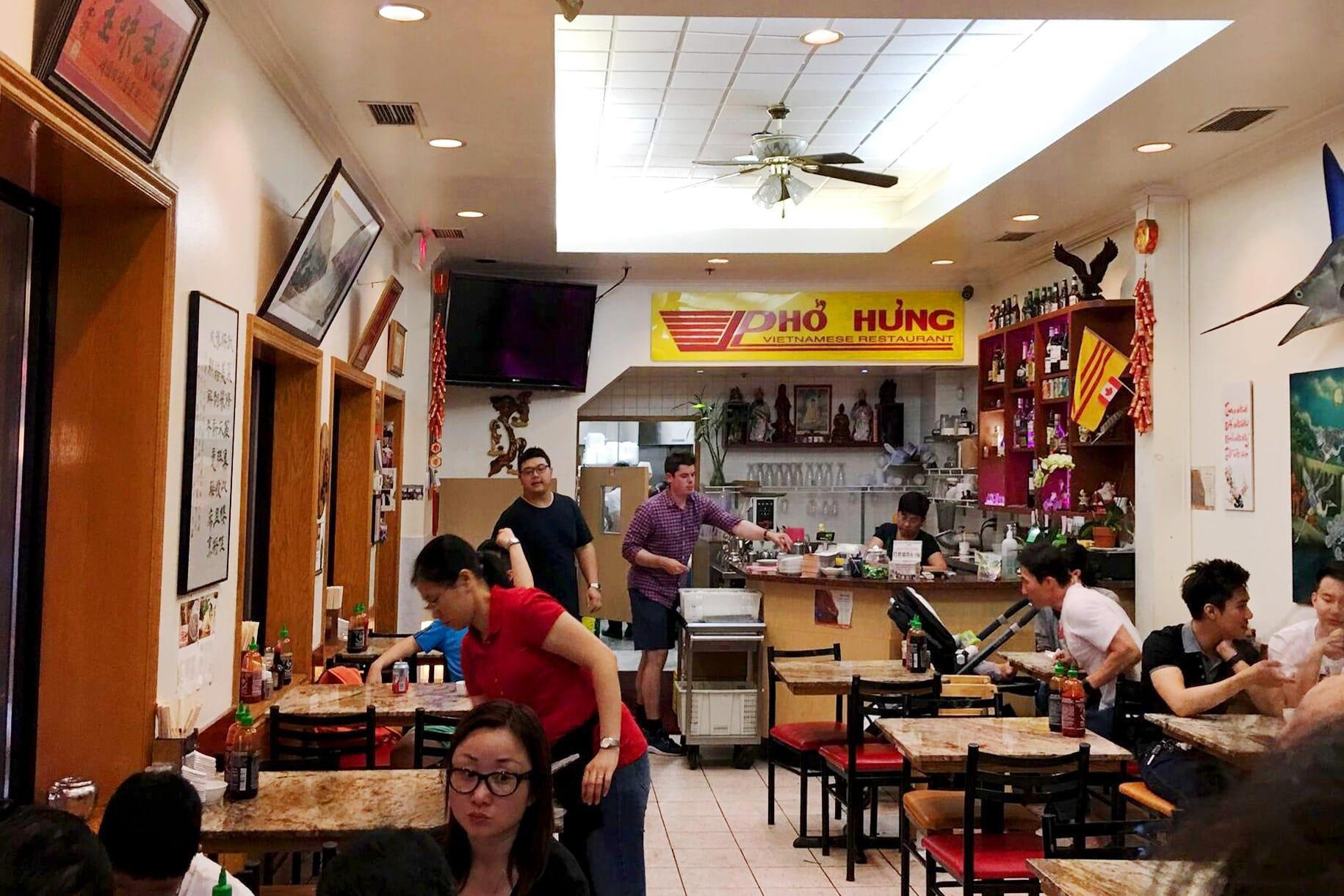
Spadina Avenue and the Pho Counter Tradition
Toronto's Chinatown corridor along Spadina Avenue has long functioned as one of the city's most reliable barometers for immigrant-cuisine staying power. The strip between Dundas and College has accumulated Vietnamese, Chinese, and Southeast Asian restaurants across several decades, and the pho house format, high turnover, minimal décor, broth-forward menus, extended hours, has proved among the more durable. Phở Hưng at 350 Spadina Ave sits squarely inside that tradition, occupying a position that says more about the neighbourhood's eating culture than about any single kitchen's ambition.
The physical context matters here. Spadina in this stretch is loud, neon-lit, and pedestrian-dense for much of the day and well into the night. The approach to a pho counter on this block carries the ambient noise of street vendors, passing trams, and adjacent kitchens, a setting where the warmth of a long-simmered broth reads less as a comfort-food cliché and more as a practical counterweight to the street's energy. This is the condition under which much of Toronto's good-value dining has always operated: unpretentious room, working kitchen, steady crowd.
Where This Fits in Toronto's Vietnamese Dining Tier
Toronto's Vietnamese restaurant scene has not consolidated into a single neighbourhood the way Montreal's or Vancouver's has. Instead, it is distributed across the downtown core, Scarborough, and North York, with different clusters serving different price tiers and customer bases. The Spadina corridor represents the downtown casual tier, accessible by transit, priced for regulars rather than occasion diners, and oriented toward volume and consistency rather than tasting-menu ambition.
That tier operates at a fundamentally different register from Toronto's fine-dining cohort. Venues like Alo (Contemporary) or Aburi Hana (Kaiseki, Japanese) compete on curation, scarcity, and formal service, the metrics that define Toronto's $$$$ end. Phở Hưng does not compete in that register and does not need to. Its competitive set is the cluster of pho houses and Vietnamese casual counters within walking distance, where the differentiators are broth depth, portion size, speed of service, and hours of operation.
For readers who move between those two tiers, as most serious eaters in any city do, understanding how each tier operates is more useful than ranking them against each other. A pho counter on Spadina serves a different decision than a kaiseki omakase or a DaNico (Italian) dinner does. The value of knowing a reliable one is precisely that it fills gaps the rest of the week.
The Broth Question: What Separates Pho Counters
In any pho-dense dining corridor, the broth is the primary editorial variable. Vietnamese pho, particularly the northern-style beef broth (pho bo) that most Toronto counters serve, requires extended simmering of bones, charred aromatics, and spice, a process measured in hours rather than minutes. The result is either clean and deeply mineral or murky and thin, and experienced pho eaters read that distinction quickly.
The Chinatown-Spadina corridor has enough volume that kitchen teams at established spots like Phở Hưng develop efficiency at scale. That efficiency, running the same broth process across high-volume service cycles, tends to produce consistency rather than creativity, which is exactly what a reliable pho house should deliver. The format does not reward improvisation. It rewards repetition, timing, and good raw material.
This is why the pho counter tradition has lasted on Spadina while other more trend-driven formats have cycled through. The demand for a solid bowl at a reasonable price, available at hours when finer kitchens are dark, does not diminish. It shifts geographically as neighbourhoods evolve, but the format persists. Comparable dynamics play out at Busters Barbeque in Kenora or Cafe Brio in Victoria, different cuisines, same principle: a format that earns local loyalty through consistency rather than spectacle.
Drinks, Beverage Context, and the Pho Counter Format
The editorial angle of cellar depth and sommelier expertise applies almost exclusively to the fine-dining tier in Toronto. At Don Alfonso 1890 or Sushi Masaki Saito, wine programs carry real curatorial weight. The pho counter format operates in an entirely different beverage register, where iced Vietnamese coffee (ca phe sua da), fresh sugarcane juice, and Thai iced tea are the functional equivalents of the sommelier's selection: they complement the food's fat and spice, they are priced for casual consumption, and they reflect the cuisine's actual beverage tradition rather than an imported fine-dining logic.
That is not a limitation, it is a different set of priorities. The Vietnamese casual counter format was not designed to accommodate a Burgundy list, nor should it be evaluated on those terms. For the reader making decisions across a week of eating in Toronto, the practical intelligence is which venues deliver in their own register. Phở Hưng's beverage program, whatever its current composition, should be assessed against that standard.
Situating the Visit: Toronto's Broader Eating Map
Phở Hưng occupies a specific geographic and cultural slot in a city with a densely layered restaurant scene. Toronto's serious eaters move across different registers in the same week, an omakase counter, a neighbourhood trattoria, a Chinatown pho house, a market lunch. The city's dining identity is built on that range rather than on a single dominant register.
For Canadian context beyond Toronto, the same kind of regionally rooted, high-value dining appears at Tanière³ in Quebec City, Restaurant Pearl Morissette in Lincoln, and AnnaLena in Vancouver, though all three operate at the formal end. At the neighbourhood-utilitarian end, the closest analogues to Phở Hưng's role in its local ecosystem are places like Eigensinn Farm in Singhampton and Fogo Island Inn Dining Room in Joe Batt's Arm, where the venue's value is inseparable from the context it occupies.
Similar Picks
Comparable venues nearby, for context on price, style, and recognition.
| Venue | Cuisine | Price | Notes |
|---|---|---|---|
| Phở Hưng RestaurantThis venue — the venue you are viewing | Authentic Vietnamese Pho | $ | Not listed |
| Kevin's Taiyaki | Japanese Taiyaki | $ | Koreatown |
| Fresca Pizza and Pasta | Classic Italian Pizza & Pasta | $ | Harbord Village |
| The Lunch Lady of Saigon | Modern Vietnamese | $$ | Trinity Bellwoods |
| The Grow-Op Juice Bar & Eatery | Vegetarian Juice Bar & Healthy Eatery | $ | Trinity Bellwoods |
| Osmow's Shawarma | Mediterranean Shawarma | $ | Downtown Yonge |
Continue exploring
More in Toronto
Restaurants in Toronto
Browse all →
Bars in Toronto
Browse all →
Hotels in Toronto
Browse all →

At a Glance
- Casual
- Family
- Casual Hangout
Current opening hours
- Monday
- 11 AM–10 PM
- Tuesday
- Closed
- Wednesday
- 11 AM–10 PM
- Thursday
- 11 AM–10 PM
- Friday
- 11 AM–10 PM
- Saturday
- 11 AM–10 PM
- Sunday
- 11 AM–10 PM
Hours can change for holidays and private events. Last verified .
Basic, canteen-like interior with scuffed decor, functional for quick casual meals.