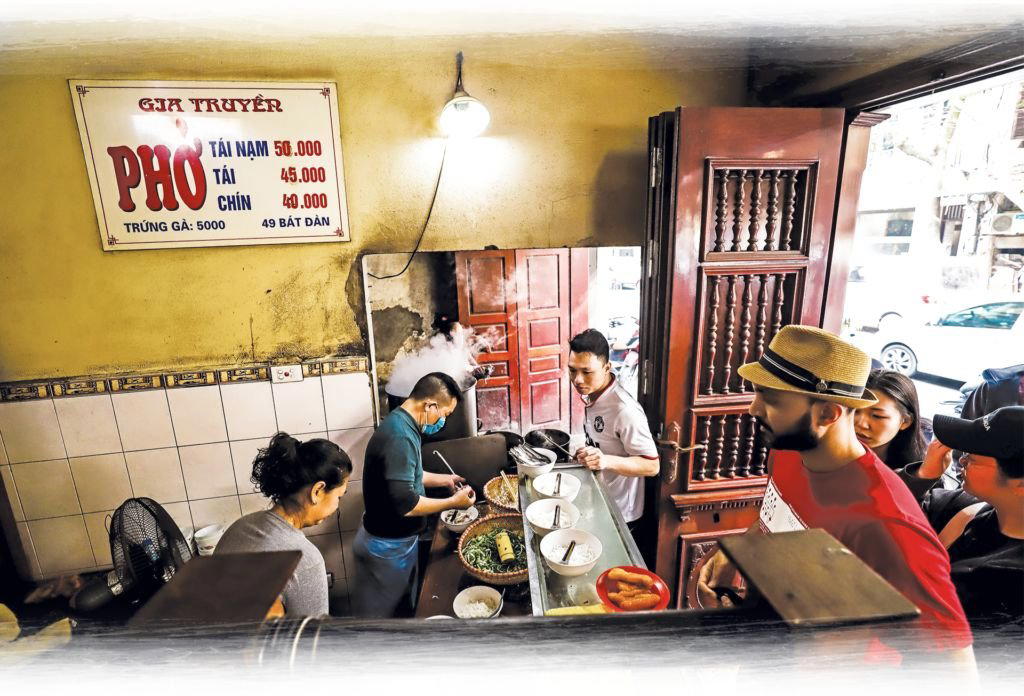
On a narrow stretch of Bat Dan in Hanoi's Old Quarter, Pho Gia Truyen 49 has served the same clear, bone-deep beef broth for generations, making it one of the city's most referenced addresses for northern-style pho. The format is stripped bare: no menu decisions, no reservations, no decor ambition. What arrives in the bowl is the point entirely.

Pearl is the En Primeur Club membership app — saves, bookings, and concierge access live there. Same editors, same standards.
Where the Queue Is the Review
In Hanoi's Old Quarter, the sidewalk outside 49 Bat Dan tells you most of what you need to know before you sit down. By early morning, a line has already formed along the narrow lane, composed in roughly equal parts of neighbourhood regulars, office workers, and visitors who have done their research. This is a scene shaped by decades of consistency in a city where pho is both daily ritual and serious subject of debate. It is a function of decades of consistency in a city where pho is both daily ritual and serious subject of debate.
Northern Vietnamese pho, the style that Hanoi claims as its own, operates on different principles than the southern bowl popularised internationally by Saigon's more herb-forward, sweeter variants. The Hanoi version is restrained: a broth built over many hours from beef bones, deliberately clear and savoury, served with a narrower set of accompaniments and without the tableside condiment theatre of the south. At its leading, the bowl requires nothing added. The craft is entirely in what goes into the pot and for how long.
Pho Gia Truyen 49 Bat Dan sits inside that northern tradition with the kind of tenure that places it in a different category than newer pho shops competing on design or social media reach. The address has functioned as a reference point in Hanoi's pho conversation long enough that it now benchmarks the style itself, rather than being benchmarked against it.
The Bowl in Context: Northern Pho as a Discipline
To understand what separates a long-running Hanoi pho house from the broader category, it helps to understand what the cuisine demands technically. The broth requires bones, time, and heat control: too aggressive and it clouds; too gentle and it lacks depth. The resulting liquid should be translucent but carry a concentration of flavour that reads as complex rather than simple. Noodle texture, cut of beef, and the temperature at which the bowl arrives all contribute to whether the result holds together.
This is why pho houses with generational continuity tend to outperform newer entrants in regulars' assessments: the recipe is fixed, the process is understood, and there is no incentive to experiment. Consistency, in this context, is the product. Hanoi's most respected pho addresses don't rotate menus or introduce seasonal variations. They refine execution within a defined framework, year after year.
That framework places 49 Bat Dan in a comparable set that is not restaurants in the conventional sense but rather category-defining addresses within a specific culinary discipline. Comparisons with the city's more ambitious dining rooms, such as Gia (Vietnamese Contemporary) or Hibana by Koki, are category errors. The relevant comparisons are other old-quarter pho houses and the handful of addresses that Hanoi residents themselves cite when discussing what northern pho should taste like.
Format, Flow, and What to Expect
The operation at 49 Bat Dan follows a model common to Hanoi pho houses: arrive, find a seat at communal tables, place a minimal order, receive the bowl quickly, eat, leave. There is no lingering encouraged and no need for it. The experience is calibrated for efficiency and repetition, which is precisely how a neighbourhood institution maintains its rhythm across decades of daily service.
No reservations are taken. The shop operates during morning and midday hours. Arriving during peak hours means joining the queue; arriving slightly off-peak, particularly mid-morning on a weekday, typically means a shorter wait.
Hanoi in the Wider Vietnamese Dining Picture
Hanoi's food culture sits in clear contrast to the dining ambition visible elsewhere in Vietnam. In Ho Chi Minh City, restaurants like Akuna signal the southern appetite for contemporary formats and international reference points. In Da Nang, La Maison 1888 represents the high end of resort dining with French-influenced credentials. Coastal destinations offer their own registers, from the seafood buffet culture visible at venues like Bien 14 Seafood Buffet Restaurant in Ha Long to the central Vietnamese specialties of White Rose in Hoi An.
Against that range, Hanoi's old-quarter pho houses represent a culinary form embedded in local daily life and resistant to commercialisation, scaling, and reinvention. The address at 49 Bat Dan is not the only holder of that position, but it is among the more consistently cited.
The contrast with internationally recognised fine dining is instructive: those restaurants rely on formal credentials and critical apparatus, while 49 Bat Dan relies on repetition, local endorsement, and consistency over time.
Planning Your Visit
Pho Gia Truyen 49 Bat Dan operates on Bat Dan street in Hanoi's Old Quarter, within walking distance of Hoan Kiem Lake. No reservations are taken. The shop runs on morning and midday hours; Payment is cash-based. Prices sit at about $3 per person, in line with the single-dish, high-volume model. Visitors arriving during the morning peak should expect a wait; the queue moves at speed once service is in flow.
A Quick Peer Check
Comparable venues nearby, for context on price, style, and recognition.
| Venue | Cuisine | Price | Awards | Notes |
|---|---|---|---|---|
| Pho Gia Truyen 49 Bat DanThis venue — the venue you are viewing | Traditional Hanoi Beef Pho | $ | Not listed | Not listed |
| Bún chả Nem rán B2 Vĩnh Hồ | Hanoi Bún Chả & Nem Rán | $ | Not listed | Dong Da |
| New Day Restaurant | Authentic Northern Vietnamese Home Cooking | $ | Not listed | Hoan Kiem |
| Streetside Dining | Vietnamese Street Food | $$ | Not listed | Hoan Kiem |
| Phở Cuốn Chinh Thắng | Traditional Vietnamese Phở Cuốn | $ | Michelin Plate | Ba Dinh |
| Phở Tiến | Michelin-Selected Chicken Pho | $ | Michelin Plate | Ba Dinh |

At a Glance
- Classic
- Well Known
- Rustic
- Casual Hangout
- Solo
- Historic Building
- Street Scene
No-frills, bustling street-side eatery with communal tables and a fast-paced, authentic local atmosphere.