Phở Tan Hoa
On the edge of the Tenderloin, Phở Tan Hoa at 431 Jones Street represents a category of San Francisco Vietnamese dining that operates on its own terms, high-volume, low-ceremony, and oriented entirely around the bowl. Compared to the city's destination tasting-menu circuit, this is a different register of eating: direct, practiced, and shaped by a neighborhood that has sustained this kind of cooking for decades.
Pearl is the En Primeur Club membership app — saves, bookings, and concierge access live there. Same editors, same standards.
- Address
- 431 Jones St, San Francisco, CA 94102
- Phone
- (415) 673-3163
- Directions
- Get directions
 Saves & bookings on Pearl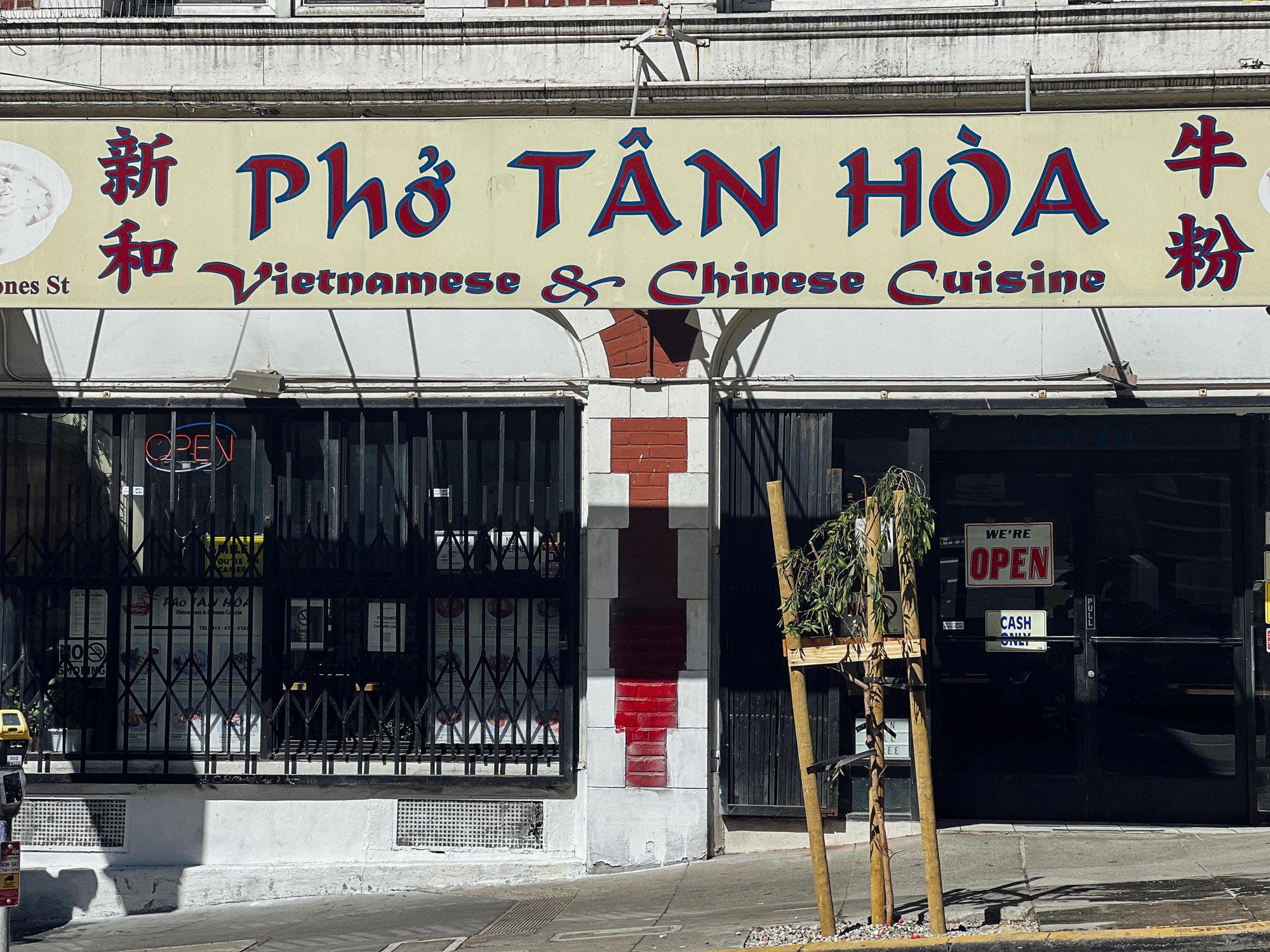
Jones Street and the Bowl in Front of You
The Tenderloin's dining character is not built on destination restaurants. It is built on consistency, neighborhood regularity, and the kind of cooking that does not require a reservation or a prix-fixe commitment. Jones Street, in particular, concentrates a run of Vietnamese and Southeast Asian kitchens that have served the district's residents, many of them from the Vietnamese diaspora, across decades of city change. Phở Tan Hoa at 431 Jones St is a casual Vietnamese restaurant in San Francisco's Tenderloin, with bowls that average about $15 per person. It sits inside that tradition. The approach to eating here is shaped by the room itself: spare, functional, oriented toward the food and nothing else.
Arriving on Jones, the surrounding block communicates what kind of meal this will be. There is no marquee signage, no curated exterior. What you find instead is a dining room that signals its purpose immediately, tables set for throughput, the kitchen audible from the front, the smell of long-simmered broth preceding everything else. San Francisco's Vietnamese cooking tradition, concentrated most densely in the Tenderloin, is one of the city's most durable food stories, and places like Phở Tan Hoa are where that story is maintained without fanfare.
The Ritual of the Bowl
Phở, as a dining format, has its own protocol, and understanding that protocol is part of eating it well. The bowl arrives hot, built in layers: broth at the foundation, noodles underneath, proteins arranged on leading. On the side comes a plate of fresh additions: bean sprouts, Thai basil, lime wedges, sliced chilies. The ritual is additive. You begin with the broth as it comes, then adjust, a squeeze of lime to cut through fat, a handful of sprouts for texture, a stripe of hoisin or sriracha according to your preference. No two bowls at the same table end up tasting the same.
This is the opposite of tasting-menu eating, where the kitchen's pacing and composition are fixed. At a phở counter, the diner is an active participant in the final dish. It is a more democratic format, and in many ways a more demanding one, there is nowhere for a weak broth to hide once you have added nothing to it. The broth is the argument. In Vietnamese cooking tradition, a proper phở broth is the result of hours of simmering bones, typically beef, with charred onion and ginger, star anise, cinnamon, cloves, and rock sugar. The spice profile should be aromatic without overwhelming; the fat should coat but not cloy. That balance is what separates a practiced kitchen from a casual one.
San Francisco's broader dining circuit runs heavily toward the tasting-menu and fine-casual format. Lazy Bear, Atelier Crenn, Benu, Quince, and Saison all operate at the $$$$ tier, with prix-fixe formats, advance bookings, and structured service. Phở Tan Hoa occupies an entirely different register. The competitive set is the cluster of Vietnamese kitchens along Larkin, Eddy, and the surrounding Tenderloin blocks. Within that set, longevity and neighborhood trust matter more than critical recognition.
What the Tenderloin Means for This Kind of Cooking
The Tenderloin's Vietnamese food corridor developed through immigration patterns dating to the post-1975 wave of Southeast Asian refugees who settled in San Francisco and built a community infrastructure that included restaurants, markets, and social organizations. That history gives the neighborhood's food a character that is not performative. These are not restaurants translating Vietnamese cooking for a non-Vietnamese audience. They are, in the main, restaurants that evolved to feed a community, and that community's standards are exacting in their own way.
A visitor eating at Phở Tan Hoa is not accessing a curated food tourism product. They are eating in a room where the surrounding tables are likely occupied by regulars who have a preference for a particular protein combination, who know how they want their broth, and who will not pause to photograph the bowl before eating it. That context matters. It sets the pace and the expectation. This is eating as a practical act, refined by repetition.
For travelers whose San Francisco trip is built around the high-end dining circuit, the kind of itinerary that might also include The French Laundry in Napa, Single Thread Farm in Healdsburg, or, further afield, Le Bernardin in New York City, Alinea in Chicago, or Providence in Los Angeles, a bowl on Jones Street is a useful recalibration. It is a reminder that cooking discipline shows up across price tiers, and that a broth held at temperature through a service is its own form of technical precision.
How to Eat Here
The format is self-directing. You will be seated, handed a menu, and expected to order without extended deliberation. In Vietnamese noodle houses of this type, the standard move is to decide on your protein combination first, rare beef, brisket, tendon, tripe, and meatball are the usual options, often available in combinations, and to specify your bowl size. Large bowls are the norm; the broth-to-noodle ratio shifts with size, and experienced diners often prefer a smaller noodle portion with extra broth.
Add-ins from the accompaniment plate should be introduced gradually rather than all at once. Bean sprouts go in first if you want them softened; basil should be added just before eating so it retains some fragrance; lime is leading squeezed at the moment the bowl hits the table while the broth is at its hottest. The condiment bottles on the table, hoisin and sriracha, typically, are for dipping the proteins on a spoon rather than adding directly to the broth, a practice that would muddy the clarity the cook has spent hours building. This is protocol observed across traditional phở kitchens in both Vietnam and its diaspora communities.
For context on what structured dining in San Francisco looks like at the other end of the spectrum, the full San Francisco restaurants guide covers the city's range from neighborhood kitchens to multi-course destinations. Elsewhere in the US, comparable fine-dining benchmarks include Addison in San Diego, Blue Hill at Stone Barns in Tarrytown, The Inn at Little Washington, Bacchanalia in Atlanta, Emeril's in New Orleans, Atomix in New York City, and internationally, 8 1/2 Otto e Mezzo Bombana in Hong Kong. The contrast is instructive.
Planning Your Visit
Address: 431 Jones St, San Francisco, CA 94102. Neighbourhood: Tenderloin, walkable from Union Square and the Civic Center BART station. Reservations: Not available; walk-in only, in keeping with the format. Dress: No code, no expectation beyond practical. Budget: Vietnamese noodle houses in this district typically price bowls in the $10–$18 range, though pricing for this specific location should be confirmed on arrival. Hours: Mon: 8 AM to 3 PM; Tue: 8 AM to 3 PM; Wed: 8 AM to 3 PM; Thu: Closed; Fri: 8 AM to 3 PM; Sat: 8 AM to 3 PM; Sun: 8 AM to 3 PM. Dress: casual. Reservations: walk-in friendly.
Just the Basics
Comparable venues nearby, for context on price, style, and recognition.
| Venue | Cuisine | Price | Notes |
|---|---|---|---|
| Phở Tan HoaThis venue — the venue you are viewing | Tenderloin, Authentic Vietnamese Pho | $ | Not listed |
| Tú Lan | Tenderloin, Authentic Vietnamese | $ | Not listed |
| Pho Phu Quoc | Not listed | $ | Sunset/Parkside, Vietnamese Pho |
| Tuyet MAI | Not listed | $$ | Tenderloin, Authentic Vietnamese from Hue |
| Golden Star Vietnamese Restaurant | Not listed | $ | Chinatown, Authentic Vietnamese Pho & Noodles |
| Golden Flower Restaurant | Chinatown, Vietnamese Pho House | $$ | Not listed |
Continue exploring
More in San Francisco
Restaurants in San Francisco
Browse all →
Bars in San Francisco
Browse all →
Hotels in San Francisco
Browse all →
At a Glance
- Cozy
- Classic
- Casual Hangout
- Family
Current opening hours
- Monday
- 8 AM–3 PM
- Tuesday
- 8 AM–3 PM
- Wednesday
- 8 AM–3 PM
- Thursday
- Closed
- Friday
- 8 AM–3 PM
- Saturday
- 8 AM–3 PM
- Sunday
- 8 AM–3 PM
Hours can change for holidays and private events. Last verified .
Warm, cozy, and welcoming with a clean, simple atmosphere and friendly family service.