Our verdict
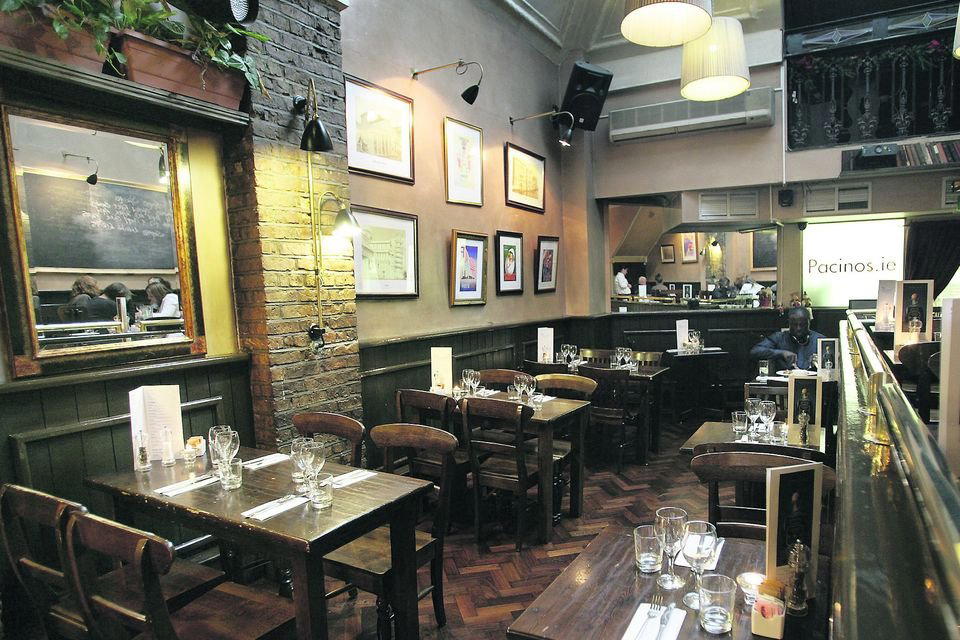
On Suffolk Street in Dublin 2, Pacino's has operated long enough to accumulate the kind of neighbourhood familiarity that newer openings spend years trying to manufacture. Positioned in the city centre's dense dining corridor, it occupies a different tier from the tasting-menu houses nearby, offering a more direct, accessible format that has kept a steady following across multiple shifts in Dublin's dining culture.

Pearl is the En Primeur Club membership app — saves, bookings, and concierge access live there. Same editors, same standards.
- Address
- 18 Suffolk St, Dublin 2, D02 NP97, Ireland
- Hours
- Mon–Thu 11 AM–10 PMFri–Sat 11 AM–11 PMSun 11 AM–10 PM
- Website
- pacinos.ie
- Directions
- Get directions
- Booking
- Book on the venue's website
The menu
What to order
- Neapolitan Pizza
- Stone-Baked Pizza
- Pasta Dishes
- Mortadella Pizza
- Diavola Pizza
Suffolk Street and the City Centre Shift
Dublin's city centre dining has reorganised itself several times over the past two decades. The corridor running through Suffolk Street, Dame Street, and the surrounding blocks once anchored a particular kind of mid-market confidence, a tier of restaurants that existed before the tasting-menu boom reshaped expectations around what a serious Dublin dinner should look like. Pacino's, at 18 Suffolk Street, sits inside that history. It is not a product of the current wave of Michelin-chasing Modern Irish cooking represented by places like Chapter One by Mickael Viljanen or Glovers Alley. Its story is about endurance and adaptation rather than reinvention through awards cycles.
Suffolk Street sits within walking distance of Grafton Street and Trinity College, which means the footfall is dense and varied: tourists, office workers at lunch, pre-theatre diners, and locals who have been returning for years. That mix shapes what a restaurant here has to be. Longevity on this particular stretch requires something that newer openings in quieter neighbourhoods can afford to ignore: the ability to serve a broad table while still holding a point of view.
What the Address Has Always Meant
The evolution of any long-running city-centre restaurant in Dublin is partly a function of what the city itself became. Dublin 2 in the 1990s and early 2000s was a different proposition from the current version, where Patrick Guilbaud continues to hold two Michelin stars at the formal end and Bastible represents the more contemporary neighbourhood-driven school further south. Pacino's carved out a position that was never about competing with the fine-dining tier. Its reputation has been built around consistent delivery at accessible terms, a reliable presence in a city that has not always made reliability easy for mid-market operators.
That positioning matters more now than it did during the years of rapid Dublin dining expansion. A restaurant that has survived multiple economic cycles, a pandemic, and the structural shift toward delivery and casual formats has, by definition, found something that its customers return for. The question worth asking is not whether Pacino's matches the ambition of D'Olier Street or the tasting-menu focus of the city's Michelin-listed houses, but whether it does its own thing with consistency. On Suffolk Street, that is a harder ask than it sounds.
The Format and What It Signals
Restaurants that last in city-centre locations without pivoting to tasting menus or high-concept formats tend to share certain structural features: a menu that rewards repeat visits without requiring them, a room that functions for multiple party sizes, and a kitchen that can handle volume without losing focus. These are operational disciplines, and they are not glamorous, but they are what separates places that accumulate a following from places that generate a moment and then fade.
Across Ireland, the restaurants that have built the most durable reputations have generally done so through disciplined execution rather than format novelty. That pattern holds from Aniar in Galway, which has maintained Michelin recognition through ingredient-led cooking, to Campagne in Kilkenny, which holds its star with French-influenced cooking at a remove from Dublin's competitive density. The smaller-town equivalents, places like Bastion in Kinsale or Chestnut in Ballydehob, operate in entirely different competitive contexts. City-centre Dublin is a different pressure system, and Pacino's has been operating inside it long enough to have absorbed several distinct phases of that pressure.
Evolution Without the Press Release
The restaurants that tend to generate the most editorial attention in any given year are the ones that opened recently or won something. The ones that have simply continued, adjusting quietly to changing costs, changing tastes, and changing neighbourhoods, rarely get the retrospective treatment they deserve. Pacino's belongs to that second category. Its evolution has not been announced through rebranding campaigns or chef changes covered in food media. It has been the quieter kind: staying open, staying relevant to its customer base, and surviving in a part of Dublin where the commercial pressures on hospitality are as acute as anywhere in the country.
That kind of longevity is worth taking seriously as a signal. It is not the same signal as a Michelin star or a placement on a critics' list, but it is a signal nonetheless. The restaurants that accumulate it tend to be the ones that know exactly who they are serving and why those people keep coming back. For context on how Irish dining outside Dublin has handled similar questions of identity and evolution, the work being done at Liath in Blackrock, dede in Baltimore, and Terre in Castlemartyr offers instructive comparison, even if the formats and ambitions are different.
At the broader level, Dublin now competes for serious dining attention with cities where the benchmark is set by restaurants like Le Bernardin in New York City or Atomix in New York City. The city's answer to that competition has been a cluster of high-ambition kitchens at the top of the market, but the health of any dining scene is also measured in what exists below that tier. The mid-market and accessible layers, the restaurants on Suffolk Street that are open on a Tuesday in January, are part of what makes a city's food culture functional rather than merely prestigious.
Planning Your Visit
Know Before You Go
- Address: 18 Suffolk Street, Dublin 2, D02 NP97, Ireland
- Location context: Central Dublin 2, within the city's main dining and retail corridor, close to Grafton Street and Trinity College
- Transport: Easily reached on foot from most central Dublin locations; Luas Green Line stop at St Stephen's Green is the nearest tram connection
- Further reading: See our full Dublin restaurants guide for the broader city context
Frequently asked questions
Where is Pacino's located?
Pacino's is located at 18 Suffolk St, Dublin 2, D02 NP97, Ireland, Dublin.
How does Pacino's fit into the broader Suffolk Street and Dublin 2 dining scene?
Suffolk Street sits at the junction of several of Dublin's most active dining corridors, linking Grafton Street to Dame Street and the wider Creative Quarter. In a zone where new openings receive the bulk of editorial attention, a restaurant that has maintained its position without a major rebrand occupies a specific role: the known quantity in a neighbourhood full of churn. For visitors staying or moving through Dublin 2, it represents a fixed point in a scene that shifts regularly.
What do regulars order at Pacino's?
The venue's Suffolk Street location and long run in Dublin city centre suggest a menu built around accessible, repeatable dishes rather than seasonal experimentation. Regulars at restaurants of this format tend to anchor on reliable house staples.
Should I book Pacino's in advance?
For a city-centre address on Suffolk Street in Dublin 2, advance booking is advisable, particularly on Thursday through Saturday evenings when the surrounding area draws significant footfall from both locals and visitors. Walk-ins may be accommodated at off-peak times. check the venue's official channels to confirm availability.
What has Pacino's built its reputation on?
Pacino's occupies 18 Suffolk Street, a stretch of Dublin 2 that has seen restaurants open and close repeatedly over the past two decades. Longevity in that location is its own credential — restaurants that hold city-centre ground without constant repositioning tend to do so through consistent output and a returning local clientele rather than headline awards or chef changes.
Can Pacino's handle vegetarian requests?
Any restaurant operating in Dublin's city-centre D02 corridor today is operating in a market where vegetarian accommodation is standard practice. Contacting the venue directly before your visit is the reliable way to confirm current options.
Is a meal at Pacino's worth the investment?
Pricing details for Pacino's have not been confirmed publicly. What the Suffolk Street address signals is a city-centre operation competing against a dense field of dining options in Dublin 2, which creates pressure to deliver value at whatever price point the menu sits. The venue's continued presence on that street is a reasonable indicator that it holds its ground commercially.
Comparison Snapshot
Comparable venues nearby, for context on price, style, and recognition.
| Venue | Cuisine | Price | Notes |
|---|---|---|---|
| Pacino'sThis venue — the venue you are viewing | Authentic Italian Trattoria | $30–50 | Not listed |
| Di Luca | Authentic Italian Pasta | $20–30 | Royal Exchange B |
| La Cosa Nostra | Authentic Italian Pizza & Pasta | $20–30 | Merchants Quay A |
| Val's | Authentic Italian Pizzeria | $20–30 | Royal Exchange A |
| Antica Venezia | Traditional Italian | $20–30 | Rathmines East A |
| Proof Trattoria | Modern Italian Trattoria | $20–30 | Merchants Quay A |