Our verdict
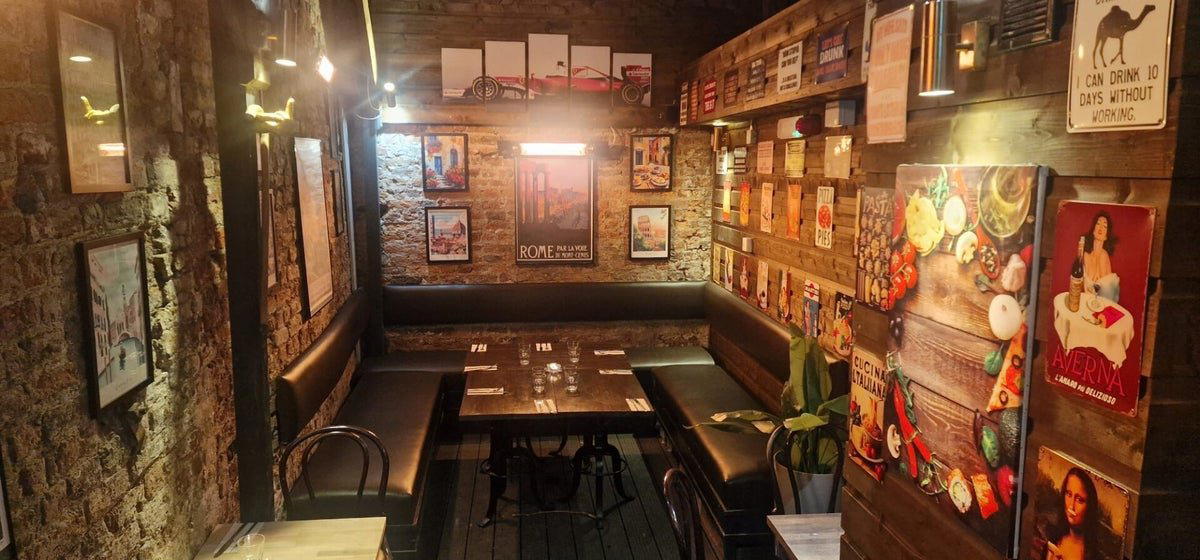
On Thomas Street in the Liberties, La Cosa Nostra occupies a stretch of Dublin long associated with independent traders and working-class culture. The name signals intent: a certain possessiveness about the neighbourhood, about the table, about the meal. In a city where Italian-inflected dining spans everything from quick-service pizza to formal tasting menus, this address plants itself at a considered middle point.

Pearl is the En Primeur Club membership app — saves, bookings, and concierge access live there. Same editors, same standards.
- Address
- 37 Thomas St, The Liberties, Dublin, D08 A319, Ireland
- Phone
- +35315327378
- Hours
- Mon–Thu 12–9:30 PMFri–Sat 12–10:30 PMSun 12–9:30 PM
- Website
- lacosanostra.ie
- Directions
- Get directions
- Booking
- Book on OpenTable
The menu
What to order
- Il Grande Capo (Margherita)
- Goomar (Diavola)
- I Federali (Pepperoni)
- Tiramisu
Thomas Street After Dark — and Before It
The Liberties is not where Dublin's fine-dining circuit tends to congregate. Merrion Street, St. Stephen's Green, and the south docklands pull more of the headline kitchens, leaving Thomas Street and its surroundings to a scrappier, more local-facing food culture. That context matters when reading La Cosa Nostra: a restaurant on this stretch is either serving the neighbourhood or making a deliberate argument against the gravitational pull of the city's more polished postcodes. The address at 37 Thomas Street places it squarely inside a district that has been slowly accumulating independent restaurants, craft producers, and creative businesses over the past decade, following the longer arc of the Liberties' transition from light-industrial to mixed-residential and cultural.
Italian dining in Dublin has fragmented considerably. At one end sit the red-sauce trattoria formats that have served the city since the 1970s; at the other, a newer tier of pasta-focused rooms where imported flour, house-cured meats, and regional Italian specificity set the tone. La Cosa Nostra, by name and by location, positions itself against the generic and in favour of something with a clearer sense of ownership. Whether that translates into the kitchen is the question a first visit answers.
The Lunch Equation in the Liberties
In most European cities, the gap between lunch and dinner service tells you something important about a restaurant's priorities. A kitchen that runs a shortened, value-led lunch alongside a full evening programme is typically chasing two different audiences with different expectations. A kitchen that serves essentially the same food at both sittings is making a different argument: that the cooking is worth the same attention regardless of the hour.
The Liberties at midday draws a working crowd: tradespeople, students from the nearby technical colleges, staff from the Guinness Storehouse a short walk west. A restaurant calibrated for that lunchtime market will look quite different from one aimed at the evening visitor coming specifically for the meal. This divide shapes how any Thomas Street address structures its day, and it is the operative question for La Cosa Nostra: does the lunch service function as a lighter, faster iteration of the evening offer, or do the two sittings occupy genuinely different registers?
In Italian dining traditions, this split has historical precedent. The midday meal in southern Italian culture was never an afterthought; it was often the main event. The evening meal, by contrast, tended to be lighter and later. Dublin has not fully adopted that rhythm, but the better Italian rooms in the city have started to treat lunch as structurally distinct rather than merely a truncated dinner, with different pacing, shorter courses, and occasionally different pricing. If La Cosa Nostra follows that model, it becomes a more interesting proposition for the neighbourhood — and a more practical one for the workers and residents who make up the Liberties' daytime population.
Placing La Cosa Nostra in Dublin's Wider Restaurant Circuit
Dublin's current restaurant generation has bifurcated between formal tasting-menu rooms and more casual, ingredient-led neighbourhood formats. The tasting-menu tier is anchored by addresses like Chapter One by Mickael Viljanen, which holds two Michelin stars, and Patrick Guilbaud, which has maintained its two-star standing for decades. Below that, a mid-tier of modern Irish kitchens, including Bastible in the Liberties itself and Glovers Alley on Fitzwilliam Street, operates with high technique but without the ceremony of the full tasting format. There is also D'Olier Street, representative of the city's appetite for modern European cooking in accessible formats.
La Cosa Nostra sits outside the modern Irish idiom entirely, which gives it a different kind of relevance. Italian-inflected cooking in Dublin does not attract the same critical attention as the native tradition, but the audience for it is substantial and, increasingly, more demanding about regional specificity and ingredient provenance. A room on Thomas Street that delivers on those expectations would be filling a real gap in the Liberties specifically, where Bastible remains the dominant serious-dining reference but the neighbourhood otherwise relies on more casual formats.
Across Ireland, the serious-dining conversation has spread well beyond the capital. Aniar in Galway holds a Michelin star for its forage-and-ferment approach; Liath in Blackrock operates a tasting counter just outside Dublin; Bastion in Kinsale, Campagne in Kilkenny, Chestnut in Ballydehob, Homestead Cottage in Doolin, House in Ardmore, and Lady Helen in Thomastown each demonstrate that ambition is no longer concentrated in the capital. Terre in Castlemartyr and dede in Baltimore further extend that geography. Against this national spread, a distinctive Italian address in Dublin's Liberties would represent a different kind of contribution to the city's dining map, one defined by cuisine tradition rather than Irish terroir.
For international comparison, the gap between casual Italian and technically serious Italian is visible in cities like New York, where the distance between a neighbourhood trattoria and a kitchen producing at the level of Le Bernardin or the precision of Atomix is enormous, with a large mid-tier in between. Dublin's Italian mid-tier remains relatively underdeveloped compared to its modern Irish equivalent, which is precisely the opening La Cosa Nostra appears to be addressing.
Planning a Visit
La Cosa Nostra is located at 37 Thomas Street in the Liberties, a ten-minute walk from Dame Street and accessible from several central bus routes. The Liberties is a navigable neighbourhood on foot from the city centre, though parking in the immediate area can be limited during peak hours. Given the sparse public information currently available about the restaurant, no website, no published phone number, no booking platform listed across major reservation services, the most reliable approach is to visit in person to confirm current hours and availability, or to check for any social media presence under the venue name. This kind of low-profile operation is not unusual for independently run neighbourhood restaurants, but it does require more planning legwork than a venue with active online booking.
For more context on where La Cosa Nostra sits within Dublin's broader dining circuit, see our full Dublin restaurants guide.
Frequently asked questions
Where do I go for La Cosa Nostra?
La Cosa Nostra is located at î37 Thomas St, The Liberties, Dublin, D08 A319, Ireland, Dublin.
Is La Cosa Nostra in Dublin good for a casual Italian lunch in the Liberties?
La Cosa Nostra on Thomas Street is one of the few Italian options in Dublin 8's Liberties quarter, a neighbourhood that has historically had fewer sit-down restaurants than its population density would suggest. For anyone working or staying west of Dame Street, it fills a gap that Merrion Street and Temple Bar don't address.
What's the must-try dish at La Cosa Nostra?
The specific menu at La Cosa Nostra on Thomas Street isn't published in detail, which is itself a signal worth reading: kitchens in the Liberties that keep their menus fluid tend to be working with seasonal and market-led produce rather than fixed signature plates. Ask the room what's being pushed that day — that conversation usually points you in the right direction.
How far ahead should I plan for La Cosa Nostra?
Booking timelines for La Cosa Nostra aren't publicly documented, but Thomas Street restaurants with a reputation in Dublin 8 fill quickly at weekends. Contacting the venue directly ahead of a Friday or Saturday visit is the sensible move. Midweek lunch, based on the Liberties neighbourhood rhythm, tends to offer more flexibility.
What makes La Cosa Nostra worth seeking out?
La Cosa Nostra sits at 37 Thomas Street in the Liberties, a part of Dublin that the fine-dining circuit centred on Merrion Street and the south docklands has largely left alone. That separation is the point: the restaurant operates closer to the neighbourhood-trattoria model than the tasting-menu rooms that dominate Dublin's awards conversation, which makes it a different kind of proposition for anyone who finds those formats too formal for a regular Tuesday dinner.
Category Peers
Comparable venues nearby, for context on price, style, and recognition.
| Venue | Cuisine | Price | Notes |
|---|---|---|---|
| La Cosa NostraThis venue — the venue you are viewing | Authentic Italian Pizza & Pasta | $20–30 | Not listed |
| Squaredish | Detroit-Style Deep-Dish Pizza | $20–30 | Mansion House B |
| Di Luca | Authentic Italian Pasta | $20–30 | Royal Exchange B |
| Hidden By One Society | Italian Brunch & Pizza | $20–30 | Arran Quay B |
| Impasto 48 | Authentic Neapolitan Pizza | $20–30 | Sutton |
| Pinocchio Restaurant | Authentic Italian | $20–30 | North City |
Continue exploring
More in Dublin
Restaurants in Dublin
Browse all →
Bars in Dublin
Browse all →
Hotels in Dublin
Browse all →
Wineries in Dublin
Browse all →
Details
- Cozy
- Rustic
- Intimate
- Casual Hangout
- Date Night
- Standalone
- Craft Cocktails
- Local Sourcing
- A La Carte
- Italian Wines
- Cocktails
Current opening hours
- Monday
- 12–9:30 PM
- Tuesday
- 12–9:30 PM
- Wednesday
- 12–9:30 PM
- Thursday
- 12–9:30 PM
- Friday
- 12–10:30 PM
- Saturday
- 12–10:30 PM
- Sunday
- 12–9:30 PM
Hours can change for holidays and private events. Last verified .
Warm and cosy atmosphere with lovely staff.