


On the north side of St. Stephen's Green, at the top of Grafton Street, The Fitzwilliam Hotel Dublin occupies one of the city's most walkable addresses.
Pearl is the En Primeur Club membership app — saves, bookings, and concierge access live there. Same editors, same standards.
- Address
- The Fitzwilliam Hotel, 127/128 St Stephen's Green, Dublin 2, D02 HE18
- Phone
- +353 1 478 7000
- Website
- fitzwilliamhoteldublin.com
- Directions
- Get directions
 Saves & bookings on Pearl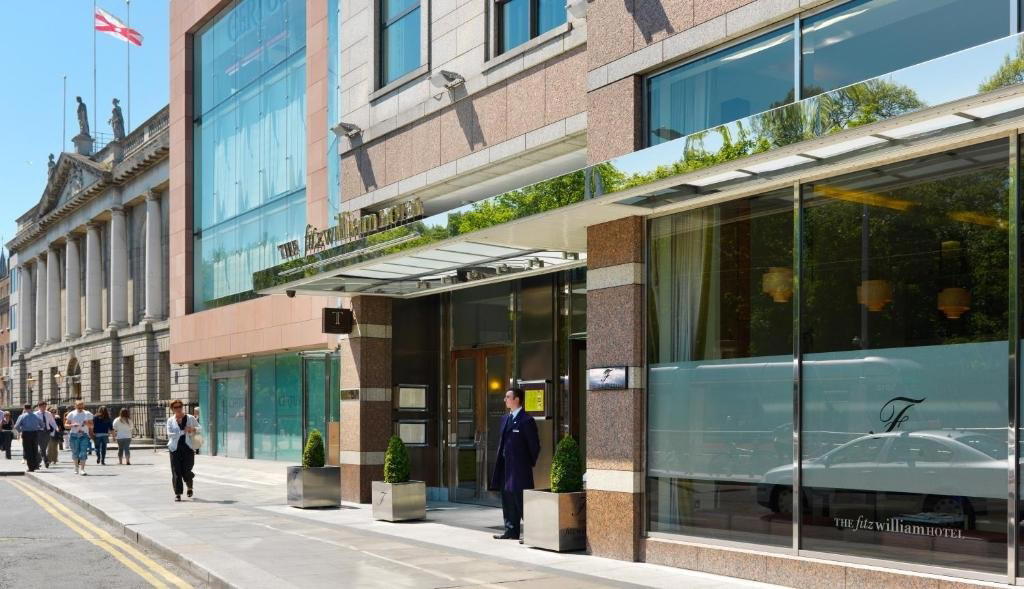
Where St. Stephen's Green Sets the Pace
Dublin's five-star hotel tier has long been anchored around two focal points: the Georgian grandeur of the city's canal-side streets and the commercial energy of Grafton Street. The Fitzwilliam Hotel Dublin sits at the junction of both. Its address at 127/128 St. Stephen's Green places it directly at the top of Grafton Street, with the park's tree canopy visible from front-facing rooms and a private courtyard garden behind. That dual orientation, city-facing one side, green-facing the other, shapes the rhythm of a stay here in ways that distinguish it from competitors whose position is more purely commercial.
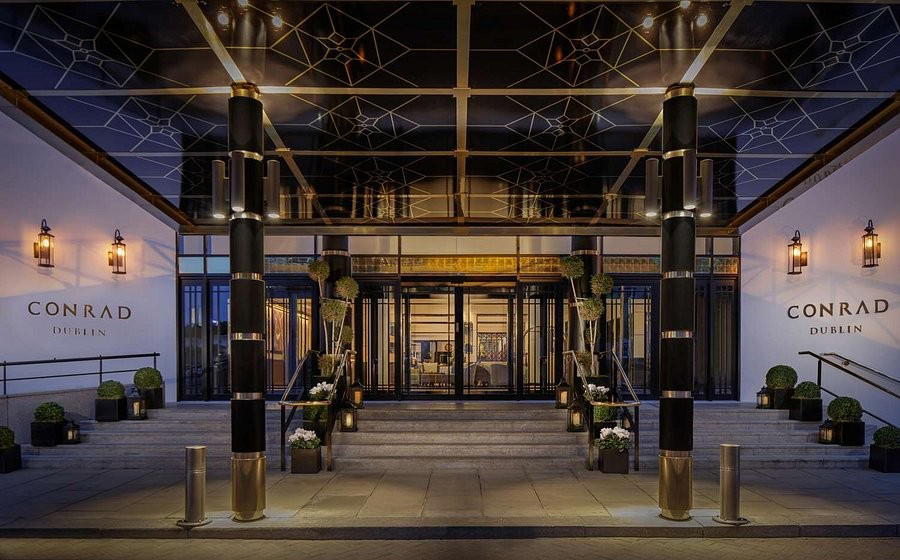
Dublin's boutique five-star category has narrowed considerably as a competitive set. The Conrad Dublin sits a few minutes away on Earlsfort Terrace, the Anantara The Marker Dublin Hotel anchors the Grand Canal Dock end of the city, and the Dylan Hotel offers a more boutique, design-forward product in Ballsbridge. What separates The Fitzwilliam is the particular density of the neighbourhood: theatres, galleries, the National Museum, and the city's primary retail strip are all within walking distance. The InterContinental Dublin and the Clayton Hotel Ballsbridge sit further south, in Ballsbridge, where the pace is quieter but the centre requires a cab or tram. Here, the city arrives at the door.
Arriving at the Fitzwilliam: A Designed Entrance
The approach to the hotel carries its own choreography. The doormen in their eggplant-coloured leading hats and tails are not incidental costume; they signal a specific register of hospitality rooted in the Conran design brief that shaped the hotel from the outset. Sir Terence Conran, whose studio oversaw the original design and later directed a refurbishment that added rooms, built the interiors around a considered tension between warmth and restraint. The lobby holds a Tomas Clement diptych of portraits that anchors the space with something closer to gallery intent than hotel decoration.
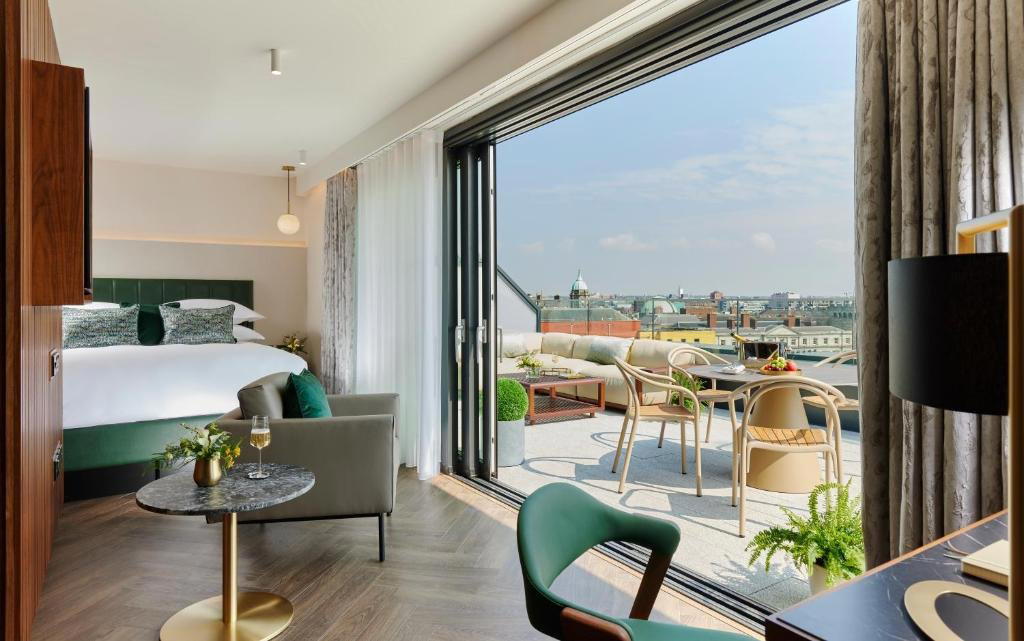
That detail matters because it sets expectations for the rest of the property. This is a hotel that communicates through its objects and surfaces rather than through volume or spectacle. The 139 rooms span six categories: Executive, Signature, Superior, Deluxe, Deluxe Premium, and a Penthouse. Rooms begin at 237 square feet. The Superior rooms come with private terraces overlooking either St. Stephen's Green or the inner courtyard, and the choice between those two orientations is genuinely worth considering. Front-facing rooms put the park in full view; courtyard rooms offer considerably more quiet. The hotel also holds a sister property in Belfast, which gives it a two-city footprint for guests travelling between the Irish capitals.
The Dining Ritual at Glovers Alley
The dining dimension of a stay at The Fitzwilliam requires some forward planning. Glovers Alley, the hotel's restaurant under chef Andy McFadden, holds a Michelin star and operates in a tier of Dublin dining where the pacing and structure of a meal are deliberate rather than casual. The name references the alley that historically ran behind this section of St. Stephen's Green, a small act of urban archaeology embedded in the branding.
In Dublin's current fine dining tier, Michelin-starred restaurants occupy a relatively small cluster. The Fitzwilliam's position as the address containing one of those restaurants shifts its status in the city's hospitality hierarchy. For guests who intend to eat in-house at least once, a table at Glovers Alley is worth reserving ahead of arrival rather than at check-in. The format is tasting-menu led, which means the meal unfolds over multiple courses at a pace the kitchen controls. That rhythm, service sequences timed to the kitchen's output rather than the diner's urgency, is a different contract from the brasserie dining that most hotel restaurants offer. Guests arriving primarily for the dining should note this distinction and plan an evening accordingly rather than expecting a quick dinner between other commitments.
For a broader view of where Glovers Alley sits relative to Dublin's dining scene, the EP Club Dublin restaurants guide maps the full city picture, including neighbourhood-level detail and category comparisons.
Room Details and Practical Intelligence
The interior palette across most of the 139 rooms runs to bold colour and pattern against neutral backgrounds, a Conran-era design signature that has remained through subsequent updates. Upholstered window seats, renovated bathrooms, and turndown service are standard. Duck-down bedding is the default, with synthetic alternatives available on request. Murdock London toiletries and complimentary high-speed Wi-Fi are included, and the hotel provides fluffy robes and slippers as standard kit.
The LUAS tram line stops directly outside the hotel on St. Stephen's Green, connecting the property to the south quarter, Dublin's business parks, and onward routes across the city. This is a practical detail that matters more than it might seem: Dublin's central streets become congested at peak times, and direct tram access removes that friction entirely for guests navigating to meetings, airports, or outer-city venues.
Hotel has commissioned a set of free, downloadable podcasts designed to guide self-directed walks through the surrounding neighbourhood. For guests who prefer structure to wandering, this is a more curated entry point to the area than a standard concierge list. Day rooms are available for guests arriving before standard check-in time, which is useful for long-haul arrivals or early morning flights.
Those comparing options in Dublin's centre will also want to look at the Number 31 and the Camden Court Hotel for different price points, and the Luttrellstown Castle Resort for those considering a city-adjacent estate option. For travel extending beyond Dublin, the wider Ireland portfolio includes Adare Manor in Adare, Ashford Castle in Cong, Ballyfin in Laois, Parknasilla Resort and Spa in Kerry, Aghadoe Heights Hotel and Spa in Killarney, Ballynahinch Castle in Recess, Ballymaloe House Hotel in Shanagarry, Hotel Isaacs Cork in Cork, Castle Leslie Estate in Glaslough, Cashel Palace in Cashel, Ballyvolane House in Castlelyons, Carton House, A Fairmont Managed Hotel in Maynooth, and Ballyfin Demesne in Ballyfin.
Recognition history
Dated appearances from independent guides and award organizations, with the underlying list record or original source where available.
Forbes Recommended
Forbes
Virtuoso Luxury Hotel Partner
Virtuoso
Forbes Recommended
Forbes
Michelin Selected
Michelin
Continue exploring
More in Dublin
Hotels in Dublin
Browse all →
Bars in Dublin
Browse all →

Restaurants in Dublin
Browse all →
Wineries in Dublin
Browse all →
At a Glance
- Elegant
- Sophisticated
- Classic
- Romantic Getaway
- Business Trip
- Anniversary
- Historic Building
- Terrace
- Wi Fi
- Fitness Center
- Spa
- Room Service
- Concierge
- Restaurant
- Business Center
- Valet Parking
- Garden
- Street Scene
- Wi Fi
- Fitness Center
- Spa
- Room Service
- Concierge
- Restaurant
- Business Center
- Valet Parking
Sophisticated Art Deco-inspired elegance with serene courtyard views, plush bedding, and warm attentive service creating a luxurious urban retreat.
Know Before You Go
- Getting there
- The Fitzwilliam Hotel, 127/128 St Stephen's Green, Dublin 2, D02 HE18