

Oxte holds a Michelin star on Rue Troyon in Paris's 17th arrondissement, where chef Enrique Casarrubias fuses Mexican technique with French seasonal produce. The compact dining room runs tight sittings across lunch and dinner, five days a week. Seasonal moles, recado negro, and a celebrated avocado-mezcal-lime dessert define a menu that moves between two culinary traditions without compromise.
Pearl is the En Primeur Club membership app — saves, bookings, and concierge access live there. Same editors, same standards.
- Address
- 5 Rue Troyon, 75017 Paris, France
- Phone
- +33 1 45 75 15 15
- Website
- restaurant-oxte.com
- Directions
- Get directions
 Saves & bookings on Pearl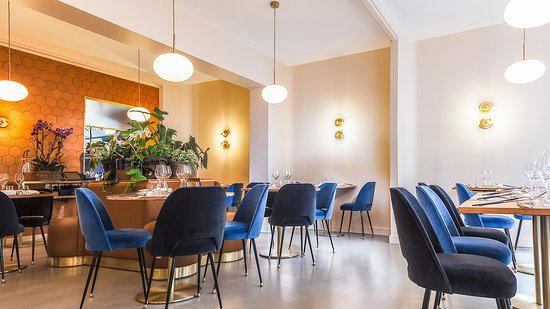
Mexican Technique in the Shadow of the Étoile
Oxte is a one-Michelin-star restaurant in Paris's 17th arrondissement, serving modern French-Mexican fine dining at about $130 per person. The city that produced Kei Kobayashi's Franco-Japanese precision at Kei, or the vegetable-centred rigour of Alain Passard at Arpège, has proven repeatedly that classical French discipline and imported culinary DNA can coexist at the highest level. Oxte operates inside that same tradition, but with an ingredient set and flavour logic that remains distinctly Mexican.
The restaurant sits at 5 Rue Troyon, a short street in the 17th arrondissement that puts it within walking distance of the Arc de Triomphe, in a neighbourhood where the competition includes particularly formally demanding kitchens in France. Le Cinq at the Four Seasons George V and the multi-starred machinery of Alléno Paris au Pavillon Ledoyen define what €€€€ dining looks like in this part of the city. Oxte prices at that same tier, but the format is the opposite of grand-room formality: small, close, and deliberately relaxed in atmosphere, with a team that moves between kitchen and dining room.
Michelin awarded the restaurant a star, confirmation that a Mexican-inflected kitchen using French seasonal produce as its primary canvas has earned a place inside the city's most closely scrutinised dining scene. That credential matters less for what it signals about prestige and more for what it says about consistency: a shifting seasonal menu built on moles, recados, and fire-linked technique, maintained at a level that satisfies inspectors who work from a framework built entirely around classical French standards.
Fire, Smoke, and the Logic of the Mexican Kitchen in Paris
The editorial angle on Oxte almost always begins with cultural fusion, but the more accurate frame is technique. Mexican cooking at its most serious is fundamentally about transformation through heat and smoke. Barbacoa, al pastor, recado negro: these are not simply flavour profiles but methods, each involving a specific relationship between protein or vegetable and fire. What Oxte does is bring that logic into contact with the French seasonal calendar, applying smoke, char, and fermented chile paste to ingredients sourced from French producers and markets.
The Michelin commentary is specific on this point. Squid paired with house-made black pudding and recado negro is the kind of construction that requires a deep command of both traditions: the recado negro, a Yucatecan paste built from charred dried chiles, spices, and burned tortilla, is one of Mexican cooking's most complex condiments, with a genuine smokiness that comes from the controlled burning of its base ingredients. Applying it to squid sourced through a French supply chain, alongside a product as classically European as black pudding, produces something that neither cuisine would arrive at independently.
Pigeon with Oxte mole, leeks, and pickled raisins is a similar exercise. Mole is not a single sauce but a category, and the house version paired with pigeon places the kitchen in a conversation with one of Mexico's most labour-intensive preparations. That Michelin reviewers specifically named the mole suggests it holds up to scrutiny rather than functioning as shorthand for Mexican flavour. The seasonal drift of the menu means these specific constructions may evolve, but the underlying architecture of fire, smoke, fermented and dried chile, and French market produce remains the kitchen's operating framework.
This approach to open-flame and smoke-driven cooking places Oxte in a specific position relative to the broader category of Mexican fine dining internationally. Restaurants such as Pujol in Mexico City have made the case for Mexican technique as a framework capable of supporting the highest level of formal dining. Oxte's contribution is to test that proposition inside the demanding possible host city, using French produce and a French fine-dining audience as the proving ground.
Seasonal Menu, Compact Format, and the Vegetable Question
The menu at Oxte changes with the seasons, which in practical terms means the dishes that earned Michelin attention in one cycle may not appear in the next. This is consistent with how the leading French kitchens operate: Bras in Laguiole and Flocons de Sel in Megève are both anchored by the same commitment to seasonal produce as the primary driver of menu evolution. What distinguishes Oxte is that the spice and condiment layer, the dried chiles, the recados, the mezcal-inflected preparations, remains consistent even as the French ingredients around it shift.
The Michelin commentary raises a specific and revealing point: the presence of dishes centred on vegetables or entirely plant-based preparations, and the suggestion that a fully plant-based menu is a possibility the kitchen has been invited to consider. This is worth noting because it places Oxte in a conversation that particularly forward-looking French kitchens are also having. Passard at Arpège moved away from meat as the menu's centre of gravity more than two decades ago. The question of whether the fire-and-smoke logic of the Mexican kitchen, historically so connected to meat cookery, can be as compelling applied entirely to vegetables and plants is exactly the kind of argument that earns sustained critical attention.
These are tight windows, and the small size of the room means the number of covers per service is limited.6 across 627 entries, a score that suggests consistent performance. The atmosphere described across reviews is consistent: small, welcoming, without the formal distance that defines the larger €€€€ rooms nearby. Compared to the institutional weight of L'Ambroisie on Place des Vosges, Oxte operates closer to the kind of owner-chef bistro that Paris does well, but with a Michelin star and a price point that reflects the ambition of the cooking.
Where Oxte Sits in Paris's Wider Dining Map
Paris's €€€€ tier is not homogeneous. At one end, there are the grande maison kitchens where format, service architecture, and cellar depth are as much the product as the food. At the other end, there is a smaller category of restaurants where the price reflects the quality and precision of the cooking rather than the weight of the institution around it. Oxte belongs to the latter group, and within that group, it occupies a position that has few direct peers in the city. There is many restaurants in Paris drawing on Asian culinary traditions at the highest level, as Kei demonstrates. Mexican fine dining at Michelin level is a considerably smaller category.
For comparison with Mexican fine dining in other contexts, Alma Fonda Fina in Denver represents a different regional approach to the same broad question of how Mexican cooking operates at the summit of the market.
France's wider constellation of landmark restaurants, from Mirazur in Menton to Troisgros in Ouches and the long-standing institution of Paul Bocuse in Collonges-au-Mont-d'Or or Auberge de l'Ill in Illhaeusern, sets the reference frame against which Oxte's Michelin recognition can be measured. Earning a star in France, where the density of competition and the historical weight of the national cuisine make the inspector's job especially conservative, carries a specific authority that stars awarded in less contested markets do not carry equally.
Planning a Visit
Oxte is at 5 Rue Troyon, 75017 Paris. The restaurant runs Monday through Friday, with lunch from 12:15 to 1:30 PM and dinner from 7:15 to 9 PM. Given the limited capacity, booking in advance is essential. The €€€€ price point places it at the higher end of the Paris market; those comparing options at this tier will find different formats in the neighbourhood, but few that match this particular combination of cooking tradition and room scale. The format rewards diners willing to engage with the menu rather than arrive with specific dish expectations, given the seasonal rotation that drives the kitchen's programme.
What's the leading thing to order at Oxte?
The short answer from the Michelin record is the avocado, mezcal, and lime dessert, which the inspectors single out as the house's emblematic preparation. Among savoury dishes, the constructions built around recado negro and the house mole represent the kitchen at its most distinctive: these are preparations that require both Mexican technique and French produce to function, and they are one direct expression of what Oxte is doing that no other kitchen in Paris replicates at this level. Given the seasonal rotation, the specific proteins change, but those looking for the core of the restaurant's argument should follow whatever the mole and recado negro are paired with on the current menu.
Quick Comparison
Comparable venues nearby, for context on price, style, and recognition.
| Venue | Cuisine | Price | Awards | Notes |
|---|---|---|---|---|
| OxteThis venue — the venue you are viewing | Modern French-Mexican Fine Dining | $$$$ | Michelin 1 Star | Not listed |
| L'Archeste | Japanese-French Fine Dining | $$$$ | Michelin 1 Star | 16th arrondissement |
| Maison Dubois | Modern French Fine Dining | $$$$ | Michelin 1 Star | 8eme arrondissement |
| L'Arôme | Contemporary French Fine Dining | $$$$ | Michelin 1 Star | 8th arrondissement |
| Anne | Modern French Fine Dining | $$$$ | Michelin 1 Star | Le Marais |
| FIEF | Modern French 100% Local | $$$$ | Michelin 1 Star | 11th Arr. - Popincourt |
Recognition history
Dated appearances from independent guides and award organizations, with the underlying list record or original source where available.
Michelin 1 Star
Michelin
Michelin 1 Star
Michelin
We're Smart World 3 Radishes
We're Smart World
Michelin 1 Star
Michelin
Continue exploring
More in Paris
Restaurants in Paris
Browse all →


Bars in Paris
Browse all →
Hotels in Paris
Browse all →








At a Glance
- Elegant
- Intimate
- Sophisticated
- Modern
- Date Night
- Business Dinner
- Special Occasion
- Celebration
- Open Kitchen
- Standalone
- Sommelier Led
- Extensive Wine List
- Local Sourcing
Current opening hours
- Monday
- 12:15–1:30 PM, 7:15–9 PM
- Tuesday
- 12:15–1:30 PM, 7:15–9 PM
- Wednesday
- 12:15–1:30 PM, 7:15–9 PM
- Thursday
- 12:15–1:30 PM, 7:15–9 PM
- Friday
- 12:15–1:30 PM, 7:15–9 PM
- Saturday
- Closed
- Sunday
- Closed
Hours can change for holidays and private events. Last verified .
Lively, colorful décor with ocre and bright blue tones; intimate setting with open kitchen views; warm and welcoming despite fine dining formality.