Orphan Andy's Restaurant
Orphan Andy's sits at 3991 17th Street in the Castro, a diner-format fixture in one of San Francisco's most defined neighbourhood identities. The physical space does what the neighbourhood has always asked of it: keep the counter stool warm, keep the coffee coming, keep the door open late. In a city where the gap between counter-service institutions and Michelin-tracked tasting rooms grows wider each year, Orphan Andy's occupies a distinct and durable position at the casual end of that spectrum.
Pearl is the En Primeur Club membership app — saves, bookings, and concierge access live there. Same editors, same standards.
- Address
- 3991 A 17th St, San Francisco, CA 94114
- Phone
- +1 415 864 9795
- Website
- orphanandys.site
- Directions
- Get directions
 Saves & bookings on Pearl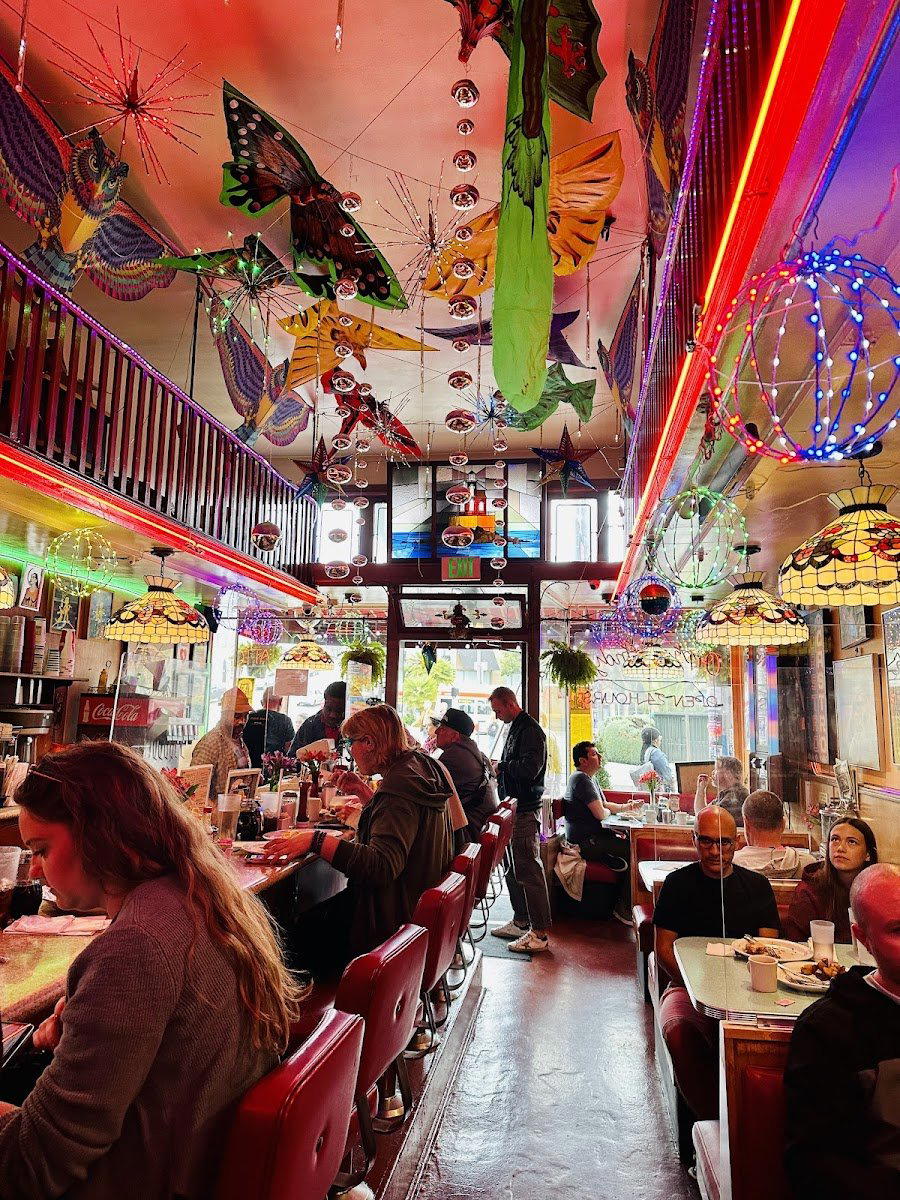
The Castro Counter: What a Neighbourhood Diner Looks Like at This Address
Walk along 17th Street in the Castro on any given evening and the shift from ambient street energy to interior warmth happens fast. The diner format, counter seating, booth upholstery, short-order rhythm, has a spatial logic that no amount of reclaimed wood or Nordic minimalism can replicate. Orphan Andy's at 3991 A 17th St belongs to this tradition: a physical container designed around speed of service, face-to-face counter geometry, and the kind of lighting that makes a mug of coffee read as an event rather than a transaction.
The Castro has long operated as one of San Francisco's most neighbourhood-coherent districts, meaning the restaurants and diners that survive here do so because they serve a community function as much as a culinary one. Late-night counter formats, in particular, carry weight in neighbourhoods with active evening populations. The diner booth and the counter stool are democratic furniture, they do not require a reservation, they do not impose a dress code, and they do not ask you to commit to a tasting format before you sit down. These are not incidental features; they are the design.
A Physical Format That Resists Trend Cycles
San Francisco's fine-dining tier has grown increasingly consolidated around the tasting-menu format. Venues like Lazy Bear (Progressive American, Contemporary) and Atelier Crenn (Modern French, Contemporary) operate at price points and booking lead times that place them in a separate category from neighbourhood day-to-day eating entirely. The same is true of Benu (French-Chinese, Asian), Quince (Italian, Contemporary), and Saison (Progressive American, Californian), each of which commands a significant per-head spend and a formal booking window. The diner counter represents the opposite end of that spectrum, and in a city where mid-range casual dining has been under pressure for over a decade, the endpoints of the dining spectrum have become more pronounced.
The interior arrangement at a classic American diner is worth taking seriously as architecture. The counter runs parallel to the kitchen pass, collapsing the distance between preparation and consumption. Booth seating along the perimeter creates a series of semi-private spaces within what is otherwise a fully public room. These are not design choices made by a hospitality consultant, they are the evolved geometry of a format that has been pressure-tested across more than a century of American eating culture. Orphan Andy's sits inside that lineage at this address on 17th Street.
The Castro's Dining Character and Where the Diner Fits
The Castro's restaurant mix has always skewed toward accessibility over ceremony. The neighbourhood's evening foot traffic, its density of residents, and its tradition of community gathering spaces all push against the kind of hushed, paced dining experience that defines the city's higher-end rooms.
Late-night diner format is particularly legible in this neighbourhood context. Cities with strong late-night food cultures, New York, New Orleans, Chicago, have historically supported counter-service institutions that operate as anchor points for neighbourhoods after kitchens in more formal restaurants have closed. In New York, that tradition runs through venues like Le Bernardin at the fine-dining end and a parallel infrastructure of 24-hour diners at the other. New Orleans has its own version, and spots like Emeril's in New Orleans exist alongside a dense layer of informal neighbourhood eating that keeps the city's food culture legible at every hour. San Francisco's version of that infrastructure is thinner than it once was, which gives any functioning late-night format in the Castro additional weight simply by remaining open.
The Diner in a City of Destination Restaurants
San Francisco's restaurant identity is substantially defined by its destination-tier venues: The French Laundry in Napa sets the regional ceiling, while urban counterparts in Chicago (Smyth), Los Angeles (Providence), and Healdsburg (Single Thread Farm) define peer comparisons across the West Coast and beyond. These venues share a commitment to the tasting format, to advance booking, and to a high degree of intentionality around every element of the physical experience. The diner counter operates on exactly the opposite set of assumptions: immediacy over planning, familiarity over revelation, repetition over discovery.
That is not a criticism. The diner format has its own discipline. Short-order cooking at volume, sustaining quality across a broad menu, managing a counter and a booth section simultaneously, these are skills that do not translate easily from the tasting-room kitchen, and vice versa. The comparison is useful precisely because it clarifies what each format is actually doing. Across the broader American dining scene, venues like Blue Hill at Stone Barns in Tarrytown, Addison in San Diego, The Inn at Little Washington, Frasca Food & Wine in Boulder, Atomix in New York City, and Atelier Moessmer Norbert Niederkofler in Brunico all sit at the formal, high-intention end of the dining spectrum. None of them would claim to serve the function that a Castro neighbourhood diner serves. The functions are genuinely different.
Know Before You Go
| Address | 3991 17th St (at Castro), San Francisco, CA 94114 |
|---|---|
| Neighbourhood | The Castro, San Francisco |
| Format | Counter and booth diner |
Fast Comparison
Comparable venues nearby, for context on price, style, and recognition.
| Venue | Cuisine | Price | Notes |
|---|---|---|---|
| Orphan Andy's RestaurantThis venue — the venue you are viewing | Classic American Diner | $ | Not listed |
| Kate's Kitchen | American Breakfast & Southern Comfort | $ | Hayes Valley |
| Moonlight Cafe | American Breakfast & Cafe | $ | Bernal Heights |
| Joe's Ice Cream | Classic American Ice Cream Parlor | $ | Outer Richmond |
| Jerry’s Roast Pork | Philly-Style Roast Pork Sandwiches | $ | Financial District/South Beach |
| Arguello Market | Classic American Deli Sandwiches | $ | Lone Mountain/USF |
Continue exploring
More in San Francisco
Restaurants in San Francisco
Browse all →
Bars in San Francisco
Browse all →
Hotels in San Francisco
Browse all →
At a Glance
- Lively
- Cozy
- Well Known
- Brunch
- Late Night
- Casual Hangout
- Historic Building
Current opening hours
- Monday
- 8 AM–9:45 PM
- Tuesday
- Open 24 hours
- Wednesday
- Open 24 hours
- Thursday
- Open 24 hours
- Friday
- Open 24 hours
- Saturday
- Open 24 hours
- Sunday
- 12 AM–9:45 PM
Hours can change for holidays and private events. Last verified .
Cheerful and lively diner atmosphere with fun decor, booth and counter seating, and a welcoming neighborhood vibe that supports easy conversation.