Tabelog 100 #21
Our verdict
Osaka’s konamon culture is at its clearest in Momodani and Tsuruhashi, where okonomiyaki sits between everyday supper and serious local craft. Okonomiyaki Omoni Honten belongs to that category: a 20-seat, no-reservations house restaurant recognized in Tabelog’s Okonomiyaki 100 selections, with a reputation built on customizable Osaka-style pancakes and stir-fried noodles.

Pearl is the En Primeur Club membership app, where members save venues, book tables and use the concierge.
The menu
What to order
- Omoni-yaki with pork, squid, shrimp, scallops and egg
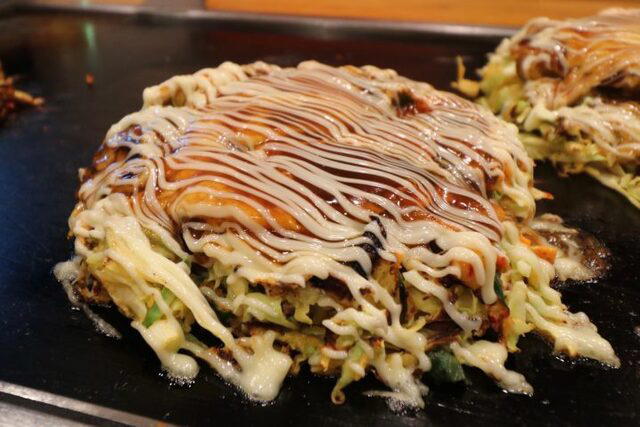
- Custom okonomiyaki with beef sinew, kimchi and squid tempura
- Tama Tama double-egg okonomiyaki style
Approaching Okonomiyaki Omoni Honten in Osaka, the city’s polish shifts into a denser rhythm: small streets, neighborhood eating rooms, and the practical appetite of everyday dining. It is the right setting for okonomiyaki. The dish is not ceremonial, but it is not careless casual dining either. In Osaka, batter, cabbage, sauce, heat, and timing form a local grammar, tied to the table, grill, and pace of groups eating together.
Okonomiyaki Omoni Honten sits in that tradition, not above it. The category is direct and specific: okonomiyaki and stir-fried noodles. The appeal is narrower and personal, closer to neighborhood dining than the department-store version of Osaka food visitors often meet first.
Osaka-style okonomiyaki through a local dining lens
Osaka gives this address its context. The city has long treated flour-based comfort food as serious everyday eating, so sauce, heat, texture, and shared appetite sit close together rather than in separate categories. Here, “local ingredients, global technique” is less a slogan than a way to understand Osaka’s habit of absorbing preferences into griddle cooking and making them feel native.
The house reputation rests on okonomiyaki and stir-fried noodles, formats that suit Osaka’s informal intelligence around casual food. The details that matter are not luxury signals but execution: the balance of batter and fillings, the timing on the grill, and the way sauce and heat turn a simple format into something highly personal.
That flexibility also explains the following beyond immediate regulars. The larger point is cultural: Osaka okonomiyaki is democratic enough to invite preference and technical enough to punish poor execution. The city rewards places that keep the form loose without letting the cooking become sloppy.
Why the recognition matters in a city built on everyday food
Osaka’s serious dining conversation often splits into two lanes. One is reservation-driven, higher-spend dining, where a restaurant such as Man masa belongs to a different kind of itinerary. The other is everyday specialty culture, where narrow formats earn loyalty through repetition, speed, and consistency. Okonomiyaki Omoni Honten belongs to the second lane, alongside focused addresses that make Osaka more than a formal dining stop.
Tabelog selected the restaurant for its Okonomiyaki 100 list in 2025. In a category as competitive as Osaka okonomiyaki, that recognition matters because it places the restaurant within a field where diners can compare versions across the city’s counters, lunch rooms, and family-run settings without ceremony.
The Tabelog score of 3.61 also needs context. In Japan, especially on Tabelog, ratings cluster tightly and high scores are hard to accumulate in everyday categories. A mid-3 rating for a specialty shop can mean more than it would on platforms where inflation is routine. The recognition and category focus point to a place competing on credibility, not luxury codes.
The price tier reinforces that reading. Dinner is listed at JPY 2,000 to JPY 2,999, with lunch at JPY 1,000 to JPY 1,999. That places it in Osaka’s strongest value proposition: food with a defined point of view without a tasting-menu budget. Compared with other focused low-spend formats, the difference is not ambition but rhythm. Some meals concentrate the experience into a single bowl or plate; okonomiyaki stretches it across a griddle, shared toppings, and conversation.
How to fit it into an Osaka food day
The restaurant is in Osaka, in a part of the city that rewards walking before or after the meal. This is not necessarily the sleekest dining geography or the most polished visitor circuit. It suits travelers who want to understand how Osaka eats when not performing for cameras: small rooms, practical appetites, and food built around repeatable satisfaction.
Planning here means treating it as an everyday specialty stop rather than a formal destination. Keep the meal flexible, allow time around lunch or dinner, and come ready for a focused format built around okonomiyaki and stir-fried noodles. The stronger reason to come is the house-restaurant feel and the shared-table logic of the cuisine.
For a broader Osaka itinerary, pair this konamon address with bakeries, counters, and snack specialists rather than forcing it into a formal fine-dining day. EP Club’s Osaka coverage includes other dining in Osaka, plus broader city guides for restaurants, hotels, bars, wineries, and experiences. Wider Japan and Japanese-influenced dining references can be useful as context, but Okonomiyaki Omoni Honten is best understood on its own terms: an Osaka specialist with a clear category identity.
The editorial case is clear: Okonomiyaki Omoni Honten is not trying to translate Osaka for visitors. It belongs to the city’s working food culture, where a low-spend meal can carry technique, local identity, and recognized category credibility. Go for Osaka-style okonomiyaki with room for personal combination, not formality.
Frequently asked questions
Where do I go for Okonomiyaki Omoni Honten?
Osaka.
What's the price range at Okonomiyaki Omoni Honten?
Pricing at Okonomiyaki Omoni Honten is listed as Dinner: JPY 2,000 - JPY 2,999; Lunch: JPY 1,000 - JPY 1,999.
How far ahead should I plan for Okonomiyaki Omoni Honten?
Plan around a focused Osaka meal rather than a long formal dining experience. The listed budget is modest, so it works well as a lunch or dinner stop built around okonomiyaki and stir-fried noodles.
What has Okonomiyaki Omoni Honten built its reputation on?
The clearest credential provided is selection for Tabelog Okonomiyaki 100 in 2025, alongside a Tabelog score of 3.61. Its listed categories are okonomiyaki and stir-fried noodles.
Where It Fits
Comparable venues for context, by category and price tier.
| Venue | Cuisine | Price | Awards | Notes |
|---|---|---|---|---|
| Okonomiyaki Omoni HontenThis venue (the venue you are viewing) | Osaka okonomiyaki house-restaurant | $20–30 | Tabelog 100 #21 | Not listed |
| Okonomiyaki Ajikuraya | Osaka okonomiyaki & teppanyaki | $30–50 | Tabelog 100 #26 | Tennōji |
| Datedachi | Stand-up Yakitori & Izakaya | $30–50 | Tabelog 100 #85 | Chūō |
| Revo Honten | Japanese Yoshoku (Steak & Hamburger Steak) | $10–20 | Tabelog 100 #94 | Nishinari |
| DINING | Japanese Kaiseki and Teppanyaki | Not listed | Not listed | Osaka |
| Grill Bon | Classic Yoshoku beef cutlet & katsu sando | $20–30 | Tabelog 100 #17 | Naniwa |
Recognition history
Dated appearances from independent guides and award organizations, with the underlying list record or original source where available.
Tabelog 100 #21 · No. 21
Tabelog · Tabelog 100 - Okonomiyaki - 2025