
Noodle & Spice Curry Kyou no Ichiban puts Kawaguchi’s low-cost counter culture into sharp focus: ramen and curry, eight counter seats, no reservations, and Tabelog Ramen EAST 100 selections in 2021, 2024, and 2025. The appeal is not ceremony; it is a tightly run, ingredient-led format where dried sardines, spice curry, and ticket-machine discipline define the meal.
Pearl is the En Primeur Club membership app — saves, bookings, and concierge access live there. Same editors, same standards.
- Address
- 埼玉県川口市飯塚3-2-12
- Website
- kyouichi.official.ec
 Saves & bookings on Pearl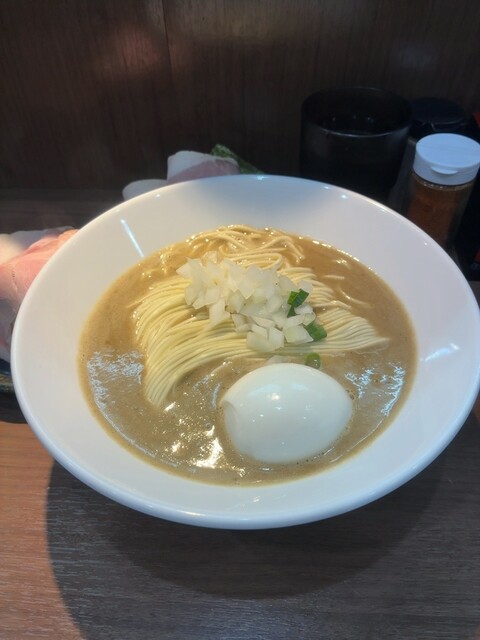
Approach the counter format in Kawaguchi and the first signal is not luxury, but compression: a small room, eight counter seats, meal tickets, and a rhythm built for diners who know what they want before they sit down. In a city often treated as a commuter edge of greater Tokyo, ramen shops carry a different kind of seriousness from formal dining. The test is speed, repeatability, and whether a narrow menu can make a clear argument. Noodle & Spice Curry Kyou no Ichiban makes that argument through ramen and curry rather than through the chef-led theatre now common at higher-priced counters.
That matters because Kawaguchi’s eating culture is not only about destination restaurants. It also runs on low-friction places where solo diners can eat well without ceremony. Within the local set, the contrast is useful: Sakaba Watanabe sits in a JPY 8,000 to JPY 9,999 bracket, while Chandoiseau, Chandoiseau Glacier Chocolatier, Mendokoro Arisa, and Noodle & Spice Curry Kyou no Ichiban occupy the sub-JPY 999 tier. The price band does not make the shop casual in intent. It makes the format sharper, with fewer ways to hide weak sourcing or loose execution.
Dried sardines, spice curry, and the logic of a narrow counter
Tokyo-area ramen has spent the past decade stretching far beyond the old shoyu, shio, miso, and tonkotsu shorthand. Niboshi, the dried-sardine base that can read clean, bitter, marine, or dense depending on extraction, has become a marker of shops willing to foreground ingredient character rather than cover it with fat. Here, storefront notices identify the types of dried sardines and curries used for the day’s Niboshi Soba and Rich Niboshi Soba, which tells diners where the flavour architecture begins before a bowl reaches the counter.
The curry side is not an accessory in the way curry rice can be at some noodle shops. The name announces the split identity, and the ordering rules underline it: set curry and seasoned noodles are tied to noodle orders, while adults are expected to order either one bowl of noodles or a single spice curry. That structure keeps the room from becoming a grazing table. It protects seat turnover, portions, and the kitchen’s ingredient flow, all of which matter in an eight-seat operation.
The limited-menu system is also part of the food culture rather than a gimmick. Limited items carry numbers that correspond to buttons on the ticket machine, and they end when they run out. This is common in Japan’s serious ramen counters: scarcity is not dressed up as exclusivity, it is the consequence of small-batch prep and finite stock. For diners, the better move is to read the posted information before ordering rather than treating the machine as an afterthought.
Recognition without the fine-dining price signal
Tabelog selected Noodle & Spice Curry Kyou no Ichiban for its Ramen EAST 100 list in 2021, 2024, and 2025, and its Tabelog score is 3.74. Those numbers place the shop inside a competitive regional ramen conversation, not just a neighbourhood convenience category. The recognition is useful because ramen pricing often hides ambition: a bowl under JPY 999 can involve sourcing decisions and prep discipline that would be easier to notice in a tasting-menu room.
Compared with Kawaguchi’s pastry and casual dining options, the shop sits in a more functional lane. Chandoiseau and Chandoiseau Glacier Chocolatier frame the city through patisserie and chocolatier craft; Eikichi runs in a slightly higher casual band. Noodle & Spice Curry Kyou no Ichiban is closer to a specialist ramen-counter thesis: compact seating, no private rooms, no private use, no smoking, and no card, electronic-money, or QR-code payments. The experience is disciplined rather than leisurely.
There is also a clear boundary around who the format serves. Solo dining is the natural fit, not because groups are unwelcome in principle, but because counter shops this small reward decisiveness. Families need to read the rules carefully: there is no kids menu, children using a seat must order a main dish, and entry with baby carriers, backpacks, or strollers is not allowed. That is not a lifestyle statement; it is how an eight-seat ramen room keeps service moving.
How to read Kawaguchi through one counter seat
Kawaguchi is not short on everyday eating, but its more interesting addresses tend to show how suburban Saitama absorbs Tokyo standards without copying Tokyo prices. A counter like this belongs to that pattern. It asks for attention to process: line protocol, cash preparation, ticket-machine literacy, and the posted details on sardines, curry, and limited items. If there is a line, the meal ticket is bought after being called, and the machine accepts only 1000-yen bills with no exchange. Parking is unavailable, though coin parking is noted nearby; the better mental model is a station-area ramen stop rather than a car-led outing.
For broader local planning, Our full Kawaguchi restaurants guide gives the useful comparison set, while Our full Kawaguchi hotels guide, Our full Kawaguchi bars guide, Our full Kawaguchi wineries guide, and Our full Kawaguchi experiences guide cover the wider trip structure. Nearby and regional restaurant references add texture: Archaique, FuFu Kawaguchiko (Kaiseki), -Grilled beef Sukiyaki- KAMAKURA TANUKIAN 鎌倉 たぬき庵 in Kamakura. 鮪と炭火焼き うお炭 秋葉原店 in Tokyo.cafe in Osaka.know in Kumamoto, (Shoku) Vietnam in Kawasaki, [Curry Senmon Ten] Maruyama Kyoju. in Sapporo, Jōdo Saké Bar in Los Angeles, and Onigiri Time in Pasadena.
The editorial read is clear: this is a compact, ingredient-conscious ramen and curry counter for diners who value sourcing cues and ordering discipline over comfort padding. The Tabelog Ramen EAST 100 selections give it a regional credential; the sub-JPY 999 price band keeps it rooted in everyday Japanese dining. Go for the grammar of niboshi and spice curry, not for a long evening.
Quick Comparison
Comparable venues by cuisine and price in the same metro.
| Venue | Cuisine | Price | Notes |
|---|---|---|---|
| Noodle & Spice Curry Kyou no Ichiban | Ramen and Japanese curry | $ | Kawaguchi |
| Menya Eita | Japanese Tsukemen / Ramen | $ | Shiba |
| らーめん かねかつ | Authentic Japanese Ramen | $ | Iizuka |
| Eikichi | Spicy Tantanmen & Chinese Noodles | $ | Nishi-Kawaguchi |
| Menya Kiryu Higashikawaguchi honten | Spicy Jiro-style ramen | $ | .戸塚 |
| Archaique | Japanese-style cake and bread shop | $$ | Higashi Kawaguchi |
Recognition history
Dated appearances from independent guides and award organizations, with the underlying list record or original source where available.
Tabelog 100 #22 · No. 22
Tabelog · Tabelog 100 - Ramen - EAST - 2025
Continue exploring
More in Kawaguchi
Restaurants in Kawaguchi
Browse all →


Bars in Kawaguchi
Browse all →



At a Glance
- Solo
- Casual Hangout
- After Work
- Standalone
Casual ramen-and-curry shop atmosphere oriented around quick meals, with a focus on the food rather than design or décor.