
Tabelog 100 #13
Our verdict
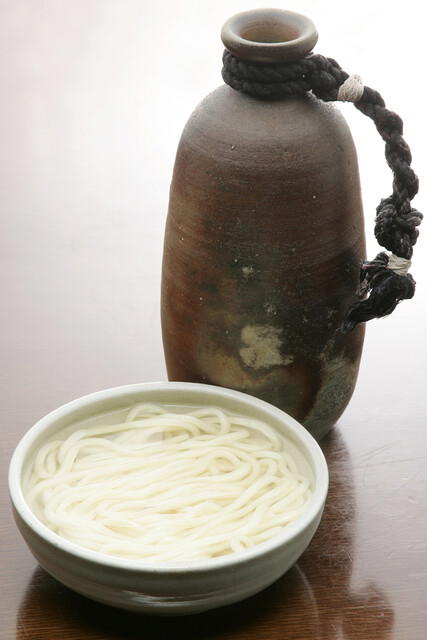
Tokyo’s serious noodle culture is not limited to soba counters and ramen queues. Nezu Kamachiku brings kamaage udon into a slower Bunkyo register, pairing a house-restaurant setting with sake-bar instincts and repeat selection in Tabelog’s Udon EAST 100, making it a useful benchmark for travelers comparing Tokyo’s specialist noodle rooms.

Pearl is the En Primeur Club membership app, where members save venues, book tables and use the concierge.
The menu
What to order
- Kama-age udon
- Zaru udon
- Tempura
- Onsen egg side dish
Approaching Nezu Kamachiku in Tokyo, the city’s dining tempo changes. The louder restaurant districts often trade in speed, signage, and station-front density; this meal belongs to a calmer Tokyo register, where a narrow specialty can carry the room. In that setting, udon reads differently. It is not only the quick bowl grabbed between trains, but a dish that can be given the same seriousness that Tokyo often reserves for sushi counters, tempura bars, and hand-cut soba rooms.
Nezu Kamachiku sits in that specialist category: udon as a focused format, not a side note. The public framing is precise, Udon (Wheat noodles) and Japanese sake bar. That combination matters. Tokyo has plenty of noodle shops built around turnover, but the city’s more interesting udon rooms depend on coordination between kitchen, sake selection, and floor pacing. The bowl is central, yet the experience is carried by the team around it.
Udon treated as a sit-down Tokyo specialty
Udon belongs to a different rhythm from ramen’s concentrated broth culture or soba’s buckwheat minimalism. The appeal is structural: wheat noodles, with texture and temperature doing much of the work. In Tokyo, where noodle categories often split into sharply defined tribes, a focused udon restaurant occupies a narrower lane. Nezu Kamachiku’s Tabelog Hyakumeiten recognition in 2024 places it within the city’s recognized udon conversation rather than the broader casual-noodle field.
The useful editorial point is the room’s clarity. This is not a generic neighborhood noodle stop, nor a restaurant trying to cover every part of Japanese dining at once. It is udon translated into a Tokyo setting with sake-bar structure and enough focus to make the category feel deliberate. That makes it especially useful for travelers who want to understand how a single everyday form can become the center of a proper meal.
Within the local comparison set, the positioning is clear. Teuchi Soba Nezu Takajo and Soba Kokoro sit in the soba conversation, where hand-cut buckwheat and lower-key noodle meals dominate. Nezu Yakitori Terusumi and Tempura Fukutarou push toward other evening formats. Nezu Kamachiku occupies the middle ground: more deliberate than a quick lunch counter, less formal than a grand tasting-menu temple, and more drink-aware than many noodle specialists. For readers mapping the area through Our full Tokyo restaurants guide, that middle tier is often where Tokyo becomes interesting.
The room works because service, sake, and noodles share the same pace
The team dynamic is the part travelers should notice. A udon house with sake-bar ambitions depends on front-of-house timing as much as kitchen consistency. Noodles can lose their point quickly; sake service needs enough attention to feel intentional without turning the meal into a formal pairing exercise. The listed category, Udon (Wheat noodles) and Japanese sake bar, signals a room designed for more than simple refueling.
That affects who should come. Tokyo visitors often over-index on omakase counters, then treat noodles as a casual add-on. Here, the better comparison is with specialist rooms where a single craft is allowed to set the meal’s pace. The appeal is not a sealed-off luxury format, but a focused restaurant whose value comes from restraint, repetition, and the confidence to let udon define the visit.
The Tokyo setting helps keep the experience away from the theatre of the city’s most internationally famous dining rooms. A udon-and-sake stop here makes more sense than forcing another prestige counter into every itinerary. For a wider day plan, pair this meal with citywide references rather than chasing only trophy rooms: Our full Tokyo bars guide, Our full Tokyo hotels guide, Our full Tokyo experiences guide, and Our full Tokyo wineries guide help frame the rest of the trip.
How to place it inside a Tokyo food itinerary
The smart use of Nezu Kamachiku is as a specialist anchor in a Tokyo day, not only as a trophy reservation. Tokyo rewards this kind of sequencing: one meal built around a craft, another around grilled skewers, curry, tempura, seafood, or another narrow form. EP Club readers comparing formats can look across other Tokyo dining rooms generically rather than treating them as interchangeable. The point is that Tokyo’s strength lies in narrow formats executed with confidence.
For Japan-wide context, the same logic extends beyond the capital. Across the country, specialist counters, noodle rooms, and compact restaurants often show how Japanese dining rewards depth over breadth. The pattern also travels abroad in different forms, where a single Japanese category can become the organizing principle. Nezu Kamachiku fits that broader way of eating: choose the form, respect its limits, and let repetition produce character.
The verdict is simple: this is a Tokyo meal for travelers who care about category literacy. It explains a slice of the city that the global fine-dining circuit can miss: udon with Tabelog Hyakumeiten recognition, Japanese sake-bar structure, and a measured Tokyo pace. For broader itinerary contrast, keep an eye on other specialist rooms in Tokyo and beyond. Dining becomes clearer when these restaurants are seen as part of a wider habit: pick a form, narrow the frame, and let the team’s timing carry the meal.
Frequently asked questions
Where do I go for Nezu Kamachiku?
Nezu Kamachiku is located in Tokyo.
Is Nezu Kamachiku more mid-range or high-end?
Pricing at Nezu Kamachiku is listed as Dinner: JPY 5,000 - JPY 5,999; Lunch: JPY 2,000 - JPY 2,999.
Is Nezu Kamachiku reservation-only?
The available listing identifies Nezu Kamachiku as a Tokyo udon and Japanese sake bar with Tabelog Hyakumeiten recognition in 2024. For current reservation rules, check directly with the restaurant before going.
What's the signature at Nezu Kamachiku?
The house is listed as Udon (Wheat noodles) and Japanese sake bar. That focus is spelled out in its Tabelog listing for Nezu Kamachiku in Tokyo.
Can Nezu Kamachiku handle vegetarian requests?
The venue is listed as an udon and Japanese sake bar, but detailed vegetarian guidance is not provided here. Vegetarian diners should check directly with Nezu Kamachiku in Tokyo before ordering.
Can I bring kids to Nezu Kamachiku?
Specific family and stroller guidance is not provided here. If visiting with children, check directly with Nezu Kamachiku in Tokyo before you go.
At a Glance
Comparable venues at the same tier for side-by-side context.
| Venue | Cuisine | Price | Awards | Notes |
|---|---|---|---|---|
| Nezu KamachikuThis venue (the venue you are viewing) | Traditional Udon in Historic Stone Warehouse | $20–30 | Tabelog 100 #13 | Not listed |
| Tempura Fukutarou | Seasonal Tempura Omakase | $150–200 | Tabelog 100 #81 | JPY 15,000 - JPY 19,999 JPY 10,000 - JPY 14,999 |
| Soba Kokoro | Traditional Soba Noodle Shop | $20–30 | Tabelog 100 #46 | JPY 3,000 - JPY 3,999 JPY 2,000 - JPY 2,999 View spending breakdown |
| Nezu Yakitori Terusumi | Yakitori Omakase | $100–150 | Tabelog 100 #50 | JPY 10,000 - JPY 14,999 |
| Teuchi Soba Nezu Takajo | Traditional hand-cut soba | $20–30 | Tabelog 100 #80 | JPY 2,000 - JPY 2,999 JPY 2,000 - JPY 2,999 View spending breakdown |
| Imojin | Traditional Japanese sweets & ice cream café | $1–10 | Tabelog 100 #48 | JPY 999 - JPY 999 |
Recognition history
Dated appearances from independent guides and award organizations, with the underlying list record or original source where available.
Tabelog 100 #13 · No. 13
Tabelog · Tabelog 100 - Udon - EAST - 2024
Continue exploring
More in Tokyo
Restaurants in Tokyo
All restaurants in Tokyo →













Details
- Classic
- Scenic
- Elegant
- Cozy
- Rustic
- Date Night
- Group Dining
- Solo
- Casual Hangout
- After Work
- Special Occasion
- Garden
- Historic Building
- Design Destination
- Standalone
- Sake Program
- Beer Program
- Garden
- A La Carte
- Sake
- Beer
Calm, traditional Japanese setting in a brick-and-stone kura-style warehouse with warm lighting, tatami and wood interiors, and views onto a small garden that create a refined yet relaxed atmosphere ideal for quiet meals and sake.