Our verdict
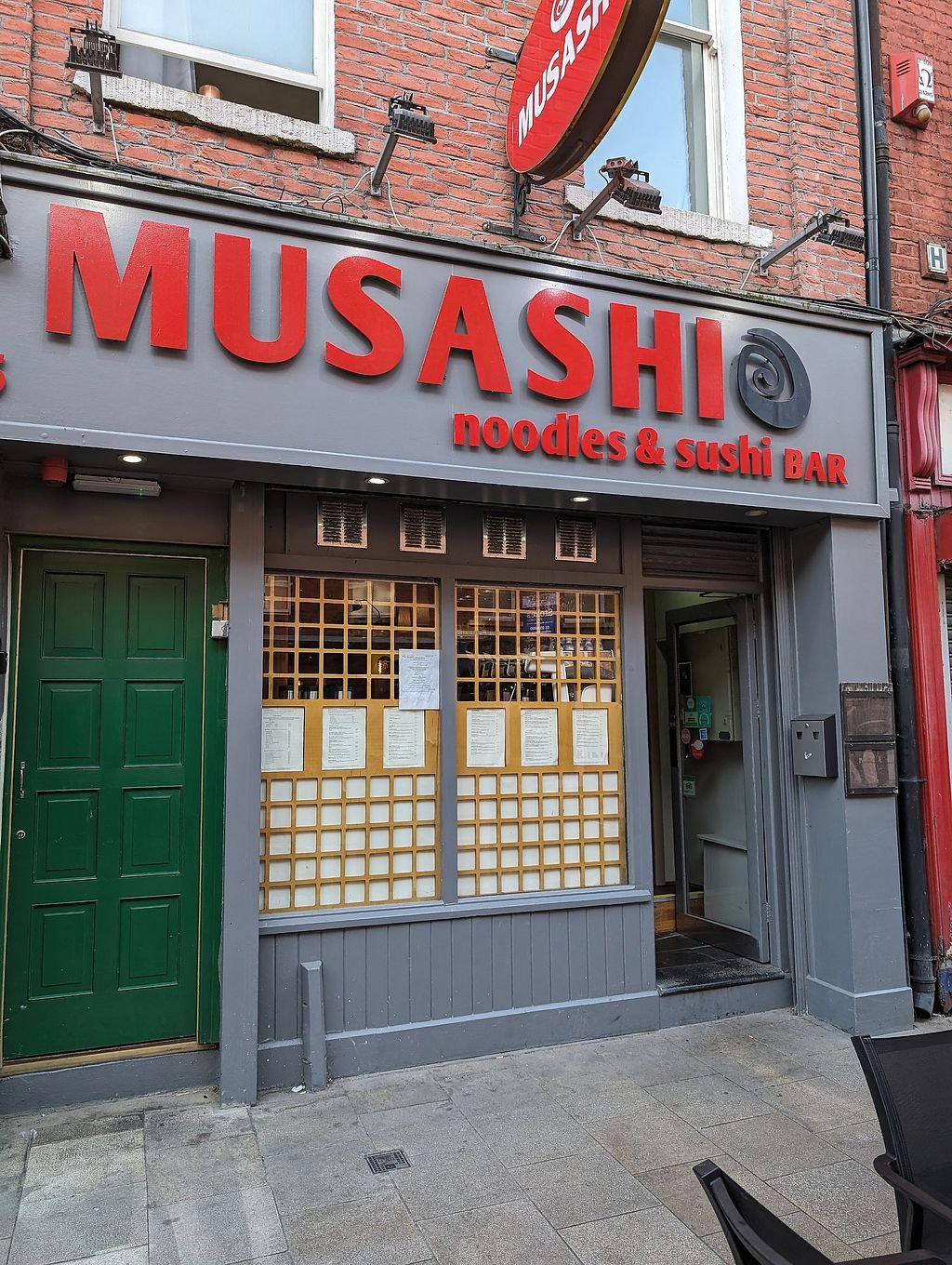
On Capel Street in Dublin 1, Musashi Noodle and Sushi Bar occupies a corner of the city's most internationally varied dining strip. The kitchen works through a Japanese-focused menu of noodles and sushi in a setting that reads as casual and accessible. For Dublin's north inner city, it represents one of the more direct routes into Japanese food outside the fine-dining tier.

Pearl is the En Primeur Club membership app — saves, bookings, and concierge access live there. Same editors, same standards.
- Address
- 15 Capel St, North City, Dublin 1, D01 E1C0, Ireland
- Phone
- +353 1 532 8057
- Hours
- Mon–Thu 12–10 PMFri–Sat 12–11 PMSun 12–10 PM
- Website
- musashi.ie
- Directions
- Get directions
- Booking
- Book on the venue's website
The menu
What to order
- Rainbow roll
- Chicken katsu curry
- Tonkotsu ramen
Capel Street and the Case for Japanese on the North Side
Capel Street has spent the better part of a decade consolidating into Dublin's most genuinely international dining corridor. Where the south city concentrates its formal restaurant energy around St Stephen's Green and Merrion Square, with addresses like Patrick Guilbaud and Glovers Alley anchoring the upmarket end, Capel Street operates differently: lower rents, higher turnover of concepts, and a dining population that skews younger and less ceremony-conscious. It is the part of Dublin where a Japanese noodle and sushi bar makes structural sense in a way it might not elsewhere in the city. Musashi Noodle and Sushi Bar, at number 15, has read that context correctly for long enough to become a fixture on a street that does not reward complacency.
The approach to the restaurant signals its register immediately. Capel Street is narrow and busy, the footpath shared between pedestrians, cyclists cutting through from the quays, and queues that form outside the more popular spots on weekend evenings. Musashi sits within that urban density rather than apart from it. There is no grand entrance sequence, no attempt to signal arrival through design theatre. What you get instead is a room that functions: practical seating, a kitchen that works at volume, and a menu built around formats, ramen and sushi principally, that require consistency above all else.
Where Japanese Technique Meets Irish Eating Habits
The editorial angle that matters most for a Japanese restaurant operating in Dublin is the relationship between imported culinary method and local ingredient availability. Japan's most transportable formats, ramen, maki, nigiri, temaki, travel well precisely because their technical logic is self-contained. A good tonkotsu broth is about pork bones, time, and heat management; a clean nigiri is about rice temperature, seasoning, and fish handling. Neither depends on geography in the way that, say, kaiseki does. This is why Japanese food has proven more durable as a transplanted cuisine than many others: the methodology survives the move.
What changes when Japanese kitchens operate in Ireland is the supply chain. Irish waters produce some of the North Atlantic's more interesting seafood, and the question for any sushi operation in Dublin is how much of that regional supply finds its way onto the menu versus how much relies on imports. The leading Irish restaurants working with global techniques, from Bastible on Leonard's Corner to Chapter One by Mickael Viljanen in Parnell Square, have made the local-global tension a central part of their editorial identity. Casual Japanese formats don't always foreground that conversation in the same way, but it shapes the kitchen's sourcing decisions whether or not it appears on the menu description. At the price point Musashi operates within, the emphasis tends toward accessibility and consistency rather than provenance storytelling.
This is not a criticism. The role of a mid-tier Japanese restaurant in a city like Dublin is not to replicate the sourcing philosophy of a destination restaurant. It is to make the format available, repeatable, and reliable. For context, a kaiseki counter at the level of Tokyo's comparable tasting formats operates in a different economy entirely, one built around scarcity, allocation, and weeks of advance planning. Dublin's Japanese dining scene has not yet produced a counter at that tier. What it has produced is a range of accessible addresses where the technique is sound and the food is priced for repeat visits.
The Noodle Side of the Menu
Ramen has become one of the more reliable indicators of a Japanese kitchen's seriousness. Broth construction is time-intensive and difficult to fake at volume; a weak broth exposes shortcuts that a competent sushi chef can more easily conceal. Across Ireland's emerging Japanese dining cohort, the ability to produce credible ramen alongside a functioning sushi operation represents a meaningful technical range. Venues that manage both, without outsourcing one discipline to a lower standard, tend to hold their customer base more effectively than those that lean entirely on one format.
The noodle and sushi combination that defines Musashi's offer places it in a specific tier of the Dublin market: broader in scope than a sushi-only specialist, more focused than a pan-Asian generalist. That positioning has practical advantages. Diners who arrive unsure whether they want something light, a few pieces of nigiri, or something more substantial, a bowl of ramen on a cold Dublin evening, find both options under the same roof. For a city where autumn and winter eating trends heavily toward warmth and comfort, that flexibility is commercially sensible and gastronomically coherent.
For reference on what the broader Irish dining scene looks like at the more ambitious end of Japanese-influenced technique, Liath in Blackrock and dede in Baltimore represent how Irish chefs have absorbed global technical training and applied it to local ingredients. The model is different from Musashi's, but the underlying question, how does a non-Irish culinary tradition find its feet in Irish conditions, is the same one the Capel Street kitchen answers in its own register.
Placing Musashi in Dublin's Wider Scene
Dublin's restaurant map rewards thinking in tiers rather than in categories. The formal tier, where you find the Michelin-tracked rooms and the expense-account clientele, is served by a relatively small number of addresses. D'Olier Street and Glovers Alley occupy that space in the modern cuisine bracket. Below that sits a mid-market tier that does much of the city's actual daily dining work, the tier where Musashi operates. This is not a gap in the market so much as the market itself. Most people eating out in Dublin on a given Tuesday are not in a tasting menu room; they are in a restaurant where the bill is manageable, the food is recognisable, and the kitchen is not trying to win awards.
The Capel Street address gives Musashi geographic logic. It is well-positioned for the city centre lunch crowd, for pre-theatre eating given the proximity to several north-side venues, and for the kind of casual dinner that Dublin's younger dining population defaults to several times a week. Seasonally, the ramen offer becomes more relevant as the year moves toward October and runs through March; the sushi side carries the warmer months when lighter eating is the preference. That seasonal swing within a single menu is a practical advantage for a restaurant operating twelve months without the ability to close and reconfigure.
For readers building a broader Irish itinerary, the full Dublin restaurants guide maps the city's dining scene by neighbourhood and price tier. Outside the capital, the country's more ambitious modern kitchens, Aniar in Galway, Campagne in Kilkenny, Terre in Castlemartyr, Bastion in Kinsale, The Oak Room in Adare, Chestnut in Ballydehob, Homestead Cottage in Doolin, and The Morrison Room in Maynooth, demonstrate the range of what the island's dining scene covers at the more formal end. Musashi answers a different question, but it answers it on one of Dublin's most active and representative streets.
Planning Your Visit
Musashi is at 15 Capel Street, Dublin 1, positioned at the lower end of the street close to the quays and easily reachable on foot from the north-side Luas stops or across the Ha'penny Bridge from Temple Bar. The restaurant's position on Capel Street makes it practical for a north-city dinner before or after crossing to the south side. Booking ahead is advisable for weekend evenings when the street operates at full capacity across multiple restaurants simultaneously; midweek visits tend to be more relaxed.
Frequently asked questions
Is Musashi Noodle & Sushi Bar okay with children?
Musashi's Capel Street format — noodle dishes alongside sushi — suits families reasonably well, since ramen and simple rolls give younger diners accessible options. The restaurant sits at street level on Dublin 1's busiest dining stretch, which keeps the setting informal rather than ceremonial. That said, the counter-style configuration common to Japanese restaurants can feel tight with small children, so off-peak visits tend to work better.
What kind of setting is Musashi Noodle & Sushi Bar?
Musashi occupies 15 Capel Street, which has consolidated into Dublin's most genuinely international dining corridor over the past decade. The format combines a noodle bar and sushi operation under one roof — a casual, counter-leaning environment rather than a white-tablecloth room. Expect a city-centre pace with a neighbourhood feel more associated with the north side than the polished south-city dining strip.
How does Musashi Noodle & Sushi Bar compare to other Japanese restaurants in Dublin city centre?
Musashi at 15 Capel Street is positioned in Dublin 1, which places it on the north-side corridor rather than among the south-city cluster of Japanese restaurants nearer St Stephen's Green. Running both a sushi bar and a noodle menu from the same kitchen is a different proposition to the specialist omakase or conveyor formats found elsewhere in the city. For Dublin diners thinking in terms of geography and format, Musashi represents the most established Japanese option on the north quays side of the city.
What's the must-try dish at Musashi Noodle & Sushi Bar?
Musashi runs both noodle and sushi menus, and the ramen side is the harder thing to execute well in an Irish context — broth construction requires time and kitchen discipline that separates serious Japanese operations from casual ones. The sushi counter gives the restaurant its name recognition on Capel Street, but arriving for ramen during service is a reasonable way to assess the kitchen's depth. Specific current dishes are best confirmed directly with the restaurant before visiting.
What part of town is Musashi Noodle & Sushi Bar in?
Musashi Noodle & Sushi Bar is located at 15 Capel St, North City, Dublin 1, D01 E1C0, Ireland, Dublin.
Do they take walk-ins at Musashi Noodle & Sushi Bar?
Musashi's position on Capel Street, one of Dublin 1's highest-footfall dining stretches, means walk-in availability shifts significantly depending on the day and hour. Arriving early in the evening or at lunch typically gives a better chance of being seated without a wait.
Comparable Spots
Comparable venues nearby, for context on price, style, and recognition.
| Venue | Cuisine | Price | Notes |
|---|---|---|---|
| Musashi Noodle & Sushi BarThis venue — the venue you are viewing | Japanese Noodles & Sushi | $20–30 | Not listed |
| No.9 By J2Sushi | Modern Japanese Sushi & Izakaya | $30–50 | South Dock |
| Yoi Izakaya | Authentic Japanese Izakaya | $30–50 | South Dock |
| Hana Izakaya | Japanese Izakaya | $30–50 | North City |
| Yamamori North City | Authentic Japanese Sushi & Izakaya | $30–50 | North City |
| Musashi Parnell Street | Japanese Sushi and Ramen | $20–30 | Rotunda B |
Continue exploring
More in Dublin
Restaurants in Dublin
Browse all →
Bars in Dublin
Browse all →
Hotels in Dublin
Browse all →

Wineries in Dublin
Browse all →

Details
- Cozy
- Trendy
- Casual Hangout
- Date Night
- Open Kitchen
- Sake Program
- A La Carte
- Beer Program
- Vegetarian Friendly
- Vegan Options
- Gluten Free Options
Current opening hours
- Monday
- 12–10 PM
- Tuesday
- 12–10 PM
- Wednesday
- 12–10 PM
- Thursday
- 12–10 PM
- Friday
- 12–11 PM
- Saturday
- 12–11 PM
- Sunday
- 12–10 PM
Hours can change for holidays and private events. Last verified .
Comfortable with well-spaced tables, busy atmosphere, and friendly service.