Mr. Fish Chips & Chowder
On Western Avenue at the edge of Pike Place Market, Mr. Fish Chips & Chowder occupies a stretch of Seattle's waterfront dining corridor where casual seafood has long been the native register. The format is direct: fried fish, chowder, and the kind of direct approach that suits both the neighborhood and the Pacific Northwest's relationship with its waters.
Pearl is the En Primeur Club membership app — saves, bookings, and concierge access live there. Same editors, same standards.
- Address
- 2010 Western Ave, Seattle, WA 98121
- Phone
- +12068120022
- Website
- mrfishseattle.com
- Directions
- Get directions
 Saves & bookings on Pearl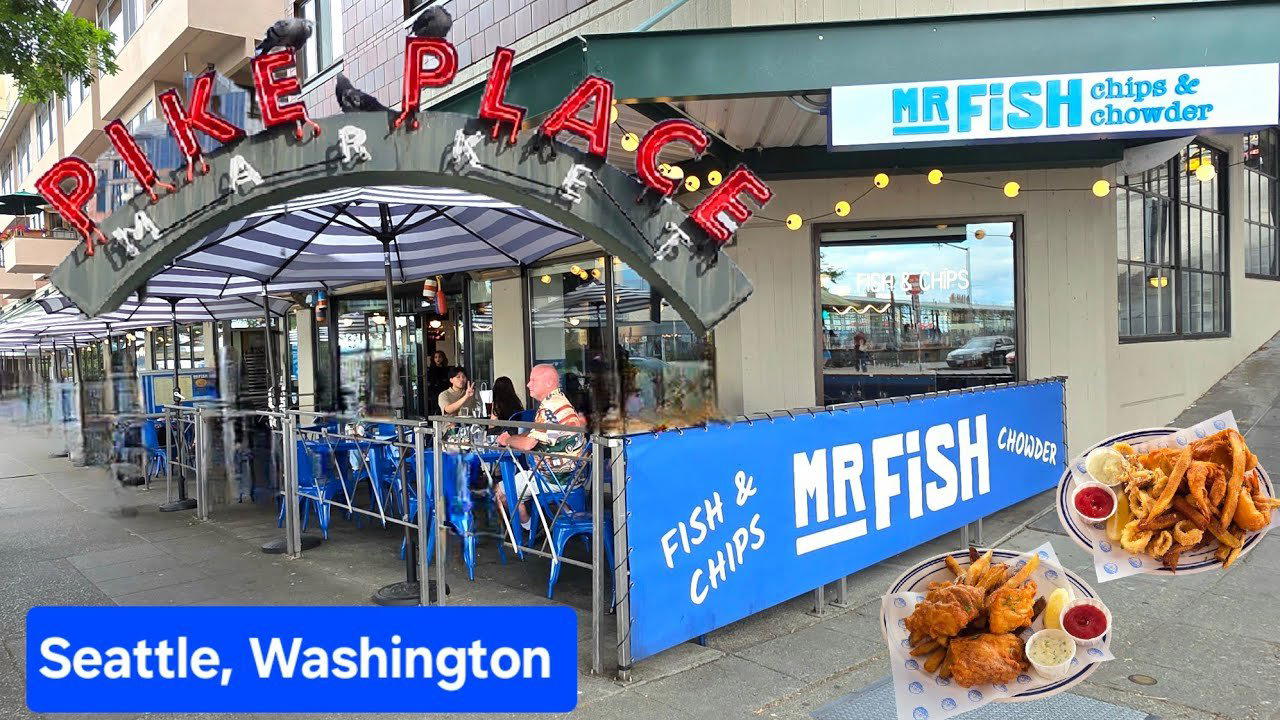
The Western Avenue Seafood Corridor
Western Avenue runs parallel to Pike Place Market, one block below the main hall, and for decades it has functioned as the transition zone between Seattle's tourist-facing waterfront and its working food culture. The street absorbs foot traffic from the Market above and the ferry terminal below, which shapes what survives here: casual formats with broad appeal, quick execution, and menus anchored to the water. Mr. Fish Chips & Chowder, at 2010 Western Ave, occupies exactly that register. This is not the tier of Seattle dining that includes reservation-required counters or tasting menus; it sits in the approachable, direct category where the question is whether the fish is fresh and the chowder is worth finishing. Mr. Fish Chips & Chowder is a casual Seattle restaurant at 2010 Western Ave, serving Pacific Northwest fish and chips and chowder at about $25 per person.
Seattle's seafood dining has always split across several registers. At one end, restaurants like Canlis treat Pacific Northwest ingredients with formal technique and long institutional pedigree. In the middle, neighborhood restaurants like Joule fold regional produce into specific culinary frameworks. At the casual end, the city's proximity to Dungeness crab, salmon runs, Pacific halibut, and Puget Sound shellfish means that a well-run fish-and-chips counter has a strong raw-material case to make. The Western Avenue corridor sits closest to that last category, and Mr. Fish Chips & Chowder operates within it.
Reading the Format: What a Chowder-and-Chips Sequence Tells You
The editorial angle worth applying here is progression: how a meal at this kind of venue moves from first bowl to final bite, and what each stage reveals about the operation's priorities. In American coastal cities, the fish-and-chips format functions as a compressed test of sourcing, temperature control, and frying discipline. A clam chowder opener is a further audit: it requires a decision about cream weight, potato texture, and clam-to-base ratio that separates places that make their chowder from places that open a commercial bucket.
The logic of this format is older than most people register. Britain's fish-and-chip tradition, transplanted to American port cities through the 19th and early 20th centuries, found natural footing in Pacific Northwest towns where cod and halibut were abundant and the waterfront labor economy demanded fast, filling food. Seattle's version of that tradition is now largely recreational rather than functional, but the format persists because it maps cleanly onto the city's self-image around fresh seafood. For visitors arriving from cities where Pacific fish is an import, a well-executed piece of battered halibut on the Seattle waterfront has genuine geographic logic behind it.
Seattle's seafood range becomes clearer in comparison with other American cities. Le Bernardin in New York City represents the opposite end of the seafood-dining spectrum, where French technique and multi-course sequencing are the point. Providence in Los Angeles similarly operates in a register where the tasting progression runs eight to twelve courses. The fish-and-chips format makes no claims in that direction: it is a single-plate proposition where execution rather than conception is the variable. That simplicity is the format's argument, not its limitation.
The Neighborhood as Context
The 2010 Western Ave address places Mr. Fish Chips & Chowder at a specific intersection of Seattle's food geography. Pike Place Market, directly uphill, is one of the oldest continuously operating farmers markets in the United States, established in 1907, and its fish stalls have set a public standard for fresh Pacific seafood that shapes visitor expectations across the entire neighborhood. Anything operating in the shadow of Pike Place is implicitly measured against what the Market itself offers, which is a tighter competitive frame than most casual restaurants face.
The broader Seattle restaurant scene has shifted significantly in the past decade. More technically ambitious restaurants now operate across Capitol Hill, Fremont, and the Central District. Addresses along 1st Avenue and spots like 1744 NW Market St and 2963 4th Ave S point to the city's expanding geography of serious dining. But the waterfront corridor serves a different function: it is where the city's seafood identity is most visibly performed for the widest audience, and casual formats like this one carry that representational weight whether they seek it or not.
Where This Sits in the Broader Seafood Conversation
Casual seafood formats have had a quiet moment of critical rehabilitation in American food culture over the past several years. The precision-cooking movement that produced places like Alinea in Chicago and The French Laundry in Napa, or farm-anchored projects like Blue Hill at Stone Barns in Tarrytown and Single Thread Farm in Healdsburg, generated a counterreaction: an interest in formats that strip away ceremony and make sourcing the entire argument. A well-fried piece of Pacific halibut, made from fish caught within the week, requires no tasting-menu scaffolding to justify itself. The question is whether the operation treats that sourcing seriously.
That same critical shift has affected the way high-conviction casual restaurants get discussed. Places like Lazy Bear in San Francisco built reputations on format innovation at the more theatrical end. But at the simpler end, credibility comes from consistency and sourcing transparency rather than menu architecture. Establishments like Emeril's in New Orleans, Addison in San Diego, Atomix in New York City, and The Inn at Little Washington occupy the formal end of American dining; Mr. Fish Chips & Chowder occupies the informal end, where the editorial questions are simpler but no less real. And internationally, the contrast holds: 8 1/2 Otto e Mezzo Bombana in Hong Kong represents a different kind of seafood ambition entirely.
Know Before You Go
| Address | 2010 Western Ave, Seattle, WA 98121 |
|---|---|
| Neighborhood | Pike Place Market corridor, Seattle waterfront |
| Format | Casual seafood: fish and chips, chowder |
| Booking | Walk-ins are welcome. |
| Leading approach | On foot from Pike Place Market; street parking limited on Western Ave |
At-a-Glance Comparison
Comparable venues nearby, for context on price, style, and recognition.
| Venue | Cuisine | Price | Notes |
|---|---|---|---|
| Mr. Fish Chips & ChowderThis venue — the venue you are viewing | Pacific Northwest Fish & Chips and Chowder | $$ | Not listed |
| Ray's Cafe | Casual Northwest Seafood | $$ | Sunset Hill |
| Marin | Modern Coastal Pacific Northwest | $$$ | Central Business District |
| Currant Bistro | American Gastropub Bistro | $$ | Denny Triangle |
| Portage Bay Cafe - South Lake Union | Organic Farm-to-Table American Brunch | $$ | South Lake Union |
| Hugo House | Event Catering | Not listed | Broadway |
Continue exploring
More in Seattle
Restaurants in Seattle
Browse all →
Bars in Seattle
Browse all →
Hotels in Seattle
Browse all →

At a Glance
- Lively
- Cozy
- Well Known
- Casual Hangout
- Family
- Waterfront
- Terrace
- Historic Building
- Craft Cocktails
- Local Sourcing
- Sustainable Seafood
- Waterfront
- Street Scene
Current opening hours
- Monday
- 11:30 AM–7 PM
- Tuesday
- 11:30 AM–7 PM
- Wednesday
- 11:30 AM–7 PM
- Thursday
- 11:30 AM–7 PM
- Friday
- 11:30 AM–7 PM
- Saturday
- 11:30 AM–7 PM
- Sunday
- 11:30 AM–7 PM
Hours can change for holidays and private events. Last verified .
Casual market vibe with indoor and patio seating overlooking Elliott Bay and bustling market activity.