
Tabelog 100 #97
Our verdict
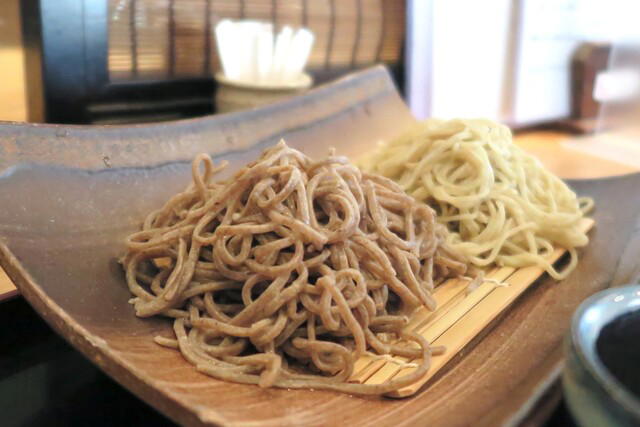
Maruyama is a Tokyo soba specialist that makes sense for travelers who want craft without the ceremony or cost of a long tasting-menu evening. Its Tabelog 100 Soba EAST 2025 selection, compact table-only room, and low lunch-to-dinner spend bracket place it in a practical tier of serious noodle shops rather than destination dining theater.

Pearl is the En Primeur Club membership app, where members save venues, book tables and use the concierge.
The menu
What to order
- Omusubi (rice ball) set meal
- Fried chicken set meal
- Seasonal set meals
- Japanese–French izakaya small plates
Tokyo’s serious soba rooms rarely announce themselves with grand architecture. The usual signals are quieter: a measured rhythm of service, diners arriving with a clear purpose, and a meal built around buckwheat rather than spectacle. In that setting, Maruyama belongs to a category that rewards attention without demanding a whole evening. The point is not luxury in the French tasting-menu sense; it is craft at a scale where the bill stays grounded and the format remains direct.
Soba occupies a different lane from sushi, tempura, or kaiseki in Tokyo’s dining hierarchy. It can be lunch, a late-afternoon reset, or a restrained dinner, and its value lies in how little needs to happen when the fundamentals are right. The city’s better soba shops ask diners to care about texture, temperature, dipping broth, and pacing. That makes the category unusually democratic: a restaurant can carry specialist recognition while keeping the spend closer to an everyday meal than a trophy reservation.
Serious soba without the tasting-menu tax
The value argument here is simple. Tokyo has many restaurants where prestige is expressed through length: courses, counter choreography, wine pairings, and booking friction. Soba works differently. A focused buckwheat-noodle meal can register as highly considered without turning into an expensive production. Maruyama’s 2025 recognition from Tabelog Hyakumeiten puts it inside a defined specialist field, yet the format remains closer to a straightforward soba room than a staged fine-dining sequence.
That matters for travelers who have already budgeted for one or two high-spend meals in Tokyo and need the rest of the itinerary to carry genuine local weight. The listed budget keeps the decision practical: dinner is JPY 3,000 - JPY 3,999, while lunch is JPY 1,000 - JPY 1,999. The appeal is a practical, conversational meal rather than a chef-counter performance. The category’s traditional rhythm suits both lunch and dinner, where soba can shift from quick nourishment to a modest meal built around noodles.
Tokyo visitors often over-index on categories with international shorthand: omakase sushi, wagyu, ramen queues, hotel bars. Soba is less photogenic as a travel cliché, but it is one of the city’s clearer tests of restraint. The meal does not need imported luxury products or visual drama to justify itself. It succeeds when the kitchen keeps the noodle at the center and the room lets diners finish without ceremony. In that respect, Maruyama offers a useful corrective to a Tokyo schedule overloaded with reservations that feel like appointments.
How it fits into Tokyo's dining map
Restaurants such as ASAHINA Gastronome and Neki sit in a different decision set, where format, spend, and occasion can pull the meal toward a planned evening. A soba specialist asks a sharper question: does the itinerary need another elaborate restaurant, or does it need a precise, local meal that leaves the rest of the day intact?
That distinction is useful across Tokyo. Around the city, a traveler can build a broader food map through contrasting formats: seafood, grills, neighborhood dining, skewers, café culture, and focused curry rooms. Against that spread, soba adds a quieter register: less social theater, more craft economy.
For broader planning, Our full Tokyo restaurants guide gives the clearest restaurant context, while Our full Tokyo hotels guide, Our full Tokyo bars guide, Our full Tokyo wineries guide, and Our full Tokyo experiences guide help position a meal like this inside a wider trip. The better use of a soba stop is often not as the headline meal, but as the hinge between neighborhoods, shopping, museums, or an evening drink.
A focused brief and a clear use case
The practical appeal is strongest for diners who want a low-drama meal with enough recognition to justify the detour. The format suits diners who value a focused soba stop over a large celebratory production. The expectation is clear: this is a purposeful urban meal, not a banquet venue or chauffeured occasion.
Payment and planning expectations also shape the decision. Smaller specialist shops in Japan can operate differently from international fine-dining venues, and this category rewards diners who arrive prepared rather than assuming every meal follows the same travel script. Timing and patience may matter more than ceremony. For a traveler, that changes the psychology of the meal. It becomes a flexible slot rather than a fixed anchor.
The stronger case for Maruyama is not that it replaces Tokyo’s grand meals. It does something more useful: it gives the itinerary a serious, fairly priced soba meal with enough third-party recognition to separate it from a random noodle stop. For diners crossing Japan, that same logic can extend beyond the capital to other focused, specialist formats in different cities. Even outside Japan, the pattern holds for concise Japanese dining concepts: narrow brief, clear identity, and no need for excess.
Side-by-Side Snapshot
Nearby venues at a similar price tier for orientation.
| Venue | Cuisine | Price | Awards | Notes |
|---|---|---|---|---|
| MaruyamaThis venue (the venue you are viewing) | Creative Japanese–French Izakaya | $30–50 | Tabelog 100 #97 | Not listed |
| Tonkatsu Hasegawa Higashi ginza ten | Tonkatsu | $20–30 | Tabelog 100 #81 | Chūō |
| Tonkatsu Aoki Ginza 8 chome ten | Japanese Tonkatsu | $20–30 | Tabelog 100 #13 | Chūō |
| Teuchi Soba Nezu Takajo | Traditional hand-cut soba | $20–30 | Tabelog 100 #80 | Bunkyō |
| 赤坂 炭火焼肉 金星 | Japanese Robatayaki | Not listed | Not listed | Minato |
| Katsuretsu Yotsuya Takeda | Japanese Yoshoku & Tonkatsu | $20–30 | Tabelog 100 #79 | Shinjuku |
Recognition history
Dated appearances from independent guides and award organizations, with the underlying list record or original source where available.
Tabelog 100 #97 · No. 97
Tabelog · Tabelog 100 - Soba - EAST - 2025
Continue exploring
More in Tokyo
Restaurants in Tokyo
All restaurants in Tokyo →


Bars in Tokyo
All bars in Tokyo →






Details
- Modern
- Lively
- Cozy
- Trendy
- Sophisticated
- After Work
- Casual Hangout
- Group Dining
- Date Night
- Solo
- Private Event
- Design Destination
- Hotel Restaurant
- Standalone
- Private Dining
- Sake Program
- Zero Proof
- Craft Cocktails
- Local Sourcing
- A La Carte
- Set Menu
- Small Plates
- Sake
- Shochu
- Cocktails
- Non Alcoholic Cocktails
Current opening hours
- Monday
- 11 AM–2 PM, 5–8 PM
- Tuesday
- 11 AM–2 PM, 5–8 PM
- Wednesday
- 11 AM–2 PM, 5–8 PM
- Thursday
- 11 AM–2 PM, 5–8 PM
- Friday
- 11 AM–2 PM, 5–8 PM
- Saturday
- 11 AM–2 PM, 5–8 PM
- Sunday
- Closed
Hours can change for holidays and private events. Hours as of .
Contemporary izakaya on the ground floor of the K5 building with a warm, convivial atmosphere; design and concept are inspired by the fluidity of water, pairing casual set-meal lunches with more sophisticated, sake-focused evenings.