Tabelog 100 #59
Our verdict
MAKIBI sits in Osaka’s Nishitenma orbit, where small-format Italian cooking competes less on ceremony than on precision, wine judgment, and repeat local demand. Its selection for Tabelog Italian WEST “Tabelog 100” 2025 places it inside a crowded but closely watched Kansai category, with Italian, pizza, and pasta as the stated frame rather than a single-course fine-dining script.

Pearl is the En Primeur Club membership app, where members save venues, book tables and use the concierge.
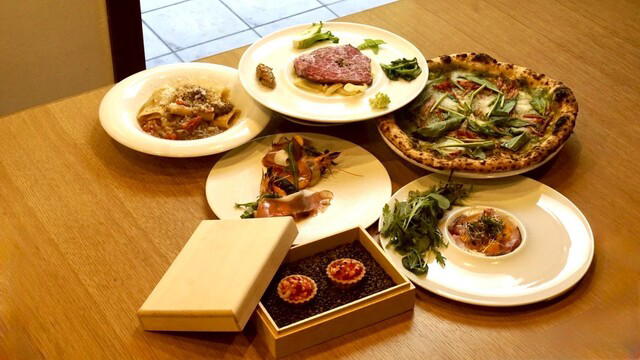
Approaching dinner in Osaka changes the register from the city’s louder food corridors. The setting is best read through the broader Osaka pattern of compact rooms, attentive service, wine-conscious meals, and restaurants that rely on repeat local confidence as much as destination diners. Within that pattern, MAKIBI belongs to the city’s serious small-restaurant tier rather than a purely tourist-facing category.
Osaka is often reduced to takoyaki, okonomiyaki, kushikatsu, and late-night appetite, but its Italian scene has long been sharper than that shorthand allows. Kansai cooks and diners tend to value direct pleasure, clear pacing, and quick judgment. Pasta, pizza, seafood, and wine can become flexible tools for a city that does not reward empty formality. A restaurant listed under Italian, Pizza, and Pasta in this context is not automatically casual; it can sit in the same conversation as tighter tasting-menu rooms, wine-led counters, and neighborhood dining rooms where the difference is format rather than ambition.
Osaka Italian with awards pressure, not fine-dining stiffness
The useful way to read MAKIBI is through reputation pressure. Recognition in the 2025 Tabelog Hyakumeiten context puts the restaurant into a group shaped by sustained public approval in a category where western Japan competes hard. Tabelog recognition is not a Michelin-style inspection system, but in Japan it carries real behavioral weight: diners use it to sort rooms that have earned repeat confidence, especially in categories where international travelers may lack local context.
That matters because dining in Osaka splits into several lanes. There are polished destination rooms such as La Kanro, more everyday-leaning tables such as Osake to Gohan Taku, distinctive destination dining such as Gessen, and higher-budget specialist counters such as Makisumi Madara. MAKIBI occupies a different pocket: an Osaka restaurant listed for Italian, pizza, and pasta, with enough recognition to draw diners looking beyond simple convenience. It is not selling rarity for its own sake; it is competing in the more demanding middle tier where value, consistency, and mood all have to land.
The restaurant’s listed categories are also a telling Osaka signal. Kansai Italian often works well when it stops trying to imitate a fixed overseas template and instead treats local appetite, pacing, and informality as advantages. That does not require a manifesto. It requires enough control for the meal to feel coherent rather than divided into separate menu labels. The central read is straightforward: this is a dinner room for people who care about Italian cooking in Osaka without needing theatrical fine-dining stiffness.
Compact-room advantage and dinner focus
Small Osaka restaurants often beat larger dining rooms on immediacy. A compact format turns timing into part of the meal, and the balance between intimacy and practical comfort usually tells diners how to use the room. A focused dinner suits couples, solo regulars, and anyone who wants the restaurant’s rhythm close at hand. Small-group meals can work well when the pacing is respected, especially in Osaka, where professional and local dining habits often shape weekday evenings.
MAKIBI’s appeal fits that reading. The restaurant is better understood as a planned dinner than as a generic drop-in trattoria scaled for anonymous turnover. Its Tabelog score of 3.66 and 2025 recognition help explain why diners treat it as more than a casual Italian listing. That point may sound minor, but in Japan’s compact dining rooms reputation changes expectations: a meal has to justify both the reservation effort and the evening slot.
For travelers building an Osaka itinerary, this is the kind of restaurant to place after a lighter day of eating rather than after heavy grazing across the city. It rewards an evening kept clean: aperitif, dinner, then a bar if the night has another stop in it. For wider planning, Our full Osaka restaurants guide gives the broader dining map, while Our full Osaka bars guide, Our full Osaka hotels guide, Our full Osaka wineries guide, and Our full Osaka experiences guide help shape the rest of the trip.
Where it fits in an Osaka eating day
Osaka dining works when the day has contrast. A serious Italian dinner reads differently if lunch was a casual snack, a bakery stop, or a sharp coffee break rather than another long seated meal. In that rhythm, unnamed citywide references serve a different purpose: they show how Osaka moves between snack culture, casual craftsmanship, and destination dinners without treating one mode as more legitimate than another.
For readers specifically tracking Italian in Osaka, the category’s spread can run from pizza-led specialization to broader pasta-and-wine dining. MAKIBI’s appeal sits in the overlap: not just pizza, not just pasta, and not merely a generic neighborhood table, but a compact dinner address with enough public reception to justify planning around it.
Beyond Osaka, the comparison becomes less about cuisine than about how regional restaurants define purpose. Some places are built around single-dish focus, others around neighborhood utility, bar-dining crossover, or a more formal destination model. MAKIBI’s model is Osaka Italian under public scrutiny, with enough structure for a planned dinner and enough looseness to feel like the city rather than imported ceremony.
Frequently asked questions
Is MAKIBI expensive?
Pricing at MAKIBI is listed as JPY 6,000 - JPY 7,999 for dinner.
How do I find MAKIBI?
MAKIBI is located in Osaka.
What's the best way to book MAKIBI?
Check the restaurant’s current reservation information before visiting. Given its 2025 Tabelog Hyakumeiten recognition and dinner budget of JPY 6,000 - JPY 7,999, planning ahead is sensible.
What's the signature at MAKIBI?
The clearest listed anchors are Italian, Pizza, and Pasta. Its 2025 Tabelog Hyakumeiten recognition gives the room more weight than a generic neighborhood trattoria.
Cuisine and Credentials
Comparable venues at the same tier for side-by-side context.
| Venue | Cuisine | Price | Awards | Notes |
|---|---|---|---|---|
| MAKIBIThis venue (the venue you are viewing) | Creative Italian | $30–50 | Tabelog 100 #59 | Not listed |
| La Barcaccia | Neapolitan Pizza & Italian Wine Bar | $50–100 | Tabelog 100 #2 | Kita |
| PESCE ROSSO | Upscale Seasonal Italian | $150–200 | Tabelog 100 #18 | Chūō |
| Shimanouchi Fujimaru Jozosho | Urban winery with Italian-based cuisine | $50–100 | Star Wine List · Tabelog 100 #96 | Chūō |
| anello | Casual Italian Trattoria & Wine Bar | $20–30 | Tabelog 100 #91 | Kita |
| BVLGARI IL CAFE Hankyuu umeda honten | Luxury Italian Cafe by Bulgari | $50–100 | Tabelog 100 #35 | Kita |
Recognition history
Dated appearances from independent guides and award organizations, with the underlying list record or original source where available.
Tabelog 100 #59 · No. 59
Tabelog · Tabelog 100 - Italian - WEST - 2025