
Madam Curry belongs to Osaka’s compact, lunch-driven curry culture rather than the city’s longer evening dining circuit. In Kitahama, its Tabelog Curry WEST 100 selections in 2019, 2020, 2023, and 2024 place a small counter-format curry shop inside a serious regional conversation about everyday food with critical traction.
Pearl is the En Primeur Club membership app — saves, bookings, and concierge access live there. Same editors, same standards.
- Address
- Japan, 〒541-0043 Osaka, Chuo Ward, Koraibashi, 2 Chome−2−2 日宝北浜ビル 1F
- Phone
- +81 6-6121-2820
- Website
- tabelog.com
 Saves & bookings on Pearl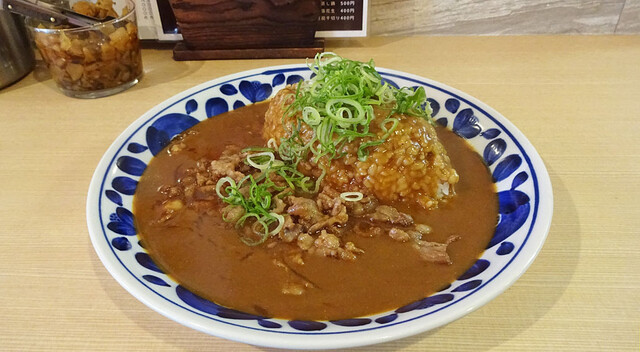
Kitahama changes register at lunchtime. The district’s banks, offices, and old merchant streets create a dining rhythm built for precision: counters fill quickly, meals move with purpose, and the strongest rooms do not need spectacle. Madam Curry fits that Osaka pattern: a small counter address in Koraibashi where curry is treated as a focused midday proposition rather than a casual afterthought.
Osaka’s curry scene is easy to underestimate from outside Japan. The city is often reduced to takoyaki, okonomiyaki, and late-night drinking, but its weekday lunch culture has its own hierarchy. Curry shops compete on repeat custom, speed, seasoning, and consistency. In that context, inclusion in Tabelog Curry WEST 100 for 2019, 2020, 2023, and 2024 matters because it signals durability across several selection cycles, not a single burst of online attention.
Kitahama curry belongs to the working-day city
The location gives the experience its shape. Kitahama is not Dotonbori theater; it is commercial Osaka, close to the river, heavy with office workers, and better suited to concise meals than drawn-out dining. A 12-counter-seat format suits that neighbourhood logic. The room is built around proximity and turnover, the sort of Osaka lunch setting where the counter is not a design flourish but the operating system.
That makes the restaurant more useful to understand as part of a district pattern than as a destination detached from place. Nearby dining can swing from everyday standing-bar energy to higher-spend Japanese and French rooms: comparison venues in the area include Kakomo Kitahama ten at a lower evening-drinking price band, macua in French dining, Hinotori for Chinese, Sumibi Yakitori Torimasa in a higher yakitori bracket, and Fushimimachi Kakoiyama for Japanese dining. Against that spread, Madam Curry occupies the low-ticket, high-frequency lane: lunch, counter, curry, repetition.
For travellers building a wider Osaka food map, this is the kind of stop that clarifies the city’s range. It sits far from a tasting-menu template and closer to the disciplined everyday meals that keep Japanese city centres moving. The same itinerary might place it alongside casual Osaka references such as 551 Horai (551蓬莱), bakery stops like 52CHO-ME BAKERY, or a sharper neighbourhood coffee pause at .cafe. The point is not sameness, but contrast: Osaka rewards diners who move between formats rather than chasing one idea of prestige.
A compact counter with regional recognition
Tabelog’s Curry WEST 100 list gives this address its clearest external credential. In Japan, where user-driven restaurant platforms carry unusual weight, repeated Hyakumeiten selection functions as a signal of category relevance. The listed score of 3.63 is not a Michelin-style judgment, but within Tabelog culture it places the shop in a monitored, competitive band for curry in western Japan.
The category itself matters. Curry in Japan is not a single lineage. It ranges from home-style roux to spice-forward independent shops, katsu counters, Osaka-specific lunch specialists, and dining-bar hybrids. Madam Curry is listed under curry and dining bar, a pairing that hints at a more adult urban format than the family-cafeteria image many visitors attach to Japanese curry. The drinks listing includes shochu, wine, and cocktails, but the public-facing rhythm remains anchored to the lunch window and counter meal.
There is also a practical austerity to the format that feels aligned with serious Japanese lunch rooms. Payment is cash-oriented, private rooms are absent, smoking is not allowed, and take-out is part of the service. None of this reads as luxury in the conventional sense. It reads as focus. The decision for an EP Club reader is therefore simple: this is not the place to seek ceremony, chef narrative, or a long wine-pairing arc. It is a place to understand how a tightly run curry counter earns repeat recognition in a city with fierce casual dining standards.
That lens also protects the experience from inflated expectations. A counter curry shop with repeated Tabelog category selection should not be judged by the grammar of kaiseki, sushi omakase, or hotel dining. It belongs closer to the serious everyday tier, where small differences in seasoning, service tempo, and reliability determine reputation. For a broader Osaka dining plan, pair it with more structured meals such as a canto (Italian) or 99 Pizza Napoletana Gourmet, then use Our full Osaka restaurants guide to build the rest of the day around neighbourhood movement rather than category collecting.
How to place it in an Osaka itinerary
The restaurant works better as a purposeful lunch stop than as a standalone evening plan. Kitahama rewards daytime routing: business-district meals, river walks, coffee, and a shift later toward Umeda, Namba, or a bar-led night. Travellers comparing Osaka’s hospitality layers can connect the meal to Our full Osaka hotels guide, then move into the city’s drinking culture through Our full Osaka bars guide. For those mapping broader regional context, Our full Osaka experiences guide and Our full Osaka wineries guide help separate genuine local structure from generic itinerary padding.
The address also fits a Japan-wide reading of specialised casual dining. Curry obsessives might compare the category with [Curry Senmon Ten] Maruyama Kyoju. in Sapporo, while travellers tracking compact-format Japanese meals could look at [ki:] in Kyoto.know in Kumamoto, (Shoku) Vietnam in Kawasaki, -Grilled beef Sukiyaki- KAMAKURA TANUKIAN 鎌倉 たぬき庵 in Kamakura, and. 鮪と炭火焼き うお炭 秋葉原店 in Tokyo. The overseas links are useful too: Jōdo Saké Bar in Los Angeles and Onigiri Time in Pasadena show how Japanese formats change once they leave Japan.
The editorial case is narrow and persuasive. The restaurant gives Osaka travellers a disciplined look at the city’s lunch-counter intelligence: small scale, category recognition, low ceremony, and a neighbourhood rhythm that makes sense only when the meal is placed inside Kitahama’s working-day tempo.
The Quick Read
Comparable venues at similar price and category levels.
| Venue | Cuisine | Price |
|---|---|---|
| Madam CurryThis venue — the venue you are viewing | Chūō, Japanese Curry | $ |
| Curry Rice | Chūō, Japanese Curry House | $ |
| Dahl | Chūō, Japanese curry house | $ |
| Umeda Kamatake Udon | Kita, Osaka Sanuki Udon Shop | $ |
| Ramen Kasumi Awaza honten | Nishi, Niboshi-focused ramen shop | $ |
| Motsuyaki Doppo Tenma ten | Kita, Japanese motsuyaki standing bar | $ |
Recognition history
Dated appearances from independent guides and award organizations, with the underlying list record or original source where available.
Tabelog 100 #86 · No. 86
Tabelog · Tabelog 100 - Curry - WEST - 2024
Continue exploring
More in Osaka
Restaurants in Osaka
Browse all →




Bars in Osaka
Browse all →




Hotels in Osaka
Browse all →




Wineries in Osaka
Browse all →
At a Glance
- Cozy
- Classic
- Casual Hangout
- Solo
- Group Dining
- Standalone
Current opening hours
- Monday
- 11:30 AM–2:30 PM
- Tuesday
- 11:30 AM–2:30 PM
- Wednesday
- 11:30 AM–2:30 PM
- Thursday
- 11:30 AM–2:30 PM
- Friday
- 11:30 AM–2:30 PM
- Saturday
- Closed
- Sunday
- Closed
Hours can change for holidays and private events. Last verified .
Casual dining-bar atmosphere with a compact, neighborhood feel; the venue reads as approachable rather than formal.